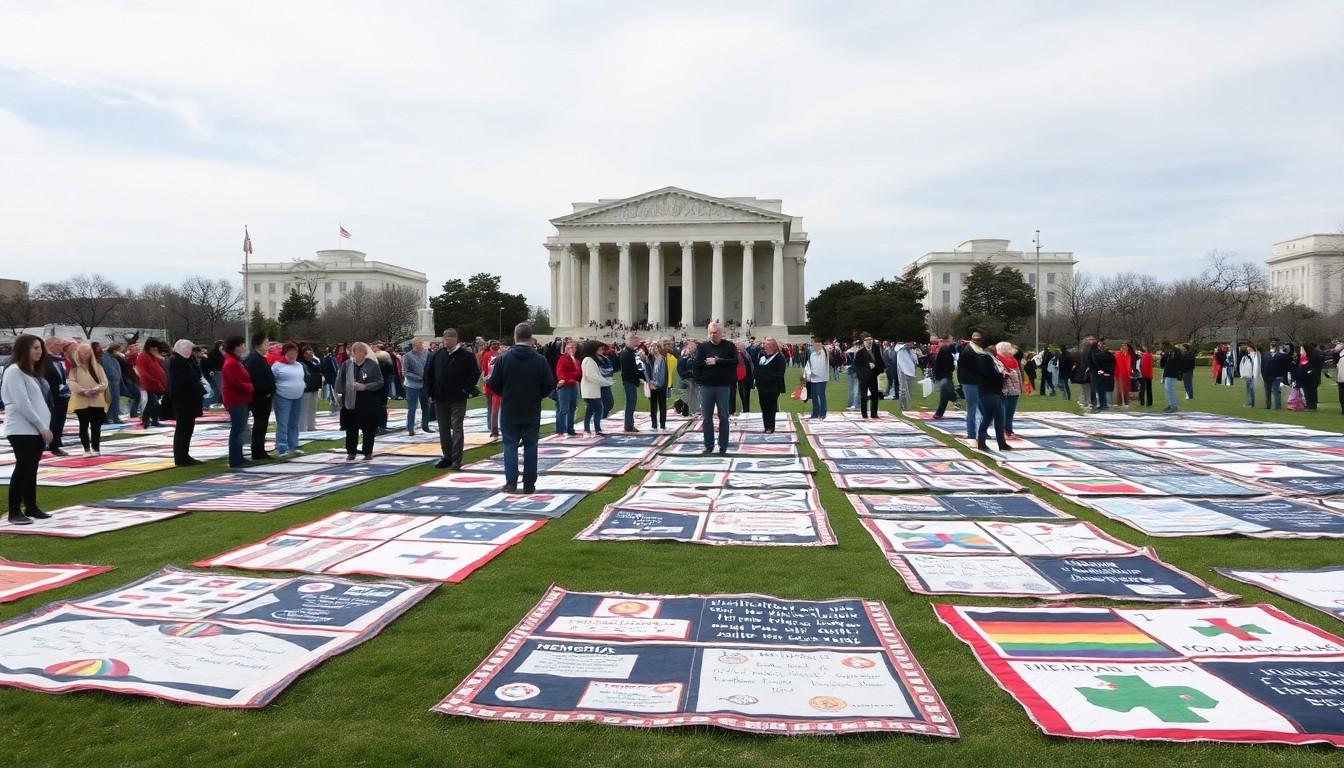
Visitors and readers are revisiting the AIDS Memorial Quilt, first displayed on Washington’s National Mall in 1987, as a powerful record of lives lost and communities united. Its hand-made panels turned grief into something visible, personal and impossible to ignore, helping preserve the human story of the AIDS crisis for new generations.
Essential Takeaways
- First displayed in 1987: The quilt appeared during the Second National March on Washington for Lesbian and Gay Rights.
- A memorial made by many hands: Individual panels honour people who died of AIDS-related causes, often using photographs, fabric and personal objects.
- A national landmark in cloth: Its size and public presentation made private grief visible on an extraordinary scale.
- Still relevant today: Archives and museums continue to preserve, document and interpret the quilt for visitors and researchers.
- More than a symbol: The project also reflects activism, community care and the fight against stigma.
A quiet sea of names and memories
The AIDS Memorial Quilt made its first major public appearance on 11 October 1987, when hundreds of panels were laid across the National Mall in Washington. According to History, the display was conceived as a way to remember people whose deaths were often reduced to statistics during the AIDS crisis.
The effect was both intimate and vast. Each square could feel like a family album, with stitched names, bright colours, photographs and small details that brought an absent person back into view. Set beside thousands of others, those personal tributes formed a much larger statement about loss, love and public indifference.
How one memorial became a movement
The project grew from a San Francisco memorial effort associated with activist Cleve Jones. As the idea spread, people from across the United States and beyond began creating panels for friends, relatives and partners, turning a local gesture into a national act of remembrance.
The Smithsonian Archives describes the quilt as an important record of community history, while the Library of Congress preserves related material that helps researchers understand how the project developed. That archival work matters because the quilt isn't only about the past. It captures how ordinary people responded when official institutions were often slow, hostile or painfully quiet.
Why the National Mall display mattered
Displaying the quilt in Washington changed its meaning. The panels were no longer confined to homes, community centres or church halls. They occupied one of the country's most recognisable civic spaces, placing the AIDS crisis directly in front of the public and political establishment.
The National Mall History project notes the importance of that setting, where scale became part of the message. Visitors could stand close to a single panel, then step back and see a field of remembrance stretching far beyond any one story. It was visually gentle but politically direct, a combination that made the memorial difficult to dismiss.
A handmade memorial with lasting relevance
Unlike a conventional monument, the quilt remains tactile and varied. Some panels are spare, others elaborate; some use neat lettering, while others feel almost improvised. That unevenness is part of its emotional force, because it shows real people making meaning with the materials and skills they had.
The San Francisco International Airport Museum has highlighted the quilt's continuing role in public education and remembrance. It can speak to visitors who lived through the crisis, but it also offers younger audiences a way into a history that may otherwise seem distant. A stitched name can make a decades-old tragedy feel immediate.
Preserving the story for the future
Keeping the quilt accessible involves more than storing fabric safely. The Library of Congress and Smithsonian collections help preserve photographs, records and related documentation, ensuring that the people represented aren't separated from the stories behind their panels.
The quilt also remains a reminder that remembrance can be an active form of care. Its history is bound up with fundraising, education and advocacy, not just mourning. That may be why it still resonates: it asks viewers not merely to look, but to consider who gets remembered, who gets heard and what communities can build together when institutions fail them.
The AIDS Memorial Quilt shows how grief can become both history and action.
Source Reference Map
Story idea inspired by: [1]
Sources by paragraph: