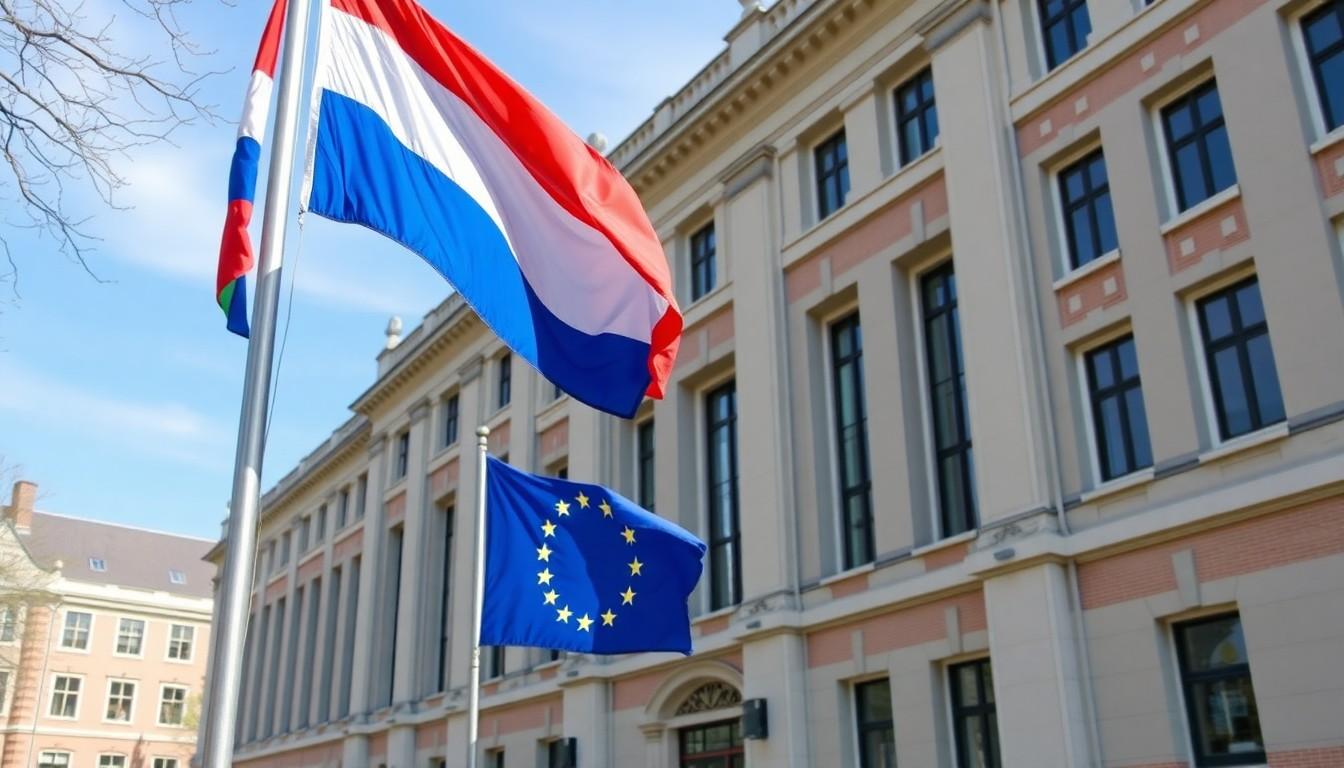
Dutch MPs have voted to fly the rainbow flag outside the House of Representatives for the first time, following a tense late-night dispute in The Hague. The decision, linked to Coming Out Day, has become a vivid test of how national institutions represent equality, identity and belonging.
Essential Takeaways
- Historic display: The rainbow flag was flown alongside the Dutch and European flags outside parliament.
- Clear majority: MPs backed the move by 90 votes to 36 after several days of disagreement.
- Late reversal: A small conservative party initially persuaded parliamentary authorities to withdraw approval.
- Broad support: Government parties and MPs from both left and centre-right groups supported the flag.
- Wider context: Dutch constitutional changes have strengthened protections against discrimination based on sexual orientation.
A rainbow flag takes its place in The Hague
The image is simple but striking: a rainbow flag lifting in the wind beside the Dutch tricolour and the European Union flag. For many people, it will look like a routine gesture of solidarity. Inside the Dutch parliament, however, it followed a surprisingly heated political tussle.
The flag was displayed on Sunday, 11 October, to coincide with Coming Out Day. According to RMF24, MPs had approved the plan in a late Thursday vote, with 90 supporting it and 36 opposed. The decision gave the rainbow symbol a prominent place outside one of the country's most visible democratic institutions.
It also offered a reminder that public symbols can carry real political weight. A flag may be fabric, but on a parliamentary building it becomes a statement about who is seen, welcomed and protected.
Why the decision became a political flashpoint
The initial approval was later withdrawn after pressure from the small Protestant Political Party, known as the SGP. Its representatives argued that the building should display only the national flag, describing the rainbow banner as a symbol of a particular group and political activism.
That position drew objections from several parties, including Progressive Netherlands, the Party for the Animals, 50Plus and Volt. They asked for the issue to be reconsidered, saying parliament should stand behind LGBT+ rights and remain an open workplace for the people who work there.
The disagreement wasn't merely about decoration. It touched a familiar question in democratic politics: should public institutions remain symbolically neutral, or should they visibly affirm rights and inclusion? The vote showed that a sizeable parliamentary majority favoured the latter approach.
A late-night vote caused its own drama
The SGP requested a named vote, meaning each MP's position was recorded. Because the decision came late in the evening, some parliamentarians had to return to The Hague after already leaving the city, prompting criticism over the time and travel involved.
RMF24 reported that BBB leader Caroline van der Plas highlighted the thousands of kilometres MPs collectively had to travel. Pieter Grinwis of the Christian Union called the episode "sad and absurd", although he still voted for the rainbow flag.
That slightly chaotic backdrop gave the story an oddly human quality. Beneath the constitutional language and party positions were tired politicians making long journeys for a decision about a symbol that many supporters regarded as both modest and meaningful.
The vote reflects a wider shift in Dutch rights
Support came from every party in the governing coalition, as well as opposition groups on the left and centre-right. Opposition came from the SGP, far-right parties including Geert Wilders' Party for Freedom, and DENK.
The result sits within a broader Dutch legal and social conversation about equality. Dutch constitutional amendments have explicitly strengthened protection against discrimination based on sexual orientation and disability, according to the Library of Congress and DutchNews.nl.
That context matters because the parliamentary flag wasn't appearing in isolation. It formed part of an evolving picture in which LGBT+ equality is increasingly treated not only as a social issue, but also as a matter for public institutions and constitutional principles.
What the parliamentary flag may signal next
Flying the flag won't resolve every disagreement over LGBT+ rights, and it won't make political opposition disappear. Still, visibility has a practical and emotional effect, particularly for staff, visitors and young people who may see the parliament as a place where their identity is acknowledged rather than debated from a distance.
The decision also shows how symbolic gestures can become unexpectedly powerful. A small flag triggered a formal vote, a long journey home for some MPs and a debate over what neutrality really means. In the end, the majority decided that inclusion deserved a place in the foreground.
A visible welcome can be a small gesture, but it still tells people they belong.
Source Reference Map
Story idea inspired by: [1]
Sources by paragraph: