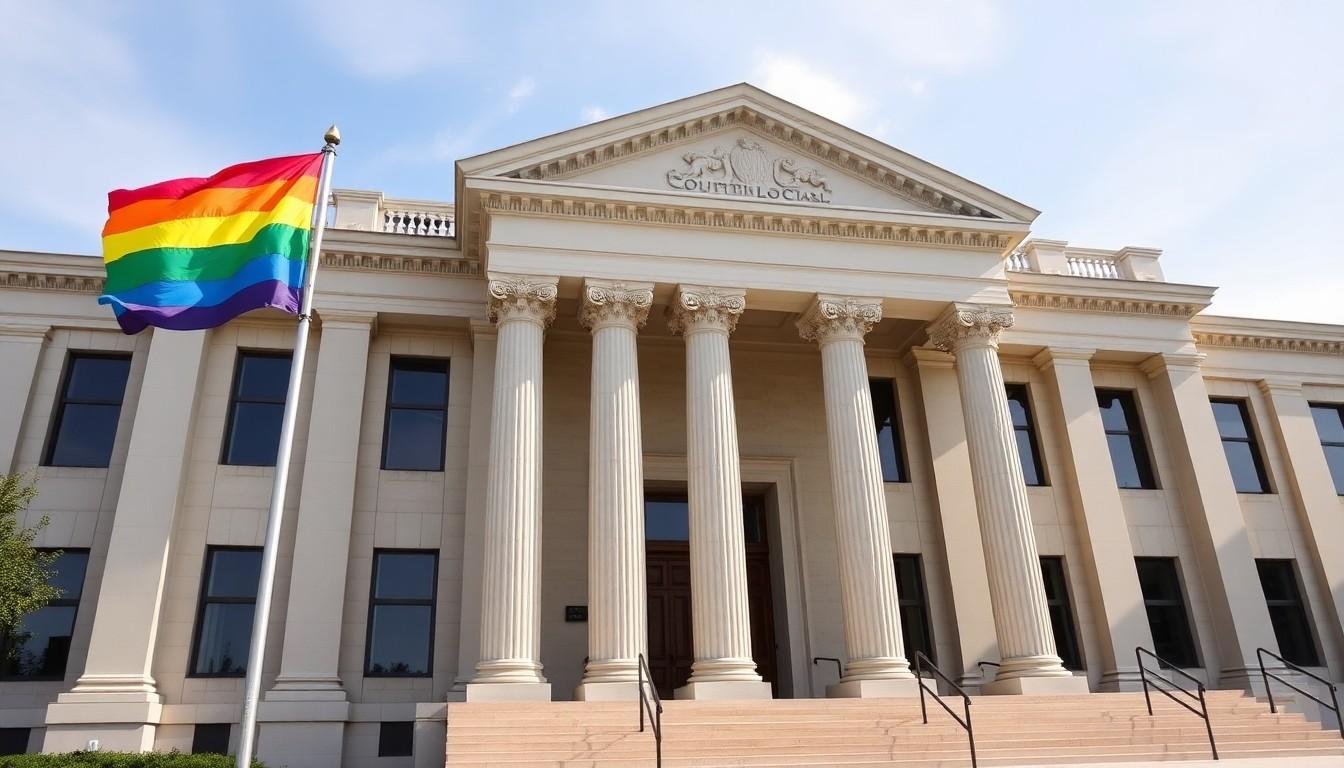
A newly published speech by Justice Samuel Alito has reignited debate over same-sex marriage, while fresh legal and political battles over trans rights show how quickly America’s LGBTQ+ landscape is shifting.
Essential Takeaways
- Alito’s warning: The Supreme Court justice argues that marriage equality can unfairly brand opponents as bigots.
- The wider dispute: His comments echo a conservative concern that legal recognition of LGBTQ+ rights suppresses religious or traditional views.
- Trans rights remain contested: Battles over identity documents, healthcare and public language continue across the US.
- A changing movement: The death of televangelist Jim Bakker also marks the passing of an older generation of outspoken anti-LGBTQ+ religious broadcasters.
Alito’s marriage equality argument is back in the spotlight
Justice Samuel Alito has revived his criticism of same-sex marriage in a speech included in a new book, reopening one of America’s most settled-looking but politically charged cultural arguments. His central concern is that treating opposition to marriage equality as bigotry could push religious believers out of public life.
That argument lands awkwardly because recognising a minority’s legal rights isn't the same as banning private disagreement. Still, it offers a revealing glimpse into how some conservative judges understand the legacy of Obergefell v. Hodges, the 2015 decision that established a constitutional right to same-sex marriage. The Atlantic’s coverage of Alito’s judicial philosophy places his remarks within the broader debate over originalism and the role of the Supreme Court. [2]
For LGBTQ+ Americans, the issue isn't abstract. Marriage equality affects tax status, inheritance, hospital visitation and parental recognition, all the quiet paperwork that becomes suddenly important during a crisis. The legal principle may sound lofty, but its consequences are intensely ordinary.
Why this still matters more than a decade after Obergefell
Supporters of marriage equality see Alito’s comments as part of a continuing effort to recast a rights ruling as an injury to those who opposed it. That framing shifts attention away from couples who were denied recognition and towards the discomfort of people whose preferred social order changed.
The Supreme Court’s LGBTQ+ record remains complicated. As TIME has noted in its review of the court’s recent history, major victories have sat alongside decisions and disputes that have left queer and trans Americans uncertain about how far constitutional protection really extends. [7] The result is a legal landscape that can feel both transformed and precarious.
That tension is especially visible when religious freedom claims collide with anti-discrimination rules. Courts are often asked to balance competing principles, but the practical question is usually simple: can a public-facing business or institution refuse equal treatment because the customer is LGBTQ+? For many people, that’s where theory meets the card machine.
Trans people are still fighting for recognition on paper
The same conflict is playing out in battles over birth certificates and gender markers. In Arizona, Republican lawmakers pursued a ban on correcting gender markers, while the Democratic governor vetoed the proposal after a lower court found that the state couldn't demand surgery as a condition of correction.
The 9th Circuit’s backing for that lower-court position matters because identity documents are more than bureaucratic labels. They can affect travel, employment checks, school enrolment and everyday safety. A mismatched document can turn a routine errand into an unwanted interrogation.
The decision also signals that some federal judges continue to recognise the importance of self-identification, even as state legislatures push in the opposite direction. That push and pull is likely to remain one of the most important trans-rights stories in the United States.
Elliot Page’s warning focuses on healthcare for trans children
Actor Elliot Page has criticised hospitals that ended services for trans young people after pressure from the Trump administration. He argued that withdrawing care can worsen depression and cause serious harm, particularly when programmes close without a new legal prohibition directly requiring them to do so.
Page’s intervention highlights an uncomfortable feature of the current debate: institutions may retreat before a court definitively orders them to act. Hospitals, universities and companies often weigh legal risk, political pressure and funding concerns, leaving families to cope with the fallout.
For parents, the practical lesson is to check exactly what a provider is offering, whether care has moved elsewhere and what professional guidance remains available. The headlines can sound dramatic, but families still need clear information, qualified clinicians and continuity rather than another round of political theatre.
Jim Bakker’s death closes a chapter in religious broadcasting
Jim Bakker, who built the PTL Club television empire with Tammy Faye Bakker, has died aged 86. His rise, fraud conviction and imprisonment made him one of the defining figures of American televangelism, while his personal life attracted years of public speculation and tabloid scrutiny.
The Guardian, CBS News, The Washington Post and KPBS all reported on Bakker’s death and his career, including the collapse of his ministry and the criminal case that followed. [3] [4] [5] [6] His story belongs to an era when a handful of charismatic broadcasters could reach millions from a studio pulpit, mixing religious conviction with celebrity, fundraising and political influence.
Many of the best-known televangelists who campaigned against LGBTQ+ rights are now gone. But their influence hasn't vanished with the television cameras. Their language, alliances and assumptions still echo through modern political campaigns, making the next phase of the LGBTQ+ rights debate feel less like a clean break than an argument inherited from the past.
The legal battles may change, but the human stakes remain familiar: dignity, safety and the freedom to build an ordinary life.
Source Reference Map
Story idea inspired by: [1]
Sources by paragraph: