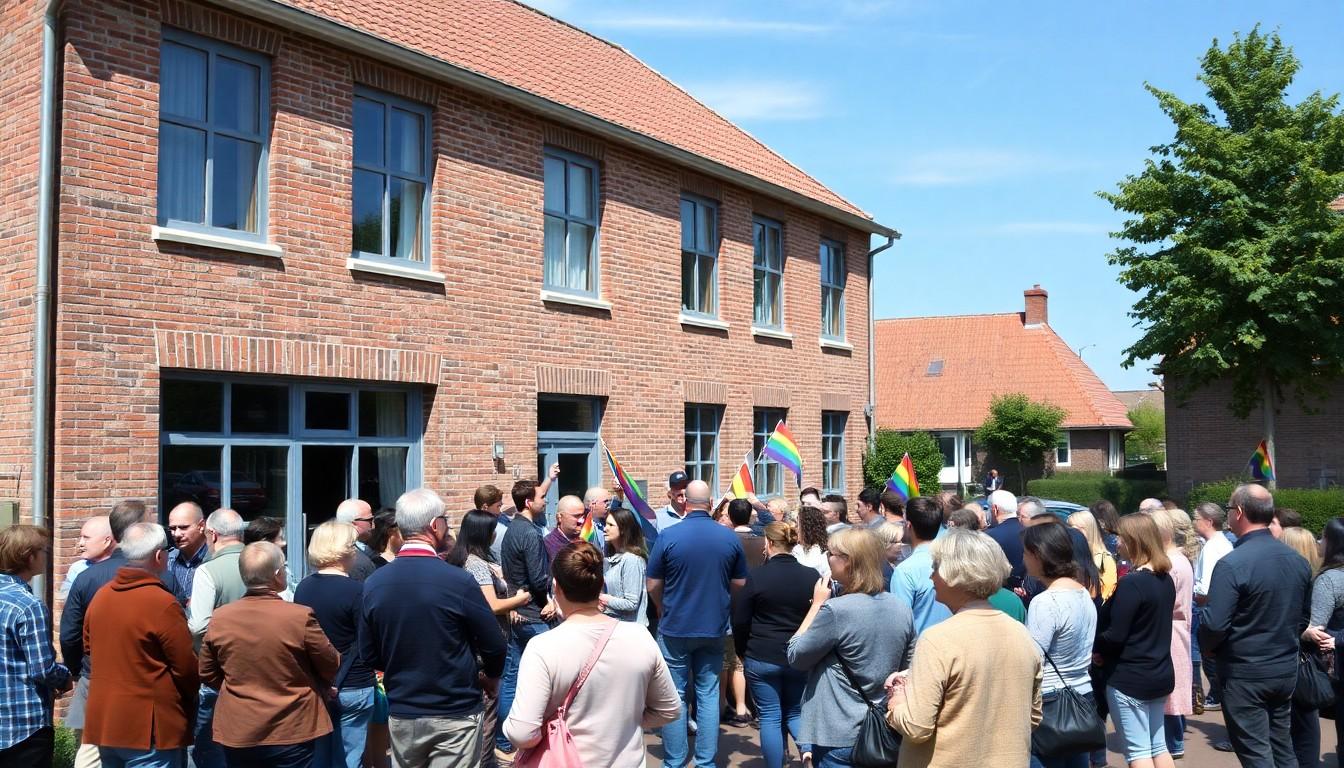
Residents, faith leaders and politicians gathered in Wezep after Oldebroek council ended its official LGBT+ policy and stopped flying the rainbow flag at the town hall. Their peaceful ceremony drew hundreds of supporters, turning one local decision into a vivid debate about belonging, safety and the place of LGBT+ people in a traditional Christian community.
Essential takeaways
- A local policy was withdrawn: Oldebroek council ended its LGBT+ policy, including the official rainbow flag display on Coming Out Day.
- The community responded visibly: Organisers distributed 379 rainbow flags, far more than the 50 initially expected.
- Faith and inclusion met: Protestant minister Han Wilmink said the flag reflects the diversity of God’s creation.
- The mayor attended: Tanja Haseloop-Amsing said she would respect the council’s decision while supporting safety for every resident.
- The ceremony stayed peaceful: Residents gathered outside the Kruiskerk in Wezep to show solidarity and welcome LGBT+ neighbours.
A council decision sparked a much bigger conversation
The rainbow flag has become an unexpectedly sharp political flashpoint in Oldebroek, a municipality of almost 25,000 people. After the council withdrew its LGBT+ policy, the decision quickly moved beyond a question of municipal branding and into a broader argument about safety, visibility and who feels welcome in public life.
According to local reporting, the former policy focused on social acceptance, resilience and safety for LGBT+ residents, as well as making the subject easier to discuss in schools and community organisations. The council also decided that the rainbow flag would no longer be raised at the town hall on 11 October, International Coming Out Day.
That change prompted a strong response from residents and campaigners. Oldebroek Vooruit, a local initiative, helped organise a separate flag-raising at the Protestant Kruiskerk in Wezep, where the atmosphere was colourful, emotional and notably calm.
Hundreds gathered outside the Kruiskerk
What began as a modest show of support quickly grew into a large public gathering. Organisers had hoped to distribute around 50 flags, but 379 were requested and delivered to residents, creating a striking display across the municipality.
The scene outside the church carried a simple visual message: rainbow flags fluttered in the clear air, while supporters gathered with umbrellas, badges and flags of their own. The turnout suggested that the council’s decision had not ended the conversation. If anything, it had made the issue more visible.
The ceremony took place on the Saturday before Coming Out Day, rather than on Sunday. Organisers said that choice was deliberate, respecting Sunday worship while showing that Christian tradition and support for LGBT+ people needn't be treated as opposites.
A minister challenged the idea that inclusion is anti-Christian
Han Wilmink, minister at the Kruiskerk, has flown a rainbow flag outside the church for five years. Speaking to the crowd, he rejected the idea that the symbol is hostile to Christianity, describing it instead as a reminder of the variety within God's creation.
His position gave the ceremony particular weight. In a conservative Christian setting, the presence of a minister beside LGBT+ supporters was more than a gesture of hospitality. It was a public argument that faith and equality can share the same space.
The local campaign group Oldebroek Vooruit has said some young people still feel unable to speak openly at home about whom they love. That concern sits at the heart of the dispute, because policy decisions can feel abstract to officials but intensely personal to teenagers searching for somewhere safe to belong.
The mayor drew a line between policy and presence
Mayor Tanja Haseloop-Amsing attended the ceremony alongside State Secretary Claudia van Bruggen and several members of parliament. Her presence raised an obvious question: was she contradicting the council by supporting a rainbow flag event after the official policy had been scrapped?
She said no. The mayor explained that she would carry out the democratically approved decision not to fly the flag at the town hall. At the same time, she said the council had unanimously committed to strengthening the social resilience of all residents, including LGBT+ people.
That distinction matters. A council can choose how it uses an official building while still accepting a wider responsibility to protect residents from hostility and exclusion. For people watching from outside Oldebroek, it also shows how quickly a symbolic decision can become a test of public leadership.
A peaceful gesture carried years of feeling
Among the crowd was Lucia Anema, who travelled from Zwolle with her wife and wore a rainbow flag around her coat. She said they had come to show solidarity and were grateful that so many people were standing alongside LGBT+ residents.
For others, the ceremony stirred older memories. Carlo Duinkerken, who is connected with LGBT+ organisation COC Zwolle, recalled coming out in 1973 and finding no room for himself in the church where he had grown up. Seeing a minister raise the rainbow flag decades later was, he said, deeply moving.
The final image was simple but powerful: Wilmink and campaigner Kjeld Mooi lifting the flag together, while Mooi told the crowd, "This is also Oldebroek." It was a reminder that communities aren't defined by one vote alone, but by the people who choose to stand visibly beside one another.
The rainbow flag has become a local symbol of LGBT+ inclusion, faith and community solidarity in Oldebroek. [2] [3]
It's a small ceremony with a much larger message: belonging is something communities show, not merely something they declare.
Source Reference Map
Story idea inspired by: [1]
Sources by paragraph:
- Paragraph 1: [2], [3]
- Paragraph 2: [3], [5]
- Paragraph 3: [4], [6]
- Paragraph 4: [2], [6]
- Paragraph 5: [4], [5]
- Paragraph 6: [2], [3]
- Paragraph 7: [4], [6]
- Paragraph 8: [5], [6]
- Paragraph 9: [2], [3]
- Paragraph 10: [4], [5]
- Paragraph 11: [2], [6]
- Paragraph 12: [3], [5]
- Paragraph 13: [2], [4]
- Paragraph 14: [5], [6]