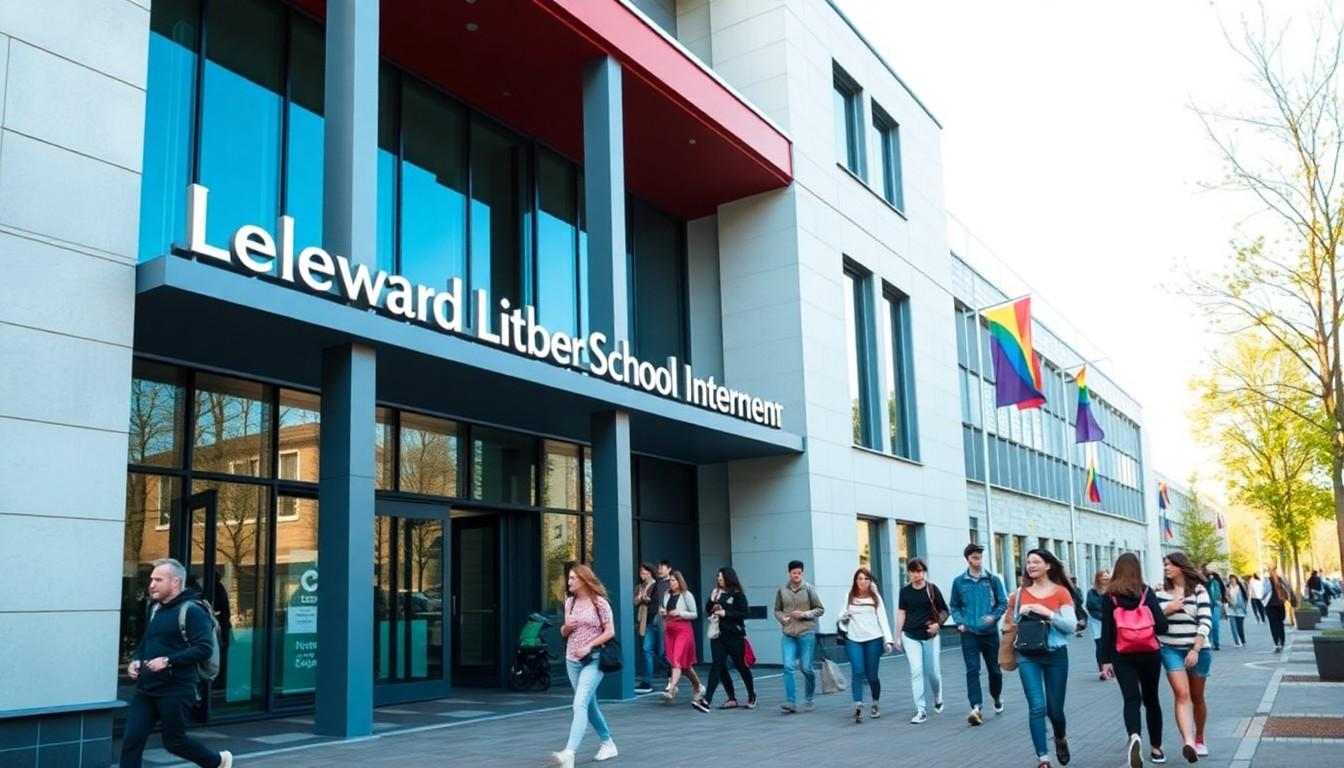
Schools across the Netherlands are turning purple for Purple Friday, but this year's campaign is about more than colourful jumpers. With record participation, teachers and pupils are using activities, classroom discussions and student-led groups to address a worrying fall in acceptance of homosexuality among young people.
Essential Takeaways
- Record participation: More than 3,000 Dutch primary, secondary and vocational schools are taking part in Purple Friday.
- Acceptance is slipping: Research found that only 22% of boys and 51% of girls aged 11 to 16 held a positive view of homosexuality in 2025.
- Conversation matters: Schools are pairing visible support with lessons and guided discussions, rather than relying on purple clothing alone.
- Students need safety: Around two pupils in a class of 30 say they are attracted, at least partly, to someone of the same sex.
- Student voices are growing: Gender and Sexuality Alliances, or GSAs, are helping LGBTQ+ pupils and allies shape activities themselves.
Purple Friday is getting bigger, but also more serious
Purple jumpers, rainbow cakes and bright badges might sound cheerful, and they are. But beneath the glitter and icing, Dutch schools are confronting a distinctly uncomfortable shift in how some young people view homosexuality.
More than 3,000 schools are participating in Purple Friday this year, according to the COC, which coordinates the nationwide event. The organisation described the turnout as heartening, although the need for the campaign has become sharper rather than less urgent.
Research from Utrecht University and the Trimbos Institute found that positive attitudes towards homosexuality have fallen substantially among 11- to 16-year-olds. The decline appears across school levels and among young people both with and without a migration background, according to Trimbos.
That makes the familiar purple hoodie feel rather less like a fashion statement and more like a small, visible act of solidarity.
Why schools are swapping slogans for real conversations
At Maris College Bohemen in The Hague, pupils are being invited to respond to questions on large banners with coloured stickers. The format is simple, but it gives teachers a chance to ask follow-up questions without turning the exchange into a public showdown.
That approach matters because pupils don't all arrive with the same assumptions. Some express discomfort around same-sex relationships while still saying people should be free to choose whom they love. Others refer to family, faith or culture when explaining their views.
School leaders say the aim isn't to embarrass pupils or force instant agreement. It's to create room for curiosity, while drawing a firm line at bullying, abuse and discrimination. The COC and Trimbos both highlight the importance of supportive school environments when discussing sexual and gender diversity.
In practice, that means a calm question can sometimes do more than a loud slogan. It also gives students a chance to hear one another, which is not always easy in an age of quick online reactions.
The numbers explain why this year's campaign feels different
The research paints a particularly stark picture among boys. In 2025, just 22% expressed a positive attitude towards homosexuality, roughly half the level recorded when the question was previously asked in 2021, according to figures shared by the COC and Trimbos Institute.
Among girls, positive attitudes fell from 78% to 51%. The figures bring acceptance back to levels comparable with those seen in the late 2000s, reversing years of gradual progress.
Meanwhile, more than 6% of pupils say they're attracted, at least partly, to someone of the same sex. A further 5% aren't yet sure. In a class of 30, that could mean several pupils are working out their identity while watching closely to see how safe the room feels.
Those figures are one reason schools are treating Purple Friday as an educational issue, not simply an annual celebration. A pupil shouldn't have to calculate whether a rainbow badge will attract support or ridicule before deciding whether to wear it.
Student-led groups make support feel less staged
In Leeuwarden, pupils are making their own buttons, including designs for allies and messages celebrating queer identities. The hands-on preparation gives LGBTQ+ students a visible role, while also making participation less dependent on teachers doing everything themselves.
The school's Gender and Sexuality Alliance offers another layer of support. These groups bring together LGBTQ+ pupils and allies, creating a social space that can feel more relaxed than a formal lesson. The COC has also developed teaching and support materials for schools, including quizzes and guided classroom discussions.
For some pupils, seeing others take part can be quietly reassuring. A purple shirt, badge or painted nail may look modest from the outside, but it can signal that someone isn't alone.
There is still caution, however. Some students choose subtle symbols because they don't know how unfamiliar classmates might react. That hesitation is a useful reminder that visibility only works when schools are prepared to protect the people being visible.
Online pressure is changing the atmosphere
School staff report that discussions around identity, gender and relationships have become more heated. Some schools have even noticed unusually high absence on Purple Friday, raising concerns that pupils may be kept at home.
The wider online climate is part of the story. The COC and related reporting have pointed to misinformation and hostile language circulating among young people, where complex questions about sexuality and gender can be reduced to provocative slogans.
Schools are therefore placing Purple Friday within a broader conversation about freedom, respect and being yourself. That can make the subject less threatening for pupils who might otherwise see it as a political demand rather than a question of everyday school life.
Still, there are no instant fixes. Teachers need clear materials, confidence and backing from senior leaders. Pupils need somewhere to go if a conversation turns cruel. And everyone benefits when disagreement is allowed without allowing discrimination to become normal.
Purple Friday began as a visible statement against anti-gay and anti-trans hostility. Its next chapter looks more like patient, sometimes awkward education. That may be less photogenic than a corridor full of purple, but it could be far more lasting.
A purple badge can start the conversation, but a safer school is built through what happens next.
Source Reference Map
Story idea inspired by: [1]
Sources by paragraph:
- Paragraph 1: [2], [6]
- Paragraph 2: [3], [4]
- Paragraph 3: [4], [5]
- Paragraph 4: [2], [7]
- Paragraph 5: [3], [4]
- Paragraph 6: [5], [7]
- Paragraph 7: [3], [4]
- Paragraph 8: [4], [5]
- Paragraph 9: [2], [6]
- Paragraph 10: [3], [7]
- Paragraph 11: [2], [4]
- Paragraph 12: [3], [5]
- Paragraph 13: [2], [6]
- Paragraph 14: [3], [7]
- Paragraph 15: [4], [5]
- Paragraph 16: [2], [3]
- Paragraph 17: [4], [7]
- Paragraph 18: [3], [5]
- Paragraph 19: [2], [4]
- Paragraph 20: [3], [6]