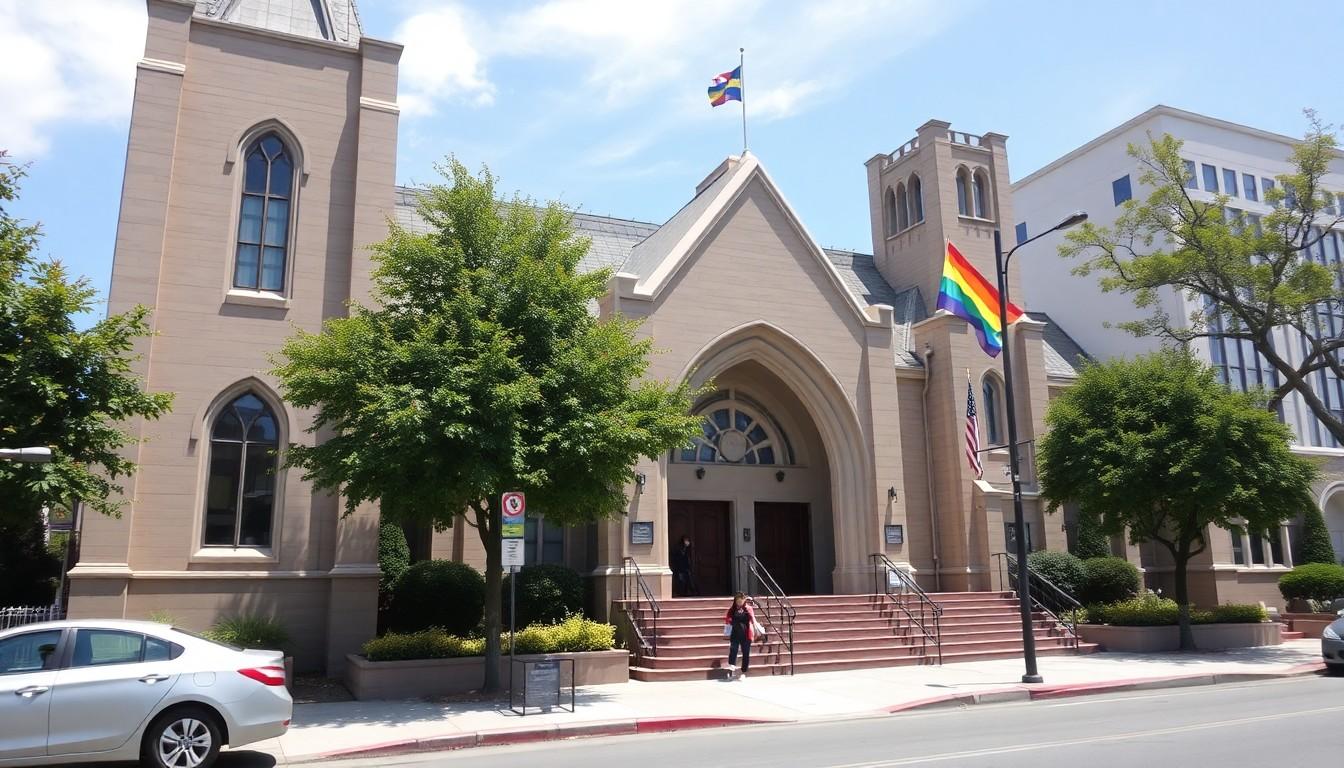
Visitors to a San Francisco church encountered Leather Pride flags, queer performance and a guest sermon from Honey Davenport during Folsom weekend. The provocative service has divided opinion, with critics calling it a step too far and supporters defending it as an expression of LGBTQIA+ inclusion, chosen family and spiritual belonging.
Essential Takeaways
- A highly visible service: Metropolitan Community Church San Francisco held its annual Folsom Sunday gathering alongside the city’s famous leather and kink festival.
- A headline-making guest: Honey Davenport, a non-binary drag performer and adult entertainer, delivered the guest reflection.
- Leather symbolism: Leather Pride flags were displayed throughout the sanctuary as a gesture of solidarity.
- A wider argument: The backlash centres on whether churches should embrace communities linked to sex work, kink and queer nightlife.
- A familiar face in leather circles: Davenport is associated with the International Mr Leather 2026 competition and its wider community.
Why this church service caused such a stir
The striking image was hard to miss: a worship space dressed in Leather Pride flags, with Honey Davenport speaking from the pulpit during one of San Francisco's busiest queer weekends. Folsom Sunday is designed to connect faith with the city's leather community, but this year's guest appearance pushed the event into a much louder public conversation.
Davenport's presence brought together several identities that conservative commentators often treat as incompatible with traditional church life. They're a drag performer, adult entertainer and non-binary public figure, while also holding a prominent place in the international leather scene. Industry coverage from Instinct Magazine and GCN has highlighted Davenport's rise within that community.
For supporters, that combination is precisely the point. MCC San Francisco has long presented itself as a welcoming spiritual home for LGBTQIA+ people, so the service was framed as a public expression of belonging rather than a stunt. Still, the leather flags and the guest speaker gave critics plenty to seize on.
A sermon built around community and action
Davenport's reflection drew on Matthew 21:23-32, a passage in which Jesus challenges religious authority and tells the parable of two sons. Its central tension is between public declarations and meaningful action, a theme that allowed the speaker to focus on chosen family and mutual support.
That message was linked to networks within queer, leather and sex-worker communities. Davenport argued that communities often create care structures when conventional institutions have excluded them. It was an emotionally resonant idea for the congregation, although opponents saw the service as blurring the boundary between worship and sexual subculture.
The International Mr Leather organisation describes itself as a community-led platform connecting people across the global leather scene. Its team and competition coverage show how the title involves more than a single stage appearance, with advocacy, visibility and community representation forming part of the role.
Honey Davenport’s leather-world profile is growing
Davenport is not a random guest pulled from the festival crowd. Coverage from The Fight and Queer.de identifies the performer as the winner of International Mr Leather 2026, a title that carries considerable recognition in leather communities around the world.
That background helps explain why the church invited Davenport during Folsom weekend. The guest brought entertainment-industry visibility, queer cultural credibility and a direct connection to the people the service was trying to welcome. In practical terms, it also ensured that the event would be noticed far beyond the pews.
The wider leather scene is diverse, though, and it can't be reduced to a single stereotype. For many participants, it involves identity, friendship, history and consent as much as fetish. That distinction is central to how supporters defend the service, even if it isn't likely to satisfy everyone watching from outside the community.
Critics see a collision of church and kink culture
The backlash was immediate, particularly among socially conservative Christian outlets. Protestia described the event as abhorrent and accused the Metropolitan Community Church movement of abandoning biblical teaching.
The criticism focuses on the combination of a pulpit, an adult performer and symbols associated with BDSM. For opponents, that combination represents a fundamental departure from what they believe a church service should be. Their argument is less about one guest alone and more about whether religious institutions should publicly align themselves with sexual subcultures.
Supporters, meanwhile, say that the outrage reveals exactly why affirming churches remain necessary. MCC began in 1968 with a mission centred on LGBTQIA+ people, and its progressive identity is hardly a secret. From that perspective, the service wasn't an unexpected detour but a very deliberate continuation of the denomination's history.
What the controversy says about modern inclusion
The dispute reflects a bigger cultural shift: institutions are increasingly being asked to recognise communities that were once kept firmly outside public life. That can be meaningful for people who have experienced rejection, but it also creates friction when inclusion reaches spaces traditionally treated as sacred or separate.
MCC San Francisco described the gathering in terms of queer liberation, bodily autonomy and solidarity with the leather community. Those phrases may sound confrontational to conservative Christians, yet they make clear that the service was intended as a statement, not simply a routine Sunday meeting.
For the congregation, the most important outcome may have been the sense of being seen. For critics, the same visibility feels like provocation. Either way, Honey Davenport's appearance has turned a local act of inclusion into a national argument about faith, identity and who gets to stand at the front of a church.
It's a controversy unlikely to disappear soon, because it touches the fault line between religious tradition and modern queer visibility.
Source Reference Map
Story idea inspired by: [1]
Sources by paragraph:
- Paragraph 1: [4], [5]
- Paragraph 2: [6], [7]
- Paragraph 3: [2], [3]
- Paragraph 4: [4], [5]
- Paragraph 5: [2], [6]
- Paragraph 6: [3], [7]
- Paragraph 7: [6], [7]
- Paragraph 8: [2], [3]
- Paragraph 9: [4], [5]
- Paragraph 10: [6], [7]
- Paragraph 11: [2], [3]
- Paragraph 12: [4], [5]
- Paragraph 13: [6], [7]
- Paragraph 14: [2], [3]
- Paragraph 15: [4], [5]
- Paragraph 16: [6], [7]