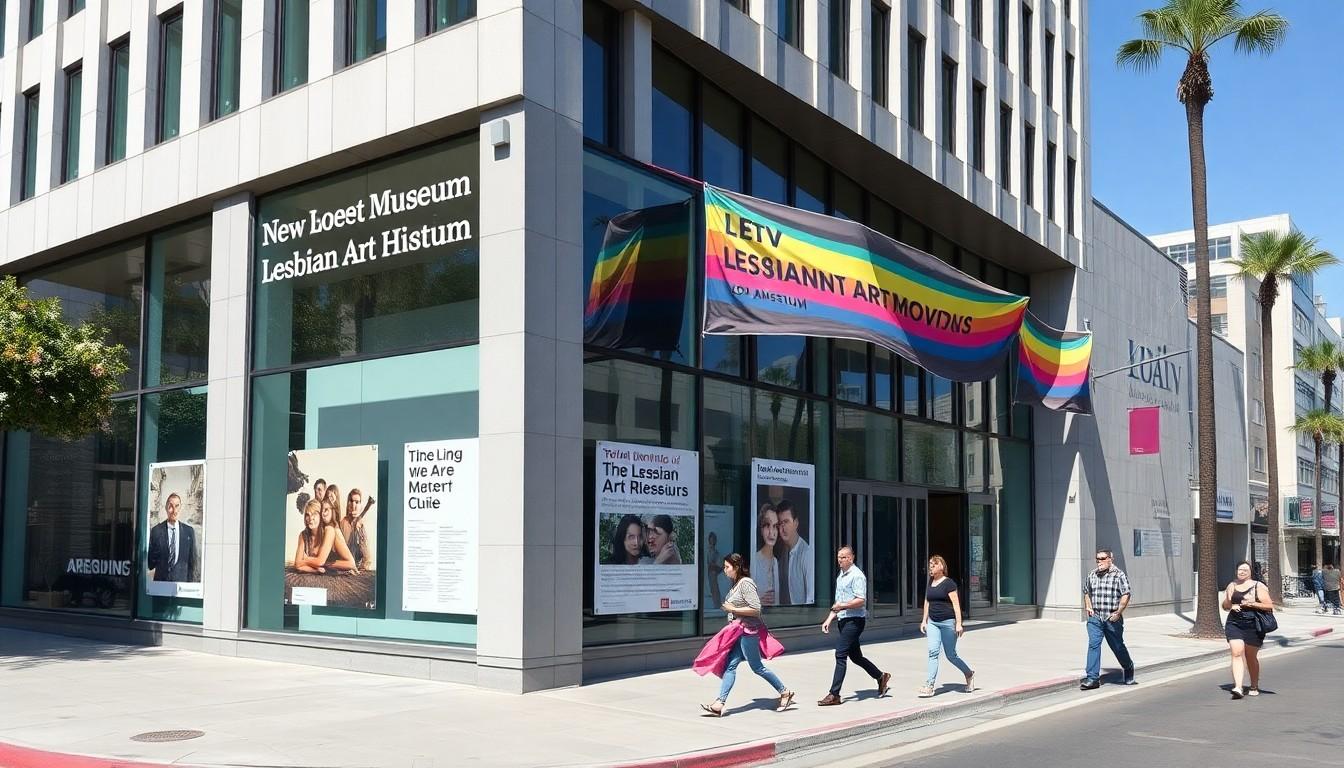
Visitors in Los Angeles are being invited to encounter lesbian art history through archives, invented museums and layered storytelling. Monica Majoli’s Countervision, alongside major presentations of Millie Wilson and Susan Silton, matters because it doesn’t simply seek visibility. Instead, these exhibitions ask who gets remembered, how communities preserve themselves and what institutions still fail to hold.
Three exhibitions, one overdue conversation
Los Angeles is having a notably rich moment for lesbian art. Monica Majoli: Countervision at the June L Mazer Lesbian Archives sits alongside presentations devoted to Millie Wilson and Susan Silton, giving three artists long associated with the margins a more substantial institutional platform. According to PBS SoCal, Majoli’s project forms part of a wider public programme around the exhibition, while Los Angeles Nomadic Division has presented the show in partnership with the archive.
The atmosphere is less grand museum spectacle than intimate historical encounter. Visitors may find themselves looking closely at photographs, drawings and archival material, with the quiet thrill of handling or discovering objects that have lived outside conventional art-world channels. It’s the kind of setting where a drawer, a faded image or a handwritten trace can feel unexpectedly loud.
Monica Majoli looks back to the Ovulars
At the heart of Countervision are the Ovulars, a feminist photography collective active at a lesbian commune in rural Oregon between 1979 and 1983. Their photographs documented daily life while also helping create a picture of lesbian community as it was being lived. The work carries a handmade, immediate quality, as though its makers were building an archive before anyone had promised to preserve it.
Majoli’s connection is personal as well as artistic. As a child in Los Angeles, she spent afternoons at Sisterhood Bookstore, searching for a community she could recognise as her own. Material linked to Sisterhood and the Ovulars now appears alongside her new drawings, bringing personal memory, collective history and contemporary art into the same room.
According to WeHo Times, the exhibition brings this lesbian history to life at the Mazer Lesbian Archives in West Hollywood. That location matters. The archive isn’t a neutral backdrop; it gives the work a lived-in context, where history feels held by a community rather than simply labelled and displayed.
Why archives can feel more powerful than galleries
Countervision also explores the difference between being seen and being properly understood. Some of Majoli’s drawings are placed within archival holdings, while others can be handled in a flat file. That physical closeness gently disrupts the usual gallery rule of look, don’t touch, and makes research feel tactile rather than remote.
The approach echoes the history of Sisterhood Bookstore, whose materials have become important evidence of feminist organising and cultural life in Los Angeles. A Sisterhood archive project documented the bookstore’s role through publications and visual material, showing how such spaces could function as meeting points, information centres and places of recognition for people still struggling to find themselves represented.
For visitors, the practical lesson is simple: allow time. These exhibitions reward slow looking more than a quick circuit, particularly if you’re interested in queer history, feminist art or the ways community archives preserve stories that formal institutions overlooked.
Millie Wilson turns the museum into a question
Millie Wilson’s Museum of Lesbian Dreams takes a more mischievous route to remembrance. Created as a fictional institution, it uses paintings, photographs, sculpture and installation to imagine a lesbian art history that might have existed, but was never fully recorded. The invented museum becomes both artwork and critique.
That premise gives Wilson room to play with the authority of cultural institutions. A museum label can make something appear official, stable and important, yet Wilson’s work asks what happens when that authority is built around imagined artists, lost histories and supposedly minor forms of culture. Lesbian pulp and lowbrow material are not treated as embarrassing leftovers; they become evidence of a community’s complicated visual language.
The result is funny, sly and slightly unsettling. It suggests that recovery isn’t always a matter of finding the perfect missing masterpiece. Sometimes it means admitting that the archive was shaped by taste, status and exclusion in the first place.
Susan Silton resists neat categories
Susan Silton’s survey expands the conversation across photography, performance, writing, sound, design and participation. The breadth is important because it refuses the idea that lesbian art must fit one medium or one easily explained political message. According to the Los Angeles Times archives, Silton’s earlier work formed part of a broader conversation around lesbian culture and representation in Los Angeles.
Her practice is especially interested in the instability of identity. Rather than presenting lesbianism as a fixed category, the work allows it to remain layered, shifting and occasionally contradictory. That can make the exhibition more demanding than a straightforward historical survey, but it’s also what gives it life.
The three exhibitions therefore work best as a conversation rather than a simple correction to the canon. Majoli looks to collective self-fashioning, Wilson invents an alternative museum and Silton challenges the boxes institutions use to make identity easier to package. Together, they suggest that recognition is welcome, but it shouldn’t flatten the work that finally receives it.
A bigger place for unruly histories
The renewed attention arrives after decades in which these artists worked with limited institutional visibility. Their exhibitions now offer recognition, but they also expose the awkwardness of that process. Institutions may open their doors, yet the artists remain alert to the categories, expectations and polite simplifications that can enter with them.
That tension gives the Los Angeles exhibitions their particular energy. They aren’t asking to be absorbed into a single official story of lesbian art. Instead, they preserve disagreement, humour, vulnerability and the rough edges of lived experience.
For anyone planning a visit, expect less of a tidy timeline and more of a series of encounters: a photograph that feels intimate, an imagined artist who becomes strangely convincing, or an object whose history seems to expand the longer you study it. That’s the pleasure here. The past isn’t presented as settled; it’s still being made visible.
It's a small but significant shift when lesbian histories can occupy institutional space without being made neat.
Source Reference Map
Story idea inspired by: [1]
Sources by paragraph:
- Paragraph 1: [2], [3]
- Paragraph 2: [4], [5]
- Paragraph 3: [3], [4]
- Paragraph 4: [2], [7]
- Paragraph 5: [4], [6]
- Paragraph 6: [5], [6]
- Paragraph 7: [3], [4]
- Paragraph 8: [2], [5]
- Paragraph 9: [6], [7]
- Paragraph 10: [2], [3]
- Paragraph 11: [4], [5]
- Paragraph 12: [3], [6]
- Paragraph 13: [2], [4]
- Paragraph 14: [5], [7]
- Paragraph 15: [3], [4]
- Paragraph 16: [2], [6]
- Paragraph 17: [3], [5]
- Paragraph 18: [4], [7]
- Paragraph 19: [2], [3]