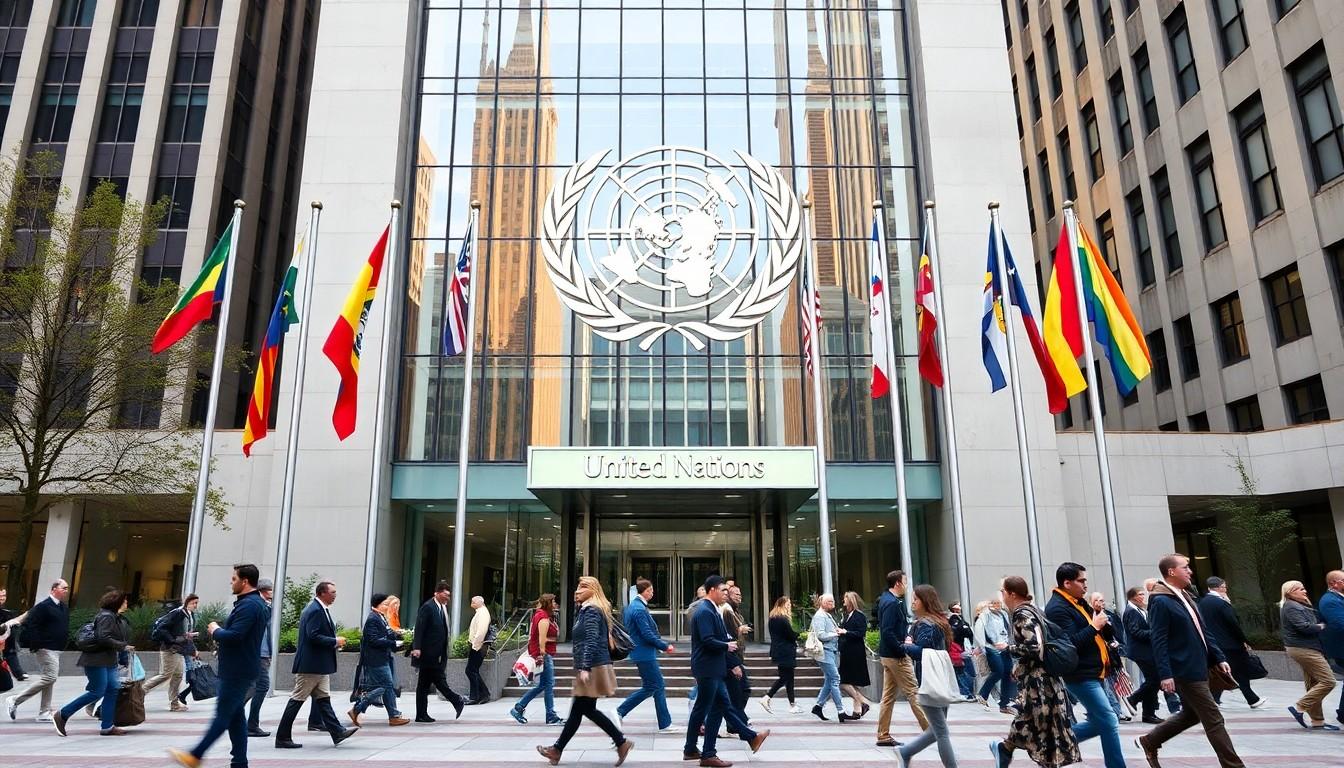
Mexico’s foreign policy drew fresh attention at the United Nations after Roberto Velasco addressed LGBT rights, equality and discrimination in New York. The timing matters: his remarks came one day before Donald Trump criticised Mexico’s security record, prompting online confusion and a sharp debate over what the speech meant.
Essential Takeaways
- The timing was central: Velasco spoke on 21 September, before Trump’s address the following day.
- The setting was diplomatic: Mexico and Norway co-chair the UN’s LGBTI Core Group.
- The message focused on rights: Velasco highlighted discrimination, violence, hate speech and misinformation.
- Trump’s criticism came later: He described Mexico as a centre of cartel violence and compared criminal groups with ISIS.
- Mexico’s main address is still ahead: The country is scheduled to speak during the UN General Assembly debate on 25 September.
The speech came before Trump’s criticism
The online reaction largely turned on chronology. Velasco’s appearance took place on Monday 21 September, during Mexico’s programme around the 81st session of the UN General Assembly. Trump’s speech followed on Tuesday, when he attacked Mexico over cartel violence and security.
That distinction matters because some social media users appeared to assume the Mexican official had chosen to discuss LGBT rights after Trump’s remarks, rather than before them. According to El Financiero, that misunderstanding helped fuel criticism of Mexico’s diplomatic representation.
It’s a familiar problem in the age of clipped video: remove a date from a speech and the political meaning can shift dramatically.
What Roberto Velasco said about LGBT rights
Velasco spoke at a meeting of the UN’s LGBTI Core Group, where he addressed equality, non-discrimination and human rights. The group exists to encourage international support for LGBT people and is co-chaired by Mexico and Norway, according to the United Nations and regional reporting.
His remarks presented inclusion as a matter of social strength, rather than a niche cultural issue. He argued that societies seeking shared prosperity need to be inclusive and resilient, while warning that LGBT people still face violence, discrimination, hate speech and disinformation.
The central idea was universal protection. Velasco said human dignity crosses borders and that commitments to equality shouldn't have exceptions, a position consistent with the UN’s wider human rights framework.
Why the message became politically charged
The speech might otherwise have passed as a standard multilateral statement. Instead, its proximity to Trump’s later address gave it a sharper political edge, particularly as the US president used his UN appearance to focus on Mexico’s security challenges.
The White House said Trump presented himself as a leader willing to act rather than simply debate international problems. Coverage of his remarks also reflected his broader criticism of global institutions and what he sees as excessive international influence over national policy.
That created two competing storylines in New York: Mexico defending LGBT rights through a UN forum, and the US president putting pressure on Mexico over organised crime. They happened close together, but they weren't the same event.
Mexico’s diplomatic balancing act
Foreign policy rarely comes in neat categories. Governments may discuss human rights in one room, security cooperation in another and trade elsewhere, all within the same week. For Mexico, the challenge is to make those priorities appear coherent while facing scrutiny from its most powerful neighbour.
Velasco’s comments also fit a broader international effort to keep LGBT rights within mainstream human rights discussions. The UN says LGBT people continue to face discrimination and violence in many parts of the world, making the issue a recurring part of multilateral diplomacy.
For readers trying to judge the episode, the simplest test is to check the date, the forum and the exact subject of each speech. That avoids treating a carefully timed news cycle as though it were one single confrontation.
What happens next at the General Assembly?
Mexico’s formal intervention in the general debate is scheduled for Friday 25 September at 6pm New York time. That appearance will provide a clearer opportunity for the country to respond to wider regional and security issues, rather than relying on a meeting focused specifically on LGBT rights.
Meanwhile, the controversy shows how quickly diplomatic language can become domestic political ammunition. A message about equality may be judged not only on what it says, but on what audiences believe it was intended to answer.
The result is a small lesson in international politics: context isn't decoration. It can completely change the story.
It's a reminder to check the timeline before judging the message.
Source Reference Map
Story idea inspired by: [1]
Sources by paragraph:
- Paragraph 1: [2], [3]
- Paragraph 2: [4], [5]
- Paragraph 3: [2], [3]
- Paragraph 4: [4], [5]
- Paragraph 5: [2], [3]
- Paragraph 6: [4], [5]
- Paragraph 7: [5], [6]
- Paragraph 8: [2], [3]
- Paragraph 9: [4], [5]
- Paragraph 10: [2], [3]
- Paragraph 11: [4], [5]
- Paragraph 12: [2], [3]
- Paragraph 13: [5], [6]
- Paragraph 14: [4], [7]
- Paragraph 15: [2], [3]
- Paragraph 16: [4], [5]
- Paragraph 17: [2], [3]
- Paragraph 18: [4], [5]