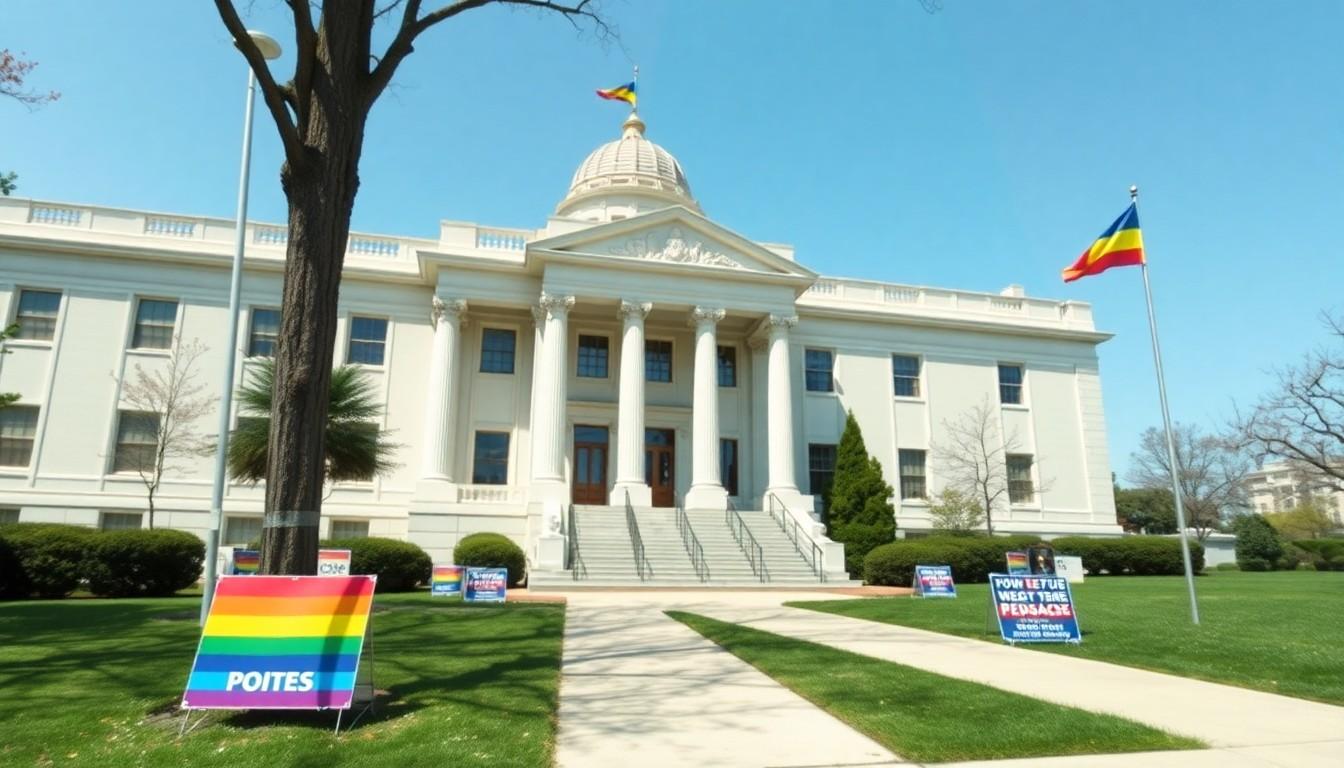
Campaign teams are turning to provocative videos and synthetic media to push anti-LGBTQ messages before America’s midterm elections. But with healthcare, fuel and household costs weighing more heavily on voters, these attention-grabbing ads may reveal more about campaign strategy than public priorities.
Essential Takeaways
- Economic worries lead: KFF polling found healthcare costs and fuel prices are major concerns for voters.
- Trans issues rank lower: Polling cited in the report placed transgender issues near the bottom of voters’ priorities.
- AI raises the stakes: Several campaigns used artificial intelligence to portray opponents in fabricated scenarios.
- Shock is the strategy: The ads rely on sexual innuendo, horror imagery, parody and absurd visual metaphors.
- Context matters: Sensational campaign material can spread widely even when the underlying policy claims are misleading or exaggerated.
Why are campaigns still pushing unpopular culture-war ads?
The political backdrop is striking. Voters are preoccupied with bills, petrol and access to healthcare, while LGBTQ and transgender issues appear to matter less to most people when compared with bread-and-butter concerns.
KFF polling has repeatedly found that healthcare affordability remains near the top of the public's economic worries. Concerns about fuel prices have also risen, giving candidates plenty of material for a traditional cost-of-living campaign.
Yet culture-war advertising hasn't disappeared. Instead, it has become more theatrical, apparently designed to trigger outrage, attract online attention and keep an opponent's name circulating. As The Guardian reported, Steve Hilton's California gubernatorial campaign drew criticism for an advert that used sexual innuendo to promote a voting message.
That mismatch is worth noticing. A subject can rank low in voter priorities and still be highly useful to a campaign looking for a sharp dividing line.
The California advert went for discomfort
The Steve Hilton campaign's video features two young women sitting on a bed in front of a pride flag. Their suggestive conversation initially sounds like it belongs in a flirtatious advert, before the scene reveals that they're filling in a ballot for Hilton.
The joke is deliberately awkward, and that's the point. It uses queer-coded imagery and sexual tension as a punchline, turning the act of voting into a staged seduction. It doesn't offer much information about policy, but it does create a clip that people may share simply to express disbelief.
The Guardian's coverage captured the controversy surrounding the spot, while KFF polling provides useful context for why such messaging is a gamble. If voters are chiefly worried about medical bills and petrol, a strange viral moment may generate attention without persuading undecided people.
Texas campaigns used AI as a political weapon
Ken Paxton's Senate campaign used AI-generated imagery in adverts attacking James Talarico. One video presents a fictionalised Talarico as a doctor beside a child in a hospital setting, accompanied by claims about gender-affirming healthcare.
Another depicts an artificial version of Talarico wearing a costume inspired by The Sound of Music and singing a rewritten version of "My Favorite Things". The parody presents a caricature of his supposed views rather than a careful account of his record.
Synthetic media makes this kind of attack particularly slippery. Viewers can recognise the target while still understanding that the footage is fabricated, but a fast-moving social media clip may travel without that context. By the time a correction appears, the emotional impression may already have done its work.
The healthcare polling from KFF adds another layer. Voters have strong concerns about medical costs and access, so campaigns are placing a highly emotive debate inside a wider environment of anxiety about health. That can make an advert feel urgent, even when its imagery bears little resemblance to everyday medical care.
The banana advert turned a policy claim into theatre
A separate Oklahoma advert featured Charles McCall holding a banana and chopping it with a kitchen knife. He used the fruit as a visual metaphor for sex and gender, arguing that changing its appearance wouldn't change what it was.
The scene is blunt, theatrical and easy to understand in seconds. It also oversimplifies complex healthcare and sporting policy, while using a violent prop to make the message feel more dramatic. In other words, it behaves more like a stage gag than a serious explanation.
That matters when evaluating campaign videos. Ask what the image is doing, rather than accepting it as evidence. Is it explaining a policy, showing a real event or simply creating a memorable emotional association?
KFF's findings suggest that voters are more focused on household pressure, including healthcare and childcare costs. That helps explain why a visually loud advert might attract attention yet struggle to address the problems people actually want politicians to solve.
Fabricated romances and security footage add another layer
In Kentucky, Ed Gallrein's campaign used AI to depict opponent Thomas Massie in an invented romantic relationship with Democratic politicians Alexandria Ocasio-Cortez and Ilhan Omar. The video was styled partly to resemble security-camera footage, giving the fiction a deliberately illicit feel.
That presentation is important. Security footage carries an air of accidental discovery, even when viewers know they may be watching a campaign production. Add a familiar political target and a scandal-shaped narrative, and the format does much of the persuading before any policy argument begins.
AI doesn't create political sensationalism, but it lowers the cost of producing convincing-looking scenes. Campaigns can now put an opponent into a hospital, a musical, a supposed relationship or almost any other setting without filming a real event.
For viewers, the practical rule is simple: pause before sharing. Check whether the footage is labelled as AI, look for independent reporting and search for the original campaign source. A polished clip isn't proof, and a grainy one isn't automatically authentic.
What these adverts say about the next campaign cycle
These videos show how political advertising is shifting towards spectacle. Some are built around humour, others around fear, but all rely on a quick emotional reaction. They ask viewers to feel disgust, alarm or amusement before they have time to assess the claim.
That approach may be especially effective online, where a bizarre advert can become news in its own right. The campaign gets free coverage, supporters receive a shareable talking point and opponents are pushed into responding on the advertiser's chosen ground.
Still, attention isn't the same as persuasion. KFF's polling repeatedly points to healthcare costs and wider living expenses as central voter concerns. Campaigns that spend heavily on identity-based attacks may be hoping that cultural conflict will drown out questions they find harder to answer.
The most useful response isn't to ignore these adverts completely, nor to treat every viral clip as a political earthquake. Watch closely, verify the imagery and bring the conversation back to what voters say they need. That tends to be less theatrical, but much more revealing.
It's worth looking past the shock and asking which real-life problem an advert is trying to distract you from.
Source Reference Map
Story idea inspired by: [1]
Sources by paragraph:
- Paragraph 1: [2], [3]
- Paragraph 2: [4], [5]
- Paragraph 3: [7], [6]
- Paragraph 4: [2], [4]
- Paragraph 5: [3], [5]
- Paragraph 6: [7], [6]
- Paragraph 7: [4], [5]
- Paragraph 8: [2], [3]
- Paragraph 9: [7], [6]
- Paragraph 10: [4], [5]
- Paragraph 11: [2], [6]
- Paragraph 12: [3], [4]
- Paragraph 13: [5], [6]
- Paragraph 14: [2], [3]
- Paragraph 15: [4], [5]
- Paragraph 16: [6], [7]