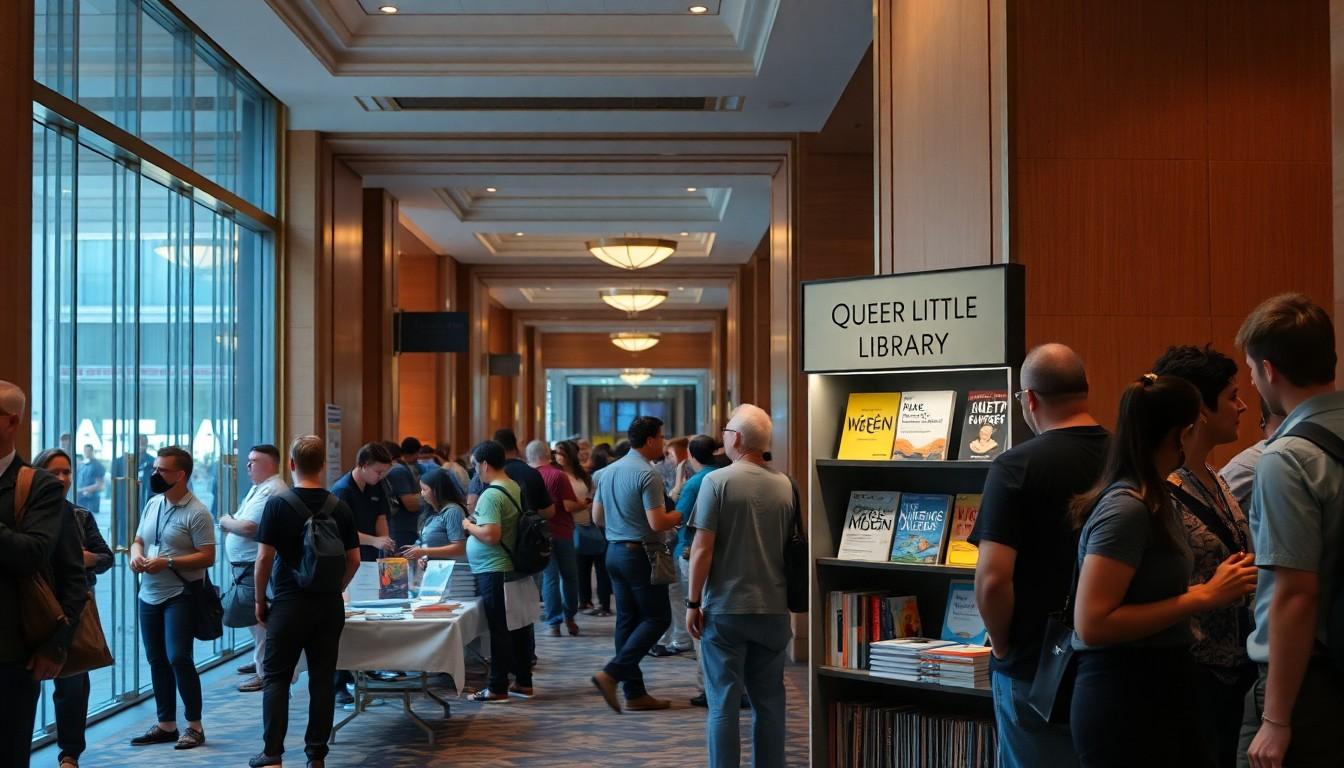
Visitors to New York's Flame Con 2026 found more than comics and costumes. Across a packed weekend, LGBTQ attendees shared books, games, dance, drag and personal histories, creating a bright, welcoming space at a difficult political moment. The convention's mix of creativity and community showed why queer storytelling still matters.
Essential Takeaways
- Books took centre stage: A free Queer Little Library encouraged visitors to share LGBTQ literature.
- Stories built community: Artists and authors used memoir, comics and performance to make queer lives visible.
- Games offered escape: Role-playing sessions helped young people imagine safer, more hopeful futures.
- Dance brought joyful resistance: Soca and dancehall fitness turned movement into celebration and protest.
- Drag made fandom feel personal: Performers recast beloved characters through queer creativity and humour.
Flame Con turns storytelling into shelter
The most powerful thing at Flame Con wasn't necessarily the loudest. Among the costumes, panels and performances, books quietly became a kind of shelter, offering visitors a chance to find themselves in pages that are too often challenged or removed.
The convention's Queer Little Library invited people to take and exchange LGBTQ books, while authors signed advance copies of forthcoming work. According to Flame Con's official programme materials, the event continues to centre queer artists, creators and audiences across its varied schedule.
That combination matters. A book can travel home in a tote bag, sit beside a child's bed or reach someone who hasn't yet found the words for their own experience. In a tense climate, that feels less like a literary extra and more like a practical act of care.
Queer authors put lived experience on the page
The vendor floor offered the usual comic-con pleasures, from fan art to collectible pieces, but personal storytelling gave the marketplace its emotional weight. Graphic memoirs and independent publishing made room for experiences that mainstream culture has often flattened or ignored.
Chad Anderson's graphic novel, Gay Mormon Dad, draws on his upbringing and family life while exploring identity, faith and belonging. His story reflects a wider reason people seek queer conventions: not simply to meet favourite creators, but to discover that complicated lives can be shared without apology.
Flame Con's published programme highlights the breadth of its author and artist line-up, spanning comics, speculative fiction and other forms of queer expression. For readers, that variety is part of the appeal. There's always the possibility of finding a story that feels uncannily familiar, or one that opens a door you hadn't considered.
Why role-playing games matter beyond escapism
At a table devoted to Role 4 Initiative, storytelling became collaborative rather than something to consume quietly. The organisation uses Dungeons and Dragons to support LGBTQ young people, giving participants a chance to make choices, solve problems and imagine characters who can survive impossible odds.
That may sound like fantasy, but the emotional benefit is very real. For young people navigating hostility or uncertainty, a game can offer a low-pressure rehearsal space for bravery, friendship and self-definition. It also makes room for laughter, which is sometimes the most welcome form of relief.
The convention programme's emphasis on interactive events reflects a broader shift in fandom. Audiences increasingly want to take part, not simply watch from the sidelines. A good tabletop session leaves everyone with a story they helped create, rather than one dictated by someone else.
Dance brought a different kind of protest
Flame Con's first Soca and dancehall Zumba class added heat, colour and plenty of movement to the weekend. Supa Soca connected queer identity, Caribbean culture, cosplay and carnival energy, transforming the dance floor into a place where bodies could feel celebrated rather than scrutinised.
That was especially meaningful in spaces where Caribbean culture and queerness aren't always treated as central. The class made inclusion physical: music pulsed, people moved together and the room briefly became its own little world.
It was also a useful reminder that resistance doesn't always look solemn. Sometimes it looks like sequins, sweat and a roomful of people learning the same steps. Joy isn't a distraction from serious issues here; it's part of how communities remain visible and connected.
Drag made fandom feel gloriously personal
The Flame Con Fireball carried the same idea into the evening, with drag performers reimagining favourite characters from comics, animation and gaming. Megami appeared as White Diamond from Steven Universe, while other performers brought characters including Storm into a world of lip-syncs, glamour and theatrical mischief.
This kind of performance works because it understands fandom as something intimate. A character can represent power, survival or self-discovery, then become newly expressive when filtered through a performer's own identity.
The official Flame Con materials position the convention as a meeting point for queer fans and creators, and the event's performance programming makes that promise tangible. People arrived dressed as characters they loved, then watched those characters transformed into something louder, stranger and more personal.
A convention built for the moment
Flame Con's 2026 programme shows how far the modern convention has moved beyond panels and merchandise. Its most memorable moments came from the connections between formats: a book leading to a conversation, a game opening up possibility, a dance class creating instant solidarity and a drag show turning fandom into celebration.
There was no suggestion that art alone can solve political violence or discrimination. But the weekend offered something more practical: a place to gather, exchange ideas and remind one another that queer lives are not marginal footnotes.
For many attendees, that may be the real luxury of a convention like this. You can leave with a new book, a favourite artist or a ridiculous photo from the dance floor, but you also leave knowing you weren't imagining the need for community.
It's a small-looking act with a surprisingly large impact: keep telling the stories, and keep making room for one another.
Source Reference Map
Story idea inspired by: [1]
Sources by paragraph:
- Paragraph 1: [2], [3]
- Paragraph 2: [4], [5]
- Paragraph 3: [6], [7]
- Paragraph 4: [2], [4]
- Paragraph 5: [3], [5]
- Paragraph 6: [6], [7]
- Paragraph 7: [2], [3]
- Paragraph 8: [4], [6]
- Paragraph 9: [5], [7]
- Paragraph 10: [2], [3]
- Paragraph 11: [4], [5]
- Paragraph 12: [6], [7]
- Paragraph 13: [2], [4]
- Paragraph 14: [3], [5]
- Paragraph 15: [6], [7]