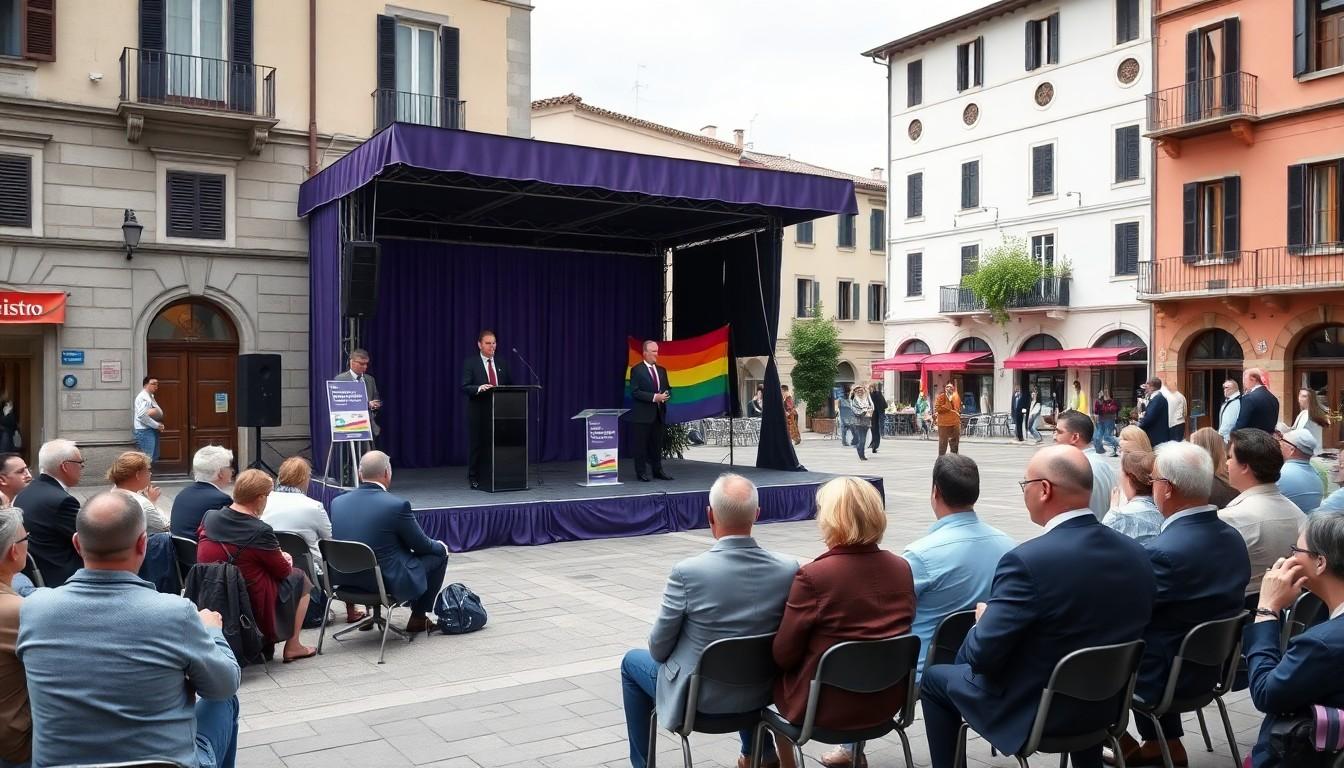
Vladimir Luxuria has reignited Italy’s political debate after kneeling at a Pride event in Verbano-Cusio-Ossola and urging the progressive alliance to unite against the right. The dramatic appeal, aimed partly at Giuseppe Conte and the Five Star Movement, has drawn sharp criticism from a senior Brothers of Italy MEP and reopened questions about Pride’s increasingly political role.
Essential Takeaways
- A theatrical appeal: Luxuria knelt on stage while calling for progressive parties to stand together.
- A direct message to Conte: She referred to the Five Star Movement’s presence and urged it not to drift away from the wider alliance.
- A fierce response: Carlo Fidanza described the moment as embarrassing and politically revealing.
- A familiar activist voice: Luxuria has spent years combining LGBTQ+ campaigning, television work and political commentary.
- The bigger issue: The episode shows how Pride events can become stages for wider battles over Italy’s political future.
A Pride speech becomes a political flashpoint
The moment was visually striking: Vladimir Luxuria on her knees on a Pride stage, appealing for unity among Italy’s progressive parties. Her message was less about symbolism than strategy, with a plea to defeat the right and avoid handing the governing bloc another term.
According to Libero Quotidiano, Luxuria addressed the so-called broad field of centre-left parties and spoke directly to Giuseppe Conte. She also referred to criticism of “woke” politics within the Five Star Movement, suggesting that internal disagreements should not break the alliance.
It was the kind of scene made for social media: emotional, instantly recognisable and open to sharply different readings. Supporters may see urgency; opponents see political theatre.
Why Carlo Fidanza’s criticism landed so sharply
Carlo Fidanza, Fratelli d’Italia’s delegation leader in the European Parliament, shared footage of the episode and attacked it as an unworthy spectacle. Il Secolo d’Italia reported the same criticism, presenting the kneeling appeal as evidence of how far the Italian left has supposedly fallen.
That reaction reflects a broader conservative tactic: treating progressive unity as both politically desperate and ideologically confused. Luxuria’s reference to Conte, the Five Star Movement and regional electoral competition gave critics plenty of material to frame the scene as a campaign intervention rather than a civic address.
But the response also shows why such moments travel so quickly. A conventional political speech can disappear into the news cycle; a kneeling plea on a Pride stage is harder to ignore.
Luxuria’s public role has always crossed boundaries
Luxuria is no newcomer to the overlap between activism, entertainment and party politics. Capital’s podcast coverage has revisited her views on Pride, institutional support and controversial questions such as surrogacy, while The Guardian previously reported on her international campaigning for gay rights during the Sochi Winter Olympics.
Her public identity is therefore unusually broad. She has been an activist, television figure, performer and politician, and audiences often bring different expectations to each role. At a Pride event, some expect celebration and visibility; others accept, or even welcome, an explicitly political message.
That tension isn't unique to Italy. Pride has long combined community, protest and electoral pressure. The argument usually begins when one side believes a political appeal strengthens the event, while another feels it narrows the space for people who came simply to be seen and supported.
What the episode says about Italy’s progressive alliance
The phrase “broad field” has become shorthand for the centre-left’s attempt to bring together parties with different histories, voters and instincts. That task is difficult enough without disputes over language, cultural issues and the limits of “woke” politics.
Luxuria’s appeal recognised that problem in public. Her message was effectively: disagree later, unite now. That may sound practical, but it also exposes the alliance’s vulnerability. If unity has to be begged for from a stage, critics will argue that the coalition lacks a convincing common purpose.
Coverage in Il Fatto Quotidiano has also shown how Luxuria’s personal story and political encounters have frequently crossed traditional party boundaries. That history helps explain why she can speak to several political audiences, even when her interventions provoke fierce opposition.
Why symbolic gestures still matter
Kneeling is a familiar gesture of supplication, protest and solidarity, so its meaning depends heavily on context. Here, it transformed a political request into a piece of visual rhetoric. The image may persuade some viewers, irritate others and leave everyone with something to discuss.
That’s the strange power of modern political communication. A short clip can flatten a complicated argument into a single gesture, while the surrounding questions about coalition-building, LGBTQ+ rights and electoral strategy become secondary.
For Luxuria, the episode reinforces a long-standing public role: direct, highly visible and unafraid of mixing social causes with political pressure. Whether that helps the progressive camp remains uncertain, but it has certainly ensured that the conversation won't remain confined to the Pride crowd.
It's a small stage moment with a much larger political echo.
Source Reference Map
Story idea inspired by: [1]
Sources by paragraph:
- Paragraph 1: [2], [3]
- Paragraph 2: [3], [4]
- Paragraph 3: [2], [3]
- Paragraph 4: [5], [6]
- Paragraph 5: [4], [5]
- Paragraph 6: [2], [3]
- Paragraph 7: [3], [7]
- Paragraph 8: [2], [4]
- Paragraph 9: [5], [6]
- Paragraph 10: [3], [4]
- Paragraph 11: [2], [3]
- Paragraph 12: [4], [7]
- Paragraph 13: [5], [6]
- Paragraph 14: [2], [3]