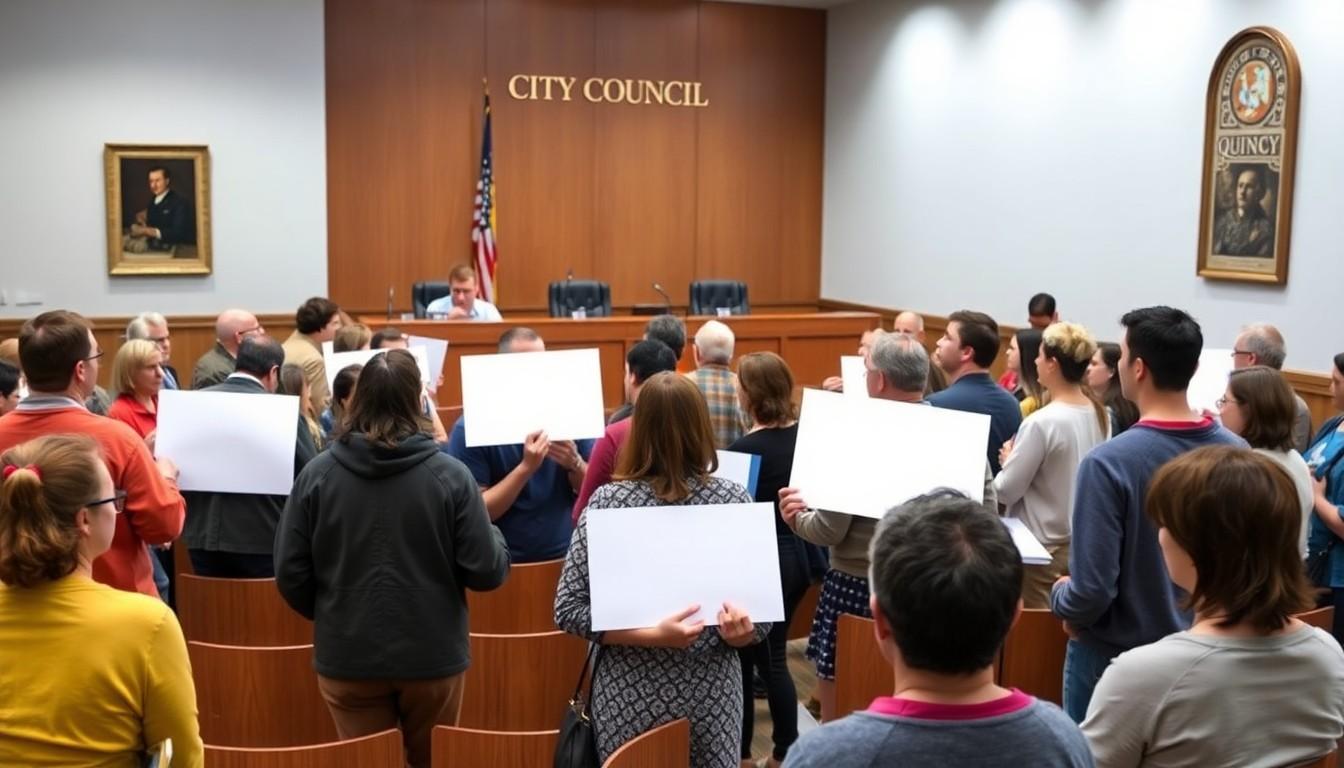
Residents packed a Quincy City Council meeting to urge individual votes on a Human Rights Commission resolution, arguing that a public record matters when community safety, religious tolerance and belonging are under discussion. The debate follows controversy over social media posts about Muslims and Islam, making the council's response a closely watched test of civic leadership.
Essential Takeaways
- A public vote was requested: Nearly 20 speakers asked aldermen to remove the resolution from the consent agenda.
- The resolution passed: The council approved it, with Jake Reed recorded as the only opposing vote among members present.
- Its message is broader than one dispute: The measure backs safety, dignity, belonging and opposition to discrimination.
- Tensions remain high: Officials have warned that threats and abusive conduct won't be tolerated.
- Community groups responded: Religious, Muslim and LGBTQ+ speakers urged dialogue rather than division.
Why residents wanted every alderman on record
The most striking moment came when an alderman asked for the resolution to be taken out of the consent agenda. Applause followed, reflecting a simple demand from the public: don't let a statement about human rights pass as routine council housekeeping.
A consent agenda is designed to speed through uncontroversial business, often using one voice vote. Here, speakers argued that the resolution deserved a clear yes-or-no decision from each participating alderman. That request turned procedure into part of the story, because residents wanted to know not only what the council approved, but who stood behind it. The Quincy City Council's official information sets out the body's role and meeting structure. (According to the City of Quincy.)
The resolution had been adopted by the city's Human Rights Commission before being forwarded to the council. The commission is an advisory body appointed by the mayor, and its stated purpose is to support a community where people can live with safety, dignity and a sense of belonging. (The City of Quincy describes the commission and its work.)
A response shaped by social media controversy
The immediate backdrop was a series of social media posts by Alderman Mike Adkins concerning Muslims and Islam, published in the weeks before the anniversary of 11 September. Critics described the posts as anti-Muslim, while Adkins rejected that characterisation and argued that his comments were protected speech.
That tension explains why the commission's measure has been interpreted in two ways. Supporters see it as a necessary statement that public leaders should avoid language that singles out groups. Opponents worry that elected officials are being pushed into repeating an approved message. Local reporting on the commission's earlier action framed the measure as an attempt to protect free expression while encouraging respectful public conduct. (WGEM reported on the Human Rights Commission's resolution.)
The Council's eventual vote gave the issue a formal outcome, but it didn't dissolve the underlying disagreement. One lesson is already clear: when online remarks spill into public life, a council statement can become a focal point for much wider arguments about responsibility, speech and trust. (WGEM reported on the council's action.)
Supporters say this is about belonging, not censorship
Human Rights Commission chair Mark Philpot said the resolution wasn't intended to censor anyone. Instead, he presented it as an opportunity for Quincy to say that hate and discrimination have no place in the community, while reminding leaders that their words can affect how vulnerable groups are treated.
That message was echoed by speakers from religious organisations, the Quincy Islamic Center and the LGBTQ+ community. A military veteran apologised to Muslim residents for hostility they had experienced, while the Islamic Center's president invited council members to visit, meet local families and share a meal. It's a notably practical invitation: less shouting online, more conversation over food.
Civil rights organisations also backed the commission's position. The Council on American-Islamic Relations' Chicago office described the resolution as a step towards accountability following the alderman's posts, while local coverage has highlighted the competing claims over free speech and community standards. (CAIR Chicago supported the resolution.)
The public response has moved beyond the council chamber
The dispute hasn't stayed inside City Hall. With debate intensifying on social media, the mayor issued two warnings about conduct and made clear that threats wouldn't be accepted. That matters because political disagreement can quickly become personal, especially when religion, identity and local representation collide.
The evening's wider calendar reflected the split mood. A Quincy Tea Party event featured William J. "Bill" Federer, whose book about Islam and the United States has been criticised for taking a polemical rather than academic approach. Elsewhere, First Christian Church planned a prayer vigil centred on care, compassion and unity.
This parallel programming is a reminder that residents aren't waiting for officials to define the conversation. Community groups are organising their own spaces, from political talks to worship and reflection. The challenge is keeping those spaces open without allowing anger to harden into intimidation. (CAIR Chicago and local reporting documented the wider public debate.)
What the vote means for Quincy
For supporters, the resolution offers a public declaration that elected leaders should help create a safe and inclusive community. For critics, it raises a familiar concern about whether civic bodies can encourage responsible speech without appearing to police opinion. Both questions are likely to remain part of Quincy's political conversation.
The next test will be less dramatic but just as important: whether the resolution leads to more listening, clearer standards and contact between groups that rarely meet outside moments of conflict. The Human Rights Commission's role is advisory, so the statement's influence will depend largely on how officials and residents use it.
A shared meal won't settle a political dispute overnight, and neither will a single vote. But, as one speaker's invitation suggested, familiarity can do some work that arguments online rarely manage. (The City of Quincy outlines the commission's advisory role, while the council's official page records the body's public function.)
A public vote has put the council's position on record. Now Quincy has to decide what it does with that record.
Source Reference Map
Story idea inspired by: [1]
Sources by paragraph: