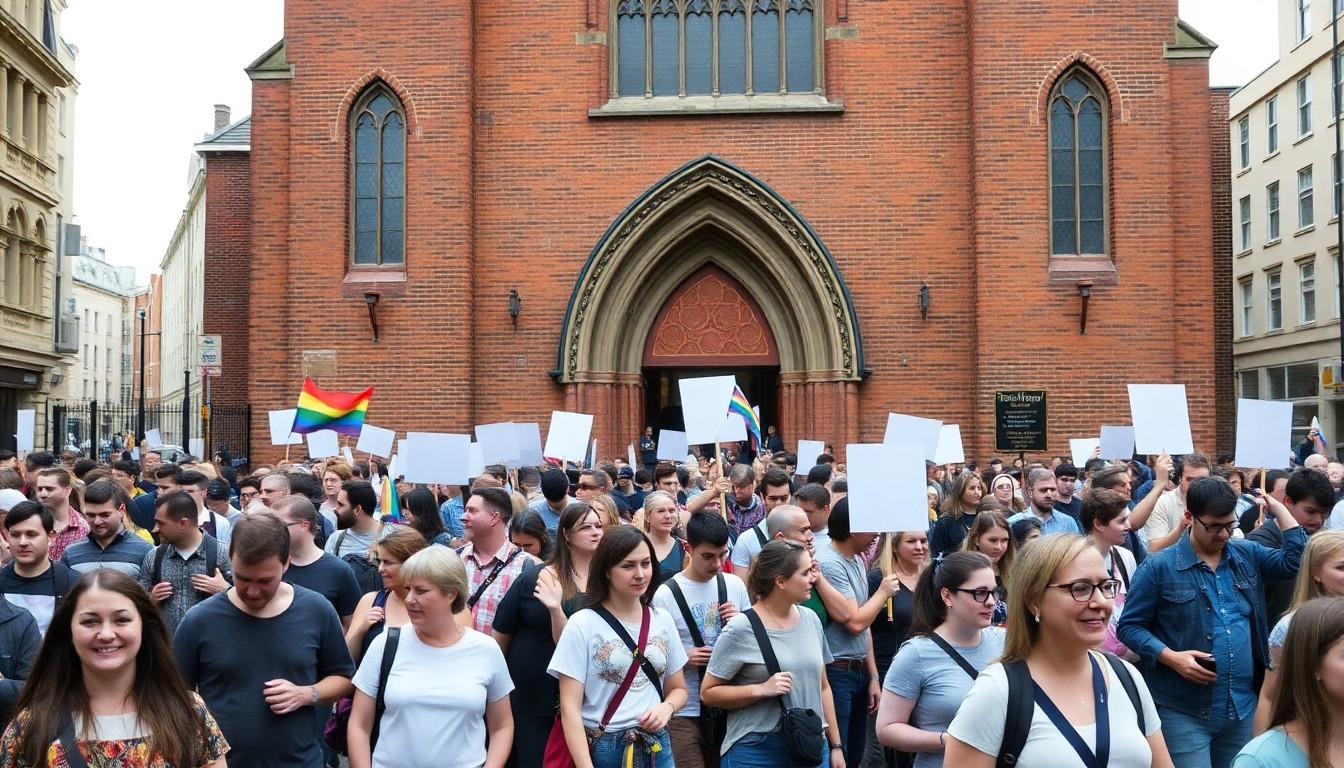
Hundreds of trans people and allies have marched through Liverpool city centre, turning a Sunday afternoon into a vivid display of solidarity. The gathering comes as campaigners warn that legal and political changes are making the UK a less welcoming place for LGBTQ+ people, giving the Liverpool trans rights march a wider national significance.
Essential Takeaways
- Hundreds gathered: Protesters met at the Bombed Out Church before walking through the city.
- A visible route: The march travelled along Bold Street and continued towards Derby Square.
- Rights remain contested: Campaigners point to legal changes affecting access to gendered spaces.
- Liverpool showed solidarity: Trans people, artists, teachers and allies stood together in public.
- The mood was determined: Speakers called for resistance and equality rather than revenge.
Liverpool takes to the streets for trans rights
The Liverpool trans rights march brought a striking burst of colour and energy to the city centre, with hundreds gathering at the Bombed Out Church before setting off. From there, the crowd moved along Bold Street and towards Derby Square, making a usually busy Sunday route feel distinctly political.
It was both protest and community gathering. People marched alongside friends, colleagues and strangers, carrying the simple but powerful message that trans people should be able to live openly and safely. According to LBC, the demonstration came during a period of growing concern about LGBTQ+ safety and rights across the UK.
For many attendees, visibility mattered as much as the speeches. A public march says that trans people aren't an abstract debate or a headline, but neighbours, workers, artists and family members.
Why the UK rights debate feels increasingly urgent
The protest took place against a difficult national backdrop. The UK's position in European LGBTQ+ rights rankings has fallen sharply from its earlier high point, with campaigners citing changes to trans protections and the treatment of gendered spaces. Novara Media reported that the country is now viewed as one of the least supportive places in Western Europe for LGBTI rights.
That shift has unsettled campaigners who once saw the UK as a regional leader. The debate has become especially heated since court and policy decisions began reshaping how organisations interpret sex, gender and access to facilities.
The result is a climate in which seemingly technical legal language can have an immediate effect on daily life. For trans people, questions about toilets, changing rooms, healthcare and employment aren't theoretical. They can determine whether ordinary situations feel safe, stressful or quietly humiliating.
Speakers call for resistance, not revenge
Teacher and DJ Billie Cashmore told the gathering that trans people must be able to define themselves rather than be reduced to hostile descriptions imposed by others. Their remarks focused on community, identity and the importance of imagining a future in which people can choose their own names and live on their own terms.
Transgender artist Mandy Romero struck a similarly determined note, acknowledging that the current period is difficult but arguing that difficulty makes solidarity more important. Romero said the people standing at the front of the struggle are also defending those who may face pressure next.
The message was notably firm without being inflammatory. As reported by the Liverpool Echo, Romero told the crowd that what was needed was resistance, not aggression or revenge. It's a distinction worth noting, particularly when peaceful demonstrations are too easily portrayed as confrontational simply because they are loud and visible.
The wider warning from campaigners
The march also reflects a broader international concern about anti-trans rhetoric and policy. The Lemkin Institute has issued warnings about what it describes as escalating anti-trans agendas, including a red-flag alert relating to the UK, as reported by PinkNews.
Those warnings are contested and politically charged, but they underline the seriousness with which some human rights organisations view the direction of travel. The institute has argued that repeated restrictions and public hostility can create conditions in which a minority is increasingly isolated and exposed.
That language helps explain why local demonstrations matter beyond their immediate route. A march in Liverpool can't rewrite national policy overnight, but it can challenge the idea that controversial measures are happening without public resistance.
What the Liverpool march says about the future
The strongest impression from the event is that the movement is not relying solely on institutions to defend trans rights. People are organising in streets, community spaces and cultural venues, often with allies who see the issue as part of a wider fight for equal treatment.
That matters because legal debates can feel remote, while a march is immediate and human. You see the faces, hear the chants and notice the small acts of support between strangers. For attendees, that shared presence may be the most reassuring part of all.
Liverpool's demonstration won't settle the UK's argument over trans rights, but it has made one thing clear: opposition to roll-backs is organised, visible and still marching forward.
A determined crowd can turn solidarity into something the whole city can see.
Source Reference Map
Story idea inspired by: [1]
Sources by paragraph: