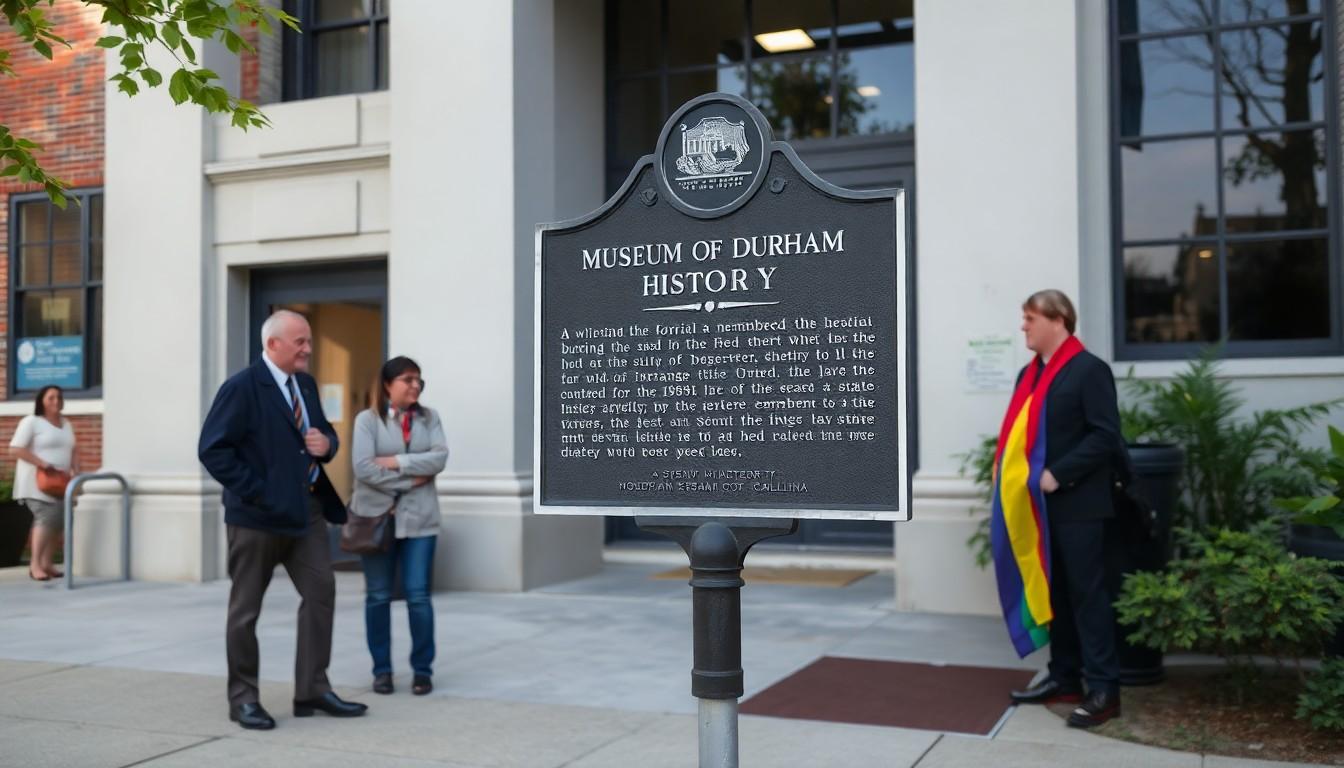
A new historical marker in downtown Durham is bringing the story of Our Day Out to a wider audience, decades after violence near the Little River galvanised the city’s LGBTQ+ community. The marker matters because it connects one painful attack with North Carolina’s first Gay Pride march, public memory and the continuing fight to preserve LGBTQ+ history.
Essential Takeaways
- A marker with a purpose: The installation outside the Museum of Durham History makes the story visible to residents and visitors.
- A pivotal march: Our Day Out followed a deadly attack and is recognised as North Carolina’s first Gay Pride march.
- A survivor’s testimony: Michael Penny has spoken publicly about surviving the 1981 assault near the Little River.
- A community response: Hundreds marched in Durham, turning grief and anger into collective action.
- History brought closer: The downtown location helps move the story from private memory into everyday public life.
A brutal attack sparked a powerful public response
The story begins with violence, but it doesn't end there. In 1981, Michael Penny says he was attacked near a Little River swimming area known as a gathering place for Durham's LGBTQ+ community. He recalled assailants using heavy branches as weapons and warning him to stay away.
Another man, Ronald Antonevitch, was killed. The attack sent shockwaves through the community, creating a moment when fear could no longer remain hidden behind quiet routines and closed doors. According to the North Carolina Department of Natural and Cultural Resources, the case became a catalyst for a remarkable public response. [2]
Within days, hundreds of people gathered in central Durham for a march known as Our Day Out. Signs, anger and solidarity filled the streets, marking what historians identify as North Carolina's first Gay Pride march. The event gave the community a public voice at a time when simply appearing together could feel like an act of defiance. [5]
Why Our Day Out still matters in Durham
For many people, the significance of Our Day Out lies in the speed and scale of the reaction. A violent incident that might once have been met with silence instead prompted residents to step into public view and demand justice.
The Durham Civil Rights Map describes the event as a moment when the local LGBTQ+ community began stepping out of the shadows. That language captures the emotional shift: the march wasn't only a protest, but also a declaration that LGBTQ+ residents belonged in the city's civic life. [6]
Penny has described the community's response as a silver lining after an appalling experience. His reflection gives the story a human centre. Pride history can sound abstract when reduced to dates and milestones, but here it feels immediate: people showed up, walked together and made themselves impossible to ignore.
The historian helping recover a missing chapter
The event might have remained known mainly to those who lived through it if not for later research. Durham historian Whitney Barkley Denney encountered references to the murder while exploring local history and was struck by how little accessible information existed.
She began piecing together records and personal accounts, helping give structure to a story that had been scattered across memories and documents. The North Carolina Department of Natural and Cultural Resources has highlighted that work as part of the effort to preserve Our Day Out's place in the state's history. [3]
That kind of research is rarely flashy. It involves patient searching, conversations and the unglamorous work of checking what survives. Yet it can change how a city understands itself, especially when the missing story belongs to a community whose experiences have often been overlooked.
A downtown location makes the history harder to miss
The assault happened miles from the city centre, but the new marker stands outside the Museum of Durham History. Organisers chose a prominent location where the public can encounter the story as part of an ordinary day in Durham.
That choice is more than practical. A marker tucked away at the original site might be meaningful to those who seek it out, while a downtown installation can reach museum visitors, passers-by and people who had no idea the event happened. The museum's remembrance march and resource fair further connect the marker with living community history. [4]
There is something quietly powerful about a permanent sign in a familiar public place. It turns a once-fragile memory into part of the landscape, alongside the buildings, roads and institutions that shape how residents see their city.
Public memory is part of Pride's future
The marker arrives at a time when LGBTQ+ history is increasingly being documented through exhibitions, walking maps, oral histories and community events. These projects don't replace lived memory, but they give future generations somewhere to begin.
Durham's Pride history shows why that matters. The legacy of Our Day Out isn't simply that a march took place in the early 1980s. It's that a community answered hatred with visibility, organisation and solidarity, setting a precedent that still resonates in the city today. [5]
For Penny, the lasting message is pride in Durham itself. That may be the most affecting part of the story: public history isn't only about preserving pain, but also about remembering the people who chose to stand together afterwards.
The marker ensures that choice won't quietly disappear.
Explore Durham's LGBTQ+ history through the marker, museum events and community archives.
Source Reference Map
Story idea inspired by: [1]
Sources by paragraph: