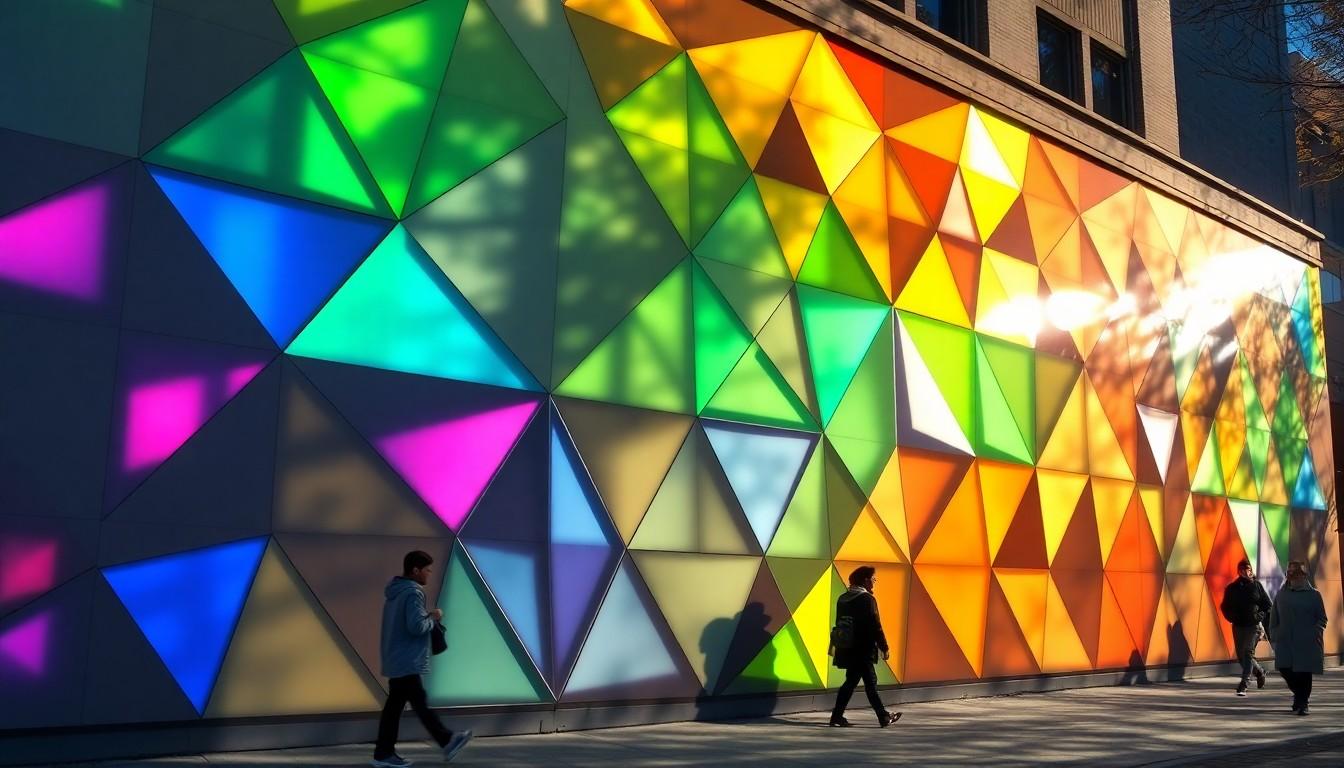
Visitors to Toronto's Church-Wellesley Village can now look up to find shifting colour, light and symbolism on The 519's facade. Created by queer architectural designer Simon Liao, Prismatic Futurity is a permanent public artwork that connects LGBTQ+ history with a more hopeful vision of the future, during and beyond Nuit Blanche.
Essential Takeaways
- Permanent installation: The artwork remains on The 519's exterior after its Nuit Blanche unveiling.
- Light in motion: Triangular prisms and pyramids scatter changing colours across the building, pavement and passers-by.
- History with a forward view: The triangle recalls the pink triangle's painful past and its later reclamation as a symbol of resistance.
- A personal commission: Liao once lived nearby and found support through The 519's programmes.
- Made for everyone: Its changing reflections invite anyone to pause, regardless of whether they're part of Toronto's queer community.
A new reason to look up in the Village
The strongest feature of Prismatic Futurity is also the simplest: it changes. Sunlight moves, reflections slide, and the facade can appear different from one moment to the next, giving the artwork an almost quietly animated quality.
The installation uses a series of triangular prisms and pyramids fixed to The 519's exterior. As light catches their surfaces, colour spills onto the building, pavement and people walking past, making the street itself part of the work. Destination Toronto lists Nuit Blanche among the city's major annual cultural events, and this addition gives visitors a striking landmark to seek out. [5]
That immediacy matters. You don't need a gallery ticket, specialist knowledge or even much time; a glance upwards can be enough. On a busy Church Street, a small burst of rainbow light is a welcome interruption. [2]
The triangle carries a complicated history
Liao's design starts with the triangle, a shape with deep and difficult associations in LGBTQ+ history. The pink triangle was used by the Nazis to identify gay men in concentration camps, before activists reclaimed it decades later as a symbol of liberation, solidarity and resistance during the AIDS crisis. [2]
The artwork doesn't flatten that history into a cheerful visual motif. Instead, it holds memory and optimism together. The angular forms suggest remembrance, while the refracted colours introduce movement and possibility, allowing the work to acknowledge what came before without treating the future as predetermined. [2]
That balance gives the installation more weight than a conventional rainbow display. It looks bright and inviting, but its geometry asks viewers to notice the story beneath the surface. In other words, the colour is doing emotional work, not merely decorative work. [2]
Why Prismatic Futurity feels personal
For Liao, The 519 isn't an arbitrary site. After moving to Toronto, he lived in Church-Wellesley Village and used the community centre's programming while building a new life in Canada. Workshops, consultations and a self-defence class helped him make connections in a place that felt markedly different from his previous homes. [2]
That background gives the commission a generous, almost circular quality. An organisation that once offered Liao a sense of belonging is now carrying his work on its walls, where it can welcome others. The 519 has described the project as part of its anniversary reflection on the past, present and future of 2SLGBTQ+ communities. [2]
There's also something moving about the fact that Liao entered the competition as an architect rather than a traditionally trained visual artist. The result feels shaped by space and people as much as by sculpture, designed to meet the public where it is rather than wait behind a gallery door. [2]
A permanent artwork with a Nuit Blanche beginning
Prismatic Futurity was introduced through Nuit Blanche, Toronto's all-night celebration of contemporary art. The city's anniversary edition featured new commissions alongside returning works, placing Liao's installation within a broader programme of public art spread across the urban landscape. [3]
That launch setting suits the piece. At night, lighting can make the prisms and pyramids glow with a more theatrical atmosphere, while daylight reveals the natural shifts that keep the work changing. It offers two experiences: a planned cultural destination after dark and an everyday discovery for neighbours afterwards. [3]
Toronto's Nuit Blanche has long made the city itself part of the exhibition, with streets, civic buildings and public spaces turned into temporary stages for art. A permanent work at The 519 extends that idea beyond one night, leaving behind a colourful marker in a neighbourhood already rich with community history. [4]
How to experience the installation
The best approach is to see Prismatic Futurity more than once, if you can. Visit in daylight for the clearest sense of sunlight moving through the forms, then return after dark when artificial lighting changes the mood and makes the facade feel more theatrical. [2]
Stand at different points along the pavement rather than directly in front of the building. Because the reflections shift with angle, weather and time, the view beside the installation may be more surprising than the obvious one. Your phone camera might capture a colourful flare, but the effect is likely to feel better in person.
If you're planning a wider art walk, check the official Nuit Blanche listings before setting off, as the programme and locations can change between editions. The 519 also offers a natural pause between installations, whether you're visiting alone, with friends or as part of a late-night city wander. [4]
A brighter future, built into the street
The work's most appealing idea is that hope doesn't have to arrive as a grand announcement. It can be a reflection on the pavement, a familiar building catching the sun or a passer-by suddenly smiling at something unexpected.
That makes Prismatic Futurity particularly well suited to The 519. It honours queer history without becoming trapped in it, and it gives the Village a visual reminder that community spaces can hold memory while still pointing forwards. Toronto's public-art programme continues to make room for works that ask people not just to observe, but to imagine. [6]
For Liao, the hope is that someone having an ordinary, difficult day notices the colours and carries a slightly lighter feeling down the street. That's a modest ambition, perhaps, but public art often works best in precisely that intimate register.
It's a small burst of light with a long memory and an open-ended future.
Source Reference Map
Story idea inspired by: [1]
Sources by paragraph:
- Paragraph 1: [2], [5]
- Paragraph 2: [2]
- Paragraph 3: [2], [5]
- Paragraph 4: [2]
- Paragraph 5: [2]
- Paragraph 6: [2]
- Paragraph 7: [2]
- Paragraph 8: [2]
- Paragraph 9: [2]
- Paragraph 10: [3]
- Paragraph 11: [3]
- Paragraph 12: [4]
- Paragraph 13: [2]
- Paragraph 14: [4]
- Paragraph 15: [6]
- Paragraph 16: [6]
- Paragraph 17: [2]