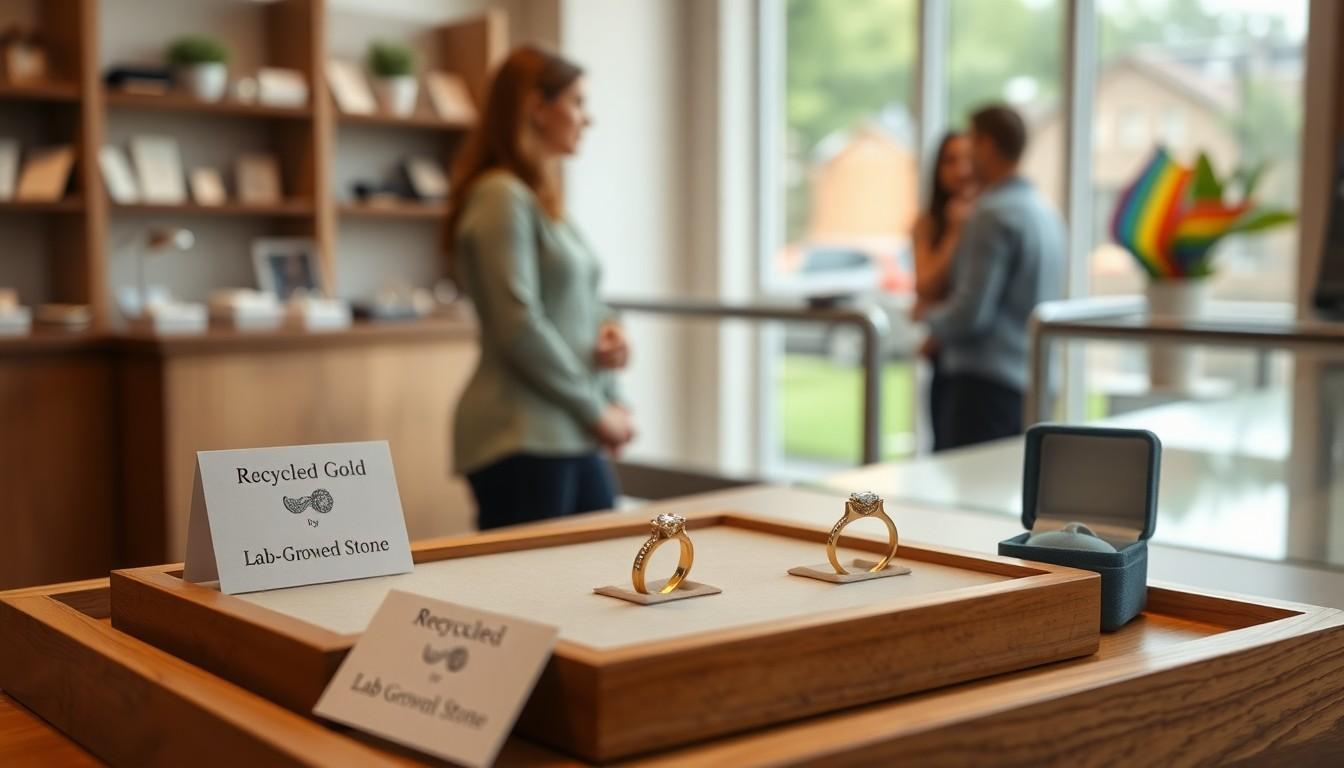
Couples are choosing lesbian engagement rings on their own terms, from double proposals and matching bands to colourful sapphires, moissanite and redesigned family gold. The result is more personal than traditional ring shopping, but it also raises practical questions about sizing, ethics, budgets and everyday wear.
The best ring choice starts with one conversation
There’s no standard script for who proposes, who buys the ring or whether both partners wear one. Some couples plan a double proposal, while others shop together and keep the question itself as the surprise.
That flexibility is part of the charm. One partner might choose a classic solitaire, while the other prefers a signet, a wide gold band or no engagement ring at all. The key is discussing expectations before anyone quietly spends thousands of pounds.
If you’re planning a surprise, think beyond the ring. Find out whether your partner actually wants an engagement ring, which finger they’d wear it on and whether their work makes a high setting impractical. A jeweller can measure accurately, which is far safer than relying on string or a guess.
Matching rings are optional, not the goal
Identical rings can look beautifully united, but they’re far from the only way to create a pair. Matching metal, a shared gemstone, a repeated engraving or a subtle motif can connect two very different designs.
This is useful when one partner likes sparkle and the other prefers something sleek. Both rings could be made in yellow gold, for instance, with one featuring a stone and the other staying deliberately plain. The result feels coordinated without looking like a two-for-one set.
Ready-made collections can help couples compare shapes and settings quickly, while custom jewellers offer more room for personal details. Industry guides from The Local Jewel note that custom work can provide a more distinctive result, although it usually requires extra time and planning.
Ethical sourcing needs more than a reassuring label
“Conflict-free” sounds comforting, but it doesn’t answer every question about mining, labour or environmental impact. The Diamond Guys’ guide to ethical engagement rings recommends looking beyond basic terminology and asking where metals and gemstones actually come from.
Recycled gold is one option because it uses existing material rather than requiring new mining. Fairmined gold offers another route, with certification focused on responsible small-scale mining. Couples can also ask whether a jeweller works with traceable stones, recycled metals or lab-grown diamonds.
Family jewellery may be the most meaningful material of all. Yellow gold generally remelts well, and an inherited ring can sometimes be transformed into two connected designs. That approach saves resources, though a jeweller should inspect the metal and stones first, particularly if the piece includes white gold, platinum or delicate settings.
Moissanite, sapphire or diamond? Look beyond sparkle
Lab-grown diamonds have the same crystal structure as mined diamonds and rank 10 on the Mohs hardness scale, making them suitable for regular wear. They can also cost considerably less, which may free up money for a more intricate setting or a second ring.
Moissanite is another popular choice, with a hardness of 9.25 and a lively, rainbow-like flash. Sapphires offer a wider colour palette, from deep blue to pink, yellow, teal and soft peach, while salt-and-pepper diamonds bring a more smoky, individual look.
Stone Theory and Adiamonds both highlight the importance of matching a setting to how the wearer lives. Someone who works with their hands, cooks constantly or spends weekends climbing may be happier with a low-profile bezel setting than tall claws. A beautiful ring is still a daily object, so comfort and durability matter just as much as the photograph.
Custom rings make room for the story
Custom design doesn’t have to begin with a perfect sketch. Bring a few images, a rough budget and details about the wearer’s taste, work and habits. A good jeweller can turn those fragments into a practical design rather than simply reproducing a picture from Pinterest.
Expect a consultation, a design stage, a deposit and a production period. Custom work can take twelve weeks or more, according to guidance from The Local Jewel, while remodelling an existing piece may be faster. Build in time for resizing, valuation and insurance, especially if the proposal date is fixed.
Personal symbolism can be wonderfully understated. A shared landscape, a pet, an inside joke or a family stone might appear inside the band rather than across the top. That’s often where the most powerful details live, quietly waiting for the wearer to notice them.
Set one budget for two rings
The old salary-based rule is best ignored. Instead, decide what you can comfortably spend on everything, including two engagement rings, wedding bands, engraving, resizing, valuation and insurance.
A shared budget can work well, but agree how it’ll be divided before choosing stones. Otherwise, one ring can accidentally absorb most of the money while the second becomes an afterthought. Ready-made rings may keep costs predictable, while custom work, unusual settings and larger stones can raise the total.
To stretch the budget, consider 14-carat or 9-carat gold, a smaller centre stone, moissanite, a colourful sapphire or a family ring that can be redesigned. The most important upgrade isn’t always a bigger gemstone. Sometimes it’s a setting that feels unmistakably like the person wearing it.
Choose the ring story that feels like yours, whether that means one ring, two or something entirely unexpected.
Source Reference Map
Story idea inspired by: [1]
Sources by paragraph:
- Paragraph 1: [2], [4]
- Paragraph 2: [5], [6]
- Paragraph 3: [7], [4]
- Paragraph 4: [2], [3]
- Paragraph 5: [4], [5]
- Paragraph 6: [6], [7]
- Paragraph 7: [2], [4]
- Paragraph 8: [5], [7]
- Paragraph 9: [3], [4]
- Paragraph 10: [2], [6]
- Paragraph 11: [5], [7]
- Paragraph 12: [3], [4]
- Paragraph 13: [2], [5]
- Paragraph 14: [4], [7]
- Paragraph 15: [3], [6]