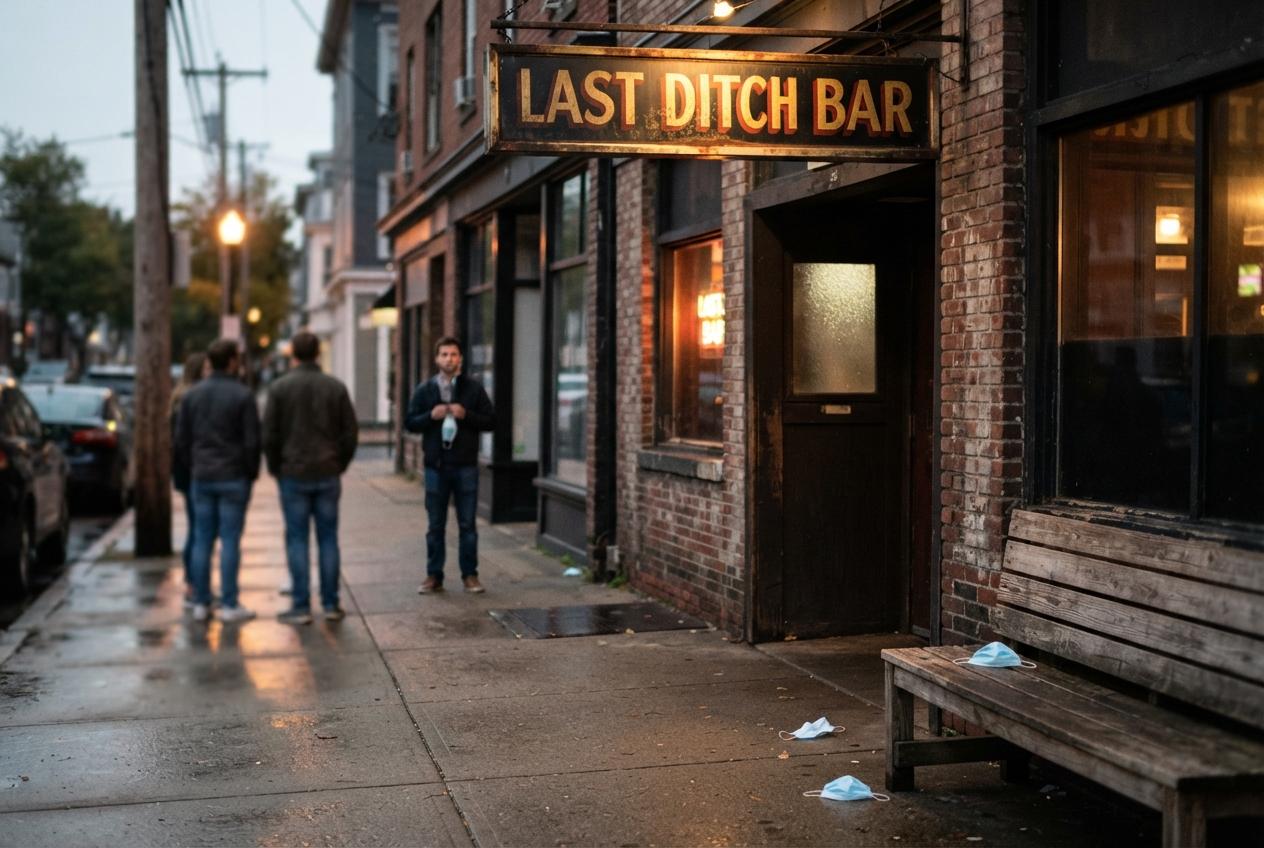
A Massachusetts lesbian bar’s decision to make Saturday nights mask-optional has sparked fierce debate about disability access, financial survival and the fragile future of queer venues. What began as a local attempt to attract more customers quickly became an international online spectacle, complete with memes, backlash and questions about who gets to feel safe on a night out.
Essential Takeaways
- A safety-first venue: Last Ditch Bar opened with mask requirements designed to support immunocompromised and COVID-conscious patrons.
- A difficult business choice: The bar later introduced mask-optional Saturdays in an effort to bring in more customers and protect its finances.
- Accessibility became part of the dispute: Critics objected not only to the policy change but also to the way the announcement and apology were presented.
- The argument travelled fast: Coverage by major publications sent interest soaring well beyond Greenfield, with online debate spreading internationally.
- The bigger issue: The controversy reflects wider tensions around shrinking lesbian venues and the limited nightlife options available to disabled queer people.
A small bar made a very big promise
Last Ditch Bar opened in Greenfield, Massachusetts, with an unusually clear proposition: queer nightlife could be welcoming to people who needed strong protection from COVID. Patrons were expected to wear a well-fitting KN95 respirator or better, creating an environment that felt deliberately different from the average crowded club.
That distinction mattered. For immunocompromised and chronically ill people, going out often involves weighing social connection against health risks. A venue where masking was the norm offered something rare: the chance to relax without constantly wondering whether the person beside you was infectious. The Atlantic explored how that promise shaped the bar’s identity and the expectations surrounding it.
But a principled model still has to pay the rent. As attendance and organisational pressures became difficult, the venue faced the familiar problem confronting many independent queer spaces: the community may value a place deeply without visiting often enough to keep it open. That tension is uncomfortable, but it’s hardly unique to Last Ditch.
Why mask-optional Saturdays caused such a backlash
The flashpoint came when the bar announced that Saturday nights would become mask-optional, while masked bookings would remain a priority and a regular masked social would continue. The intention appeared to be practical. The wording, however, struck many disabled patrons as too breezy for a change that could affect whether they felt able to attend at all.
That difference between intention and impact is where the argument caught fire. Supporters saw a struggling venue trying to broaden its audience. Critics saw a space that had specifically welcomed disabled people quietly narrowing their access to its busiest night. The Boston Globe’s reporting brought those competing interpretations to a much larger audience.
The controversy also showed how easily accessibility can become reduced to a single rule. A mask requirement may be central, but so are clear communication, reliable information, online access and a sense that disabled patrons are being consulted rather than managed. When an apology appeared as an image without alternative text, frustration deepened. For someone using a screen reader, even a well-meant statement can become inaccessible at the moment it matters most.
Financial survival and disability access collided
The later community meeting made the situation more emotionally charged. Reports described the venue’s financial strain, including a substantial business loan and the owner’s precarious personal circumstances. Those details encouraged sympathy, but they didn’t erase the concerns raised by people who feared losing one of the few spaces where they could safely participate.
That’s the bind facing many community venues. A bar can’t serve anyone if it closes, yet survival strategies can undermine the very people who made its mission distinctive. The Daily Beast treated the episode as a remarkable piece of internet-era drama, but underneath the spectacle was a serious question: what does inclusion mean when the business model can’t support every access need every night?
The meeting also exposed other fractures, including arguments about race, power and how criticism was handled. Last Ditch later defended performer and patron Soe Noire after he reportedly faced threats, slurs and online harassment. Whatever someone thought of the dispute, racist abuse was never a legitimate extension of a disagreement about venue policy.
From local disagreement to internet spectacle
Once major media coverage appeared, the argument escaped its original context. TMZ and other outlets helped amplify the story, while Know Your Meme documented the memes and online shorthand that turned a complicated dispute into easily shareable content.
That transformation is familiar. Social platforms reward the sharpest version of an argument, not the most complete one. A difficult discussion about public health, access and business survival becomes a punchline, then a culture-war prop, then evidence supposedly proving that an entire community is unreasonable. The New Boston Post’s coverage reflected how quickly the dispute was being framed for audiences beyond the bar’s local queer scene.
Search interest surged after the coverage, reaching far beyond Massachusetts. People in the US, Canada, Ireland, Australia and the UK began looking up the venue and its controversy. Some were drawn by the absurdity of the online drama; others recognised a familiar story about queer spaces disappearing, changing shape or becoming inaccessible to people who need them most.
What the Last Ditch controversy says about queer nightlife
Dedicated lesbian bars have long faced financial pressure, rising costs and changing nightlife habits. In many places, permanent venues have been replaced by occasional lesbian nights, pop-ups or events hosted inside broader LGBTQ+ spaces. That can create more flexibility, but it also makes community access less predictable.
For disabled queer people, the loss is sharper. If a venue closes or drops its safety measures, the alternatives may be limited, expensive or simply unavailable. A night out that looks casual to one person can involve masks, transport planning, medication, fatigue management and the risk of several weeks of illness for another.
There’s no neat answer here. Venues need enough customers to survive, while patrons need policies they can trust. The most constructive path is likely to involve earlier consultation, accessible communication, transparent finances and clearly separated events, rather than treating disabled access as an afterthought. As the Boston Globe’s video coverage showed, this was never just an argument about one Saturday night. It was a test of whether queer nightlife can remain both viable and genuinely welcoming.
The reported interest in turning the story into a documentary or scripted project adds another layer of strangeness. It may sound entertaining, but any adaptation would need to remember that the people involved aren’t fictional characters. For them, the consequences were financial, personal and painfully real.
It's a small venue story with a much bigger question behind it: who gets to belong in queer nightlife?
Source Reference Map
Story idea inspired by: [1]
Sources by paragraph:
- Paragraph 1: [2], [6]
- Paragraph 2: [2], [6]
- Paragraph 3: [5], [7]
- Paragraph 4: [4], [6]
- Paragraph 5: [2], [7]
- Paragraph 6: [3], [6]
- Paragraph 7: [5], [7]
- Paragraph 8: [4], [5]
- Paragraph 9: [6], [7]
- Paragraph 10: [2], [6]
- Paragraph 11: [3], [4]
- Paragraph 12: [5], [7]
- Paragraph 13: [2], [6]
- Paragraph 14: [3], [7]
- Paragraph 15: [4], [6]