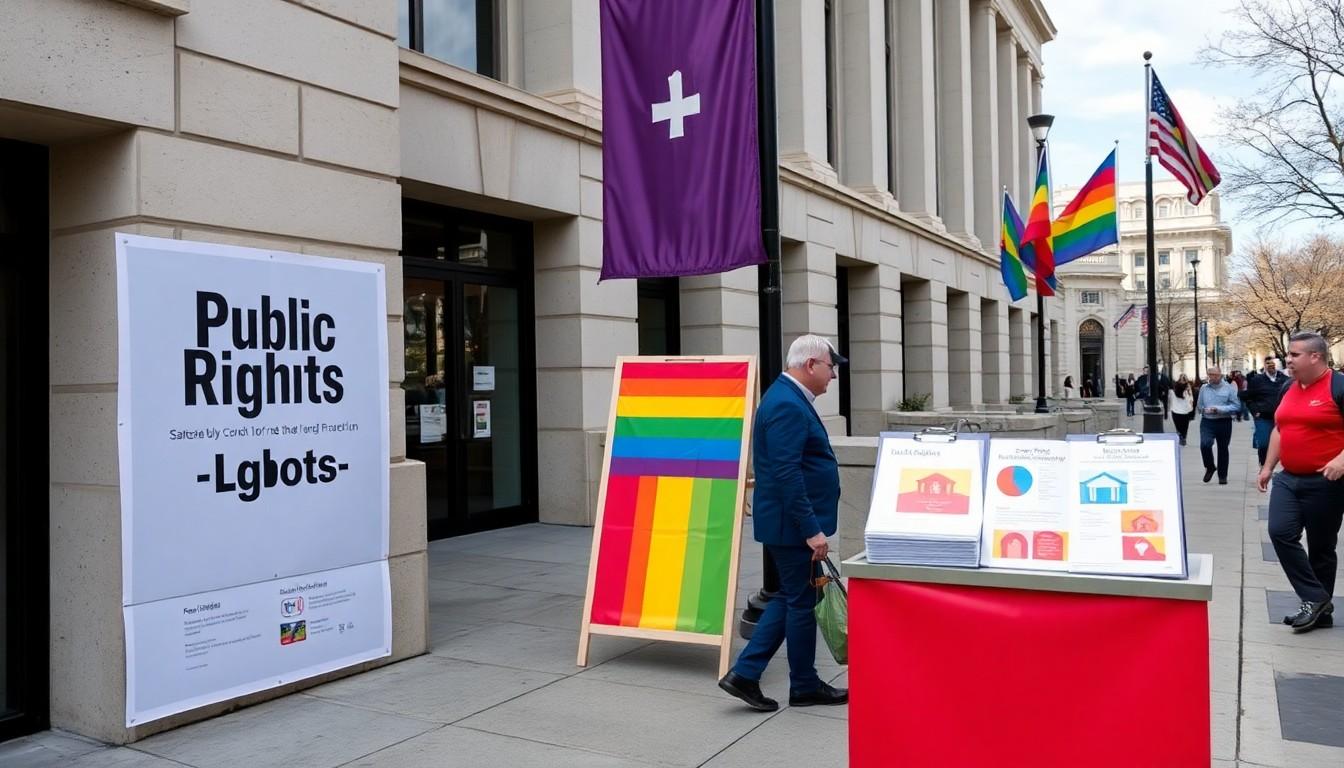
Advocates are shifting from defending hard-won protections to imagining what full LGBTQ+ equality could look like, with Lambda Legal preparing a new Bill of Rights for LGBTQ+ people across the United States. The campaign matters because it combines legal action, state policy and public storytelling at a moment when federal routes to justice feel increasingly uncertain.
Essential Takeaways
- A new direction: Lambda Legal is pairing courtroom challenges with a more ambitious policy campaign.
- Five central priorities: The framework focuses on health, education, opportunity, family and democracy.
- State-by-state strategy: Initial work will target 20 states considered more supportive of LGBTQ+ equality.
- Practical focus: Healthcare, schools, economic access and family recognition all feature prominently.
- Beyond legislation: Personal stories and public education will help turn legal rights into everyday belonging.
Equality needs a forward plan, not just a defence
For years, LGBTQ+ organisations have been forced into a defensive crouch, responding to restrictions, funding threats and legal challenges. Lambda Legal's new campaign is intended to change that rhythm, offering a clearer picture of what equality should deliver in daily life rather than simply which protections must be preserved.
The organisation's five-year strategy, Rising Together, places the proposed Bill of Rights within a wider programme of litigation, policy work and public engagement. Lambda Legal describes that plan as a way to connect its legal expertise with longer-term change. Its own strategic materials also emphasise collaboration and sustained organising, rather than relying on isolated courtroom victories. [2]
That distinction matters. A favourable judgment can remove a barrier, but it doesn't automatically make a clinic feel welcoming, a school feel safe or a family feel recognised. The new framework is designed to address that gap.
Five priorities bring the idea down to earth
The proposed agenda is built around health, education, opportunity, family and democracy. Those headings may sound broad, but they point to recognisable experiences: finding competent healthcare, learning without harassment, earning a decent living and being treated as part of the community rather than an exception.
Healthcare is one of the most immediate priorities. Lambda Legal's work in this area covers access to care, discrimination and the needs of LGBTQ+ people and those living with HIV. Its healthcare resources underline how policy decisions can shape everything from insurance access to the quality of treatment received in a consulting room. [4]
Education is similarly practical. Lambda Legal's student-rights work focuses on protections for LGBTQ+ pupils and students, including fair treatment and safer learning environments. [5] For a young person, that can mean the difference between concentrating on lessons and spending the day scanning the room for danger.
Why states are becoming the main battleground
Lambda Legal plans to begin with 20 states whose political leadership is broadly supportive of LGBTQ+ equality. The approach reflects a familiar pattern in American civil rights history: build durable protections locally, test workable policies and allow successful ideas to travel.
That strategy is especially significant as federal politics becomes more volatile. State legislatures, agencies and local institutions can sometimes move faster than Congress, while state laws can provide a more stable foundation for people whose rights may be contested nationally.
Lambda Legal's policy programme covers legislative and administrative work alongside litigation, giving the organisation tools to pursue change outside the courts. [6] It isn't quite as dramatic as a landmark Supreme Court ruling, perhaps, but a well-written state policy can make a surprisingly large difference to someone's Tuesday morning.
The campaign is also about changing the story
Legal protections matter, but public understanding helps determine whether those protections are respected in practice. That's why Lambda Legal is pairing policy work with videos, educational materials and personal accounts, including stories about transgender young people and their parents.
Its history shows a long tradition of combining legal action with movement-building. Lambda Legal has worked across generations of LGBTQ+ rights campaigns, adapting its priorities as the political and social landscape has changed. [3] The new Bill of Rights draws on that history while trying to make the next phase feel less reactive.
Personal storytelling can be particularly powerful when debates become abstract. A family describing support, worry and ordinary affection can reach people who might switch off when faced with another political argument. It puts a human face on what is otherwise reduced to slogans and soundbites.
What success would feel like in everyday life
The most compelling test of the proposal won't be how impressive it looks on paper. It will be whether LGBTQ+ people can access care without bracing for judgement, attend school without hiding, build families without legal uncertainty and participate in public life without being treated as a problem to manage.
Lambda Legal's public policy work reflects that wider ambition, linking legal rights with democratic participation and institutional accountability. [6] Its resources on healthcare and students' rights likewise show how equality is experienced through systems that people use every day, not just through major constitutional cases. [4] [5]
That makes the campaign both ambitious and grounded. The organisation is still prepared to litigate, but it wants the destination to be visible as well as the threat. After years of defending the progress already made, many LGBTQ+ people may welcome a plan that asks not only how to hold the line, but what a genuinely inclusive future should feel like.
It's a small shift in language, but a significant one: from surviving setbacks to building belonging.
Source Reference Map
Story idea inspired by: [1]
Sources by paragraph: