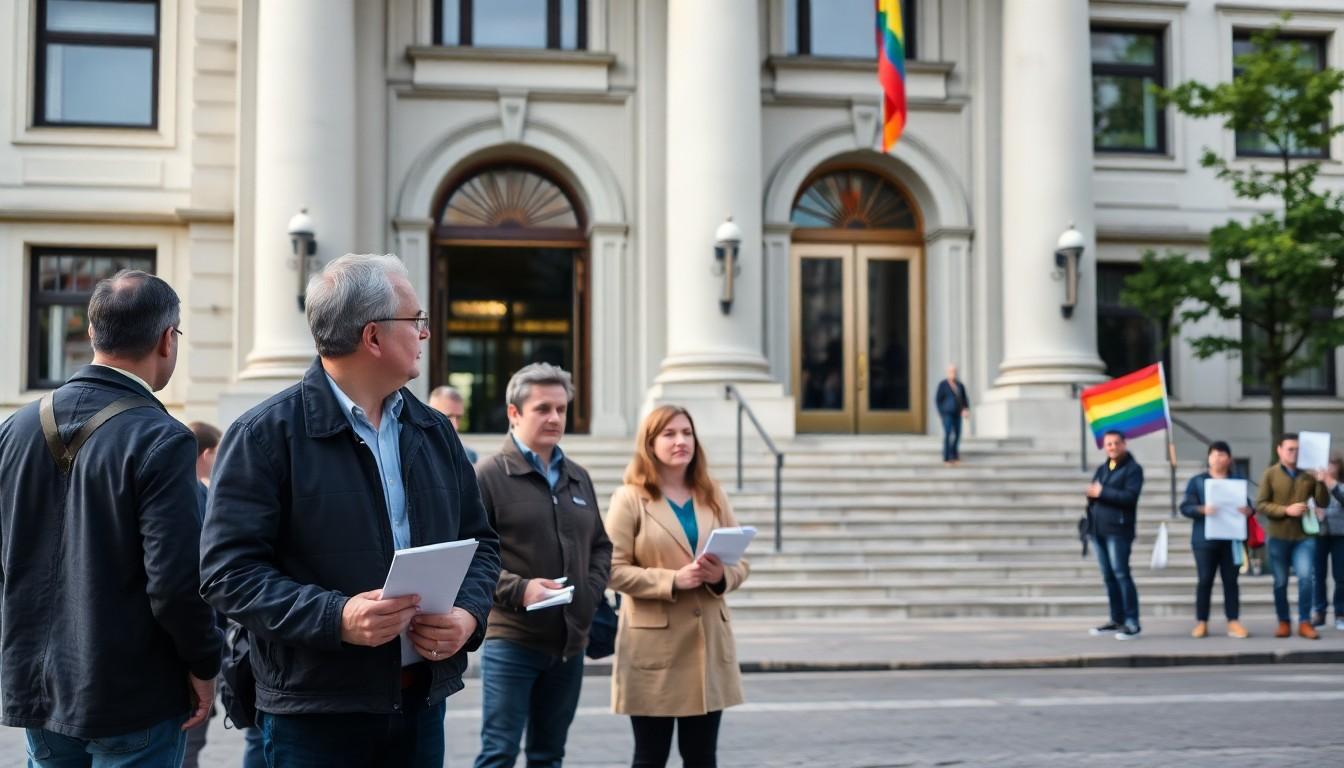
Campaigners in Hungary are urging parliament to restore legal gender recognition, as thousands support a petition calling for clearer, faster access to updated identity documents. The issue matters far beyond paperwork: campaigners say mismatched records can make everyday moments, from a bank visit to an airport check, stressful and exposing.
Essential Takeaways
- A growing petition: More than 2,800 people have backed Háttér Society’s campaign, which is aiming for 3,333 signatures.
- Section 33 remains central: The 2020 measure replaced the registered sex category with “sex at birth” and made it unchangeable.
- Daily obstacles: Campaigners highlight difficulties with identity checks, healthcare, work, education, banking and travel.
- European pressure continues: European institutions have repeatedly called for an accessible legal gender recognition process.
- Reform remains incomplete: Hungary’s newer government has changed some LGBT-related policies but hasn’t yet amended Section 33.
A petition built around real-life paperwork problems
The campaign’s strongest message is also its most human. Háttér Society has published 33 personal accounts over 33 days, linking each story to Section 33 and showing how a single line on an identity document can follow someone everywhere.
According to Háttér Society, people have described awkward or distressing encounters when their appearance doesn’t match the sex or name recorded on official documents. A document check that should be routine can instead become an unwanted explanation, whether it happens at a university desk, a clinic or an airport gate.
The petition calls for a procedure that’s quick, transparent and accessible. That may sound like a modest request, but for transgender people living with outdated documents, it could make ordinary administration feel ordinary again.
What Hungary’s Section 33 changed
Section 33 was introduced in 2020 as part of amendments to Hungary’s civil registration system. It established “sex at birth” as the relevant recorded category, based on biological characteristics, and stated that the information couldn’t later be changed.
Amnesty International said the measure effectively blocked transgender people from obtaining identity documents that reflect their gender. The organisation also warned that the resulting mismatch could affect privacy, dignity and access to services.
The government’s argument has been consistent: biological sex is an objective fact and the civil register should record that fact rather than an individual’s gender identity. Critics, however, say the policy turns a contested political principle into a practical barrier encountered in everyday life.
European courts and institutions keep up the pressure
Hungary’s approach has faced criticism well beyond domestic campaign groups. European human rights bodies have found that the absence of a workable legal gender recognition process can interfere with a person’s right to private life.
The Council of Europe has also stressed that legal recognition procedures should be available without unnecessary delay and should allow people to amend relevant names and gender markers in official records. Its broader guidance on legal gender recognition has encouraged states to create procedures that are clear, fair and respectful of human rights.
For campaigners, this makes the Hungarian dispute more than a national argument about terminology. It’s also about whether official systems can accommodate people’s lived identities without forcing them into repeated disclosures.
Hungary’s wider LGBT policy shift leaves one major gap
The country’s political direction has begun to change in some areas. Proposed reforms have sought to remove explicit references to homosexuality and gender reassignment from certain restrictions affecting education, advertising and media, while replacing them with broader rules focused on potential harm.
There have also been signs of a softer approach to adoption rules affecting people in same-sex relationships. Yet Section 33 has so far remained outside those changes, leaving legal gender recognition as a conspicuous gap in the reform agenda.
That gap matters because revising media or education rules won’t solve the immediate problem of an identity card that contradicts the person holding it. As Amnesty and other rights groups have argued, recognition is not simply symbolic; it can shape access to healthcare, employment and public services.
What could happen next?
The petition gives Háttér Society a visible measure of public support, but signatures alone won’t rewrite the civil register. The next test will be whether Hungary’s government treats legal gender recognition as part of its broader policy reset, rather than as an issue it can continue to postpone.
The practical question is straightforward: can people obtain documents that allow them to move through daily life without repeated confusion or exposure? For many transgender Hungarians, that’s the point at which political reform becomes something tangible.
A clearer process would not remove every difficulty, but it would take one particularly sharp edge out of ordinary life.
Explore the issue through the campaign’s personal stories and the wider European legal debate.
Source Reference Map
Story idea inspired by: [1]
Sources by paragraph:
- Paragraph 1: [2], [3]
- Paragraph 2: [2], [4]
- Paragraph 3: [2], [3]
- Paragraph 4: [4], [5]
- Paragraph 5: [6], [7]
- Paragraph 6: [3], [4]
- Paragraph 7: [5], [6]
- Paragraph 8: [3], [4]
- Paragraph 9: [2], [6]
- Paragraph 10: [3], [5]
- Paragraph 11: [6], [7]
- Paragraph 12: [2], [3]
- Paragraph 13: [4], [5]
- Paragraph 14: [2], [6]
- Paragraph 15: [3], [4]
- Paragraph 16: [5], [7]
- Paragraph 17: [2], [6]