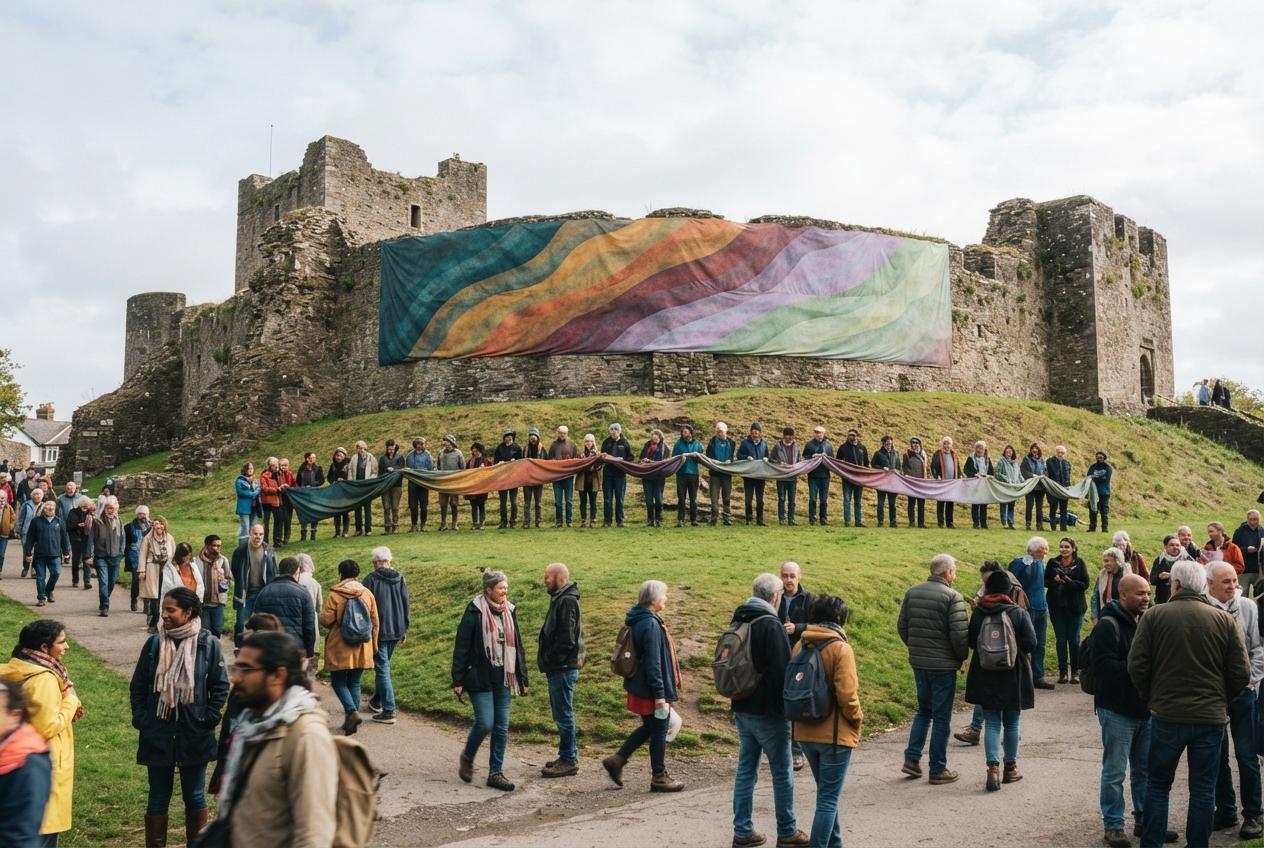
Visitors in Totnes, Devon, watched a striking piece of public art as a 150ft rainbow flag was unfurled around the town's historic castle. The colourful display marked the return of Totnes Pride, bringing hundreds together beneath the Norman landmark while highlighting both LGBTQ+ joy and the continuing importance of visible community celebrations.
Essential Takeaways
- Historic backdrop: Totnes Castle dates from the period after the Norman Conquest.
- Big visual moment: Around 400 people gathered to watch 30 flag bearers unfurl the giant flag.
- Community-led event: The display replaced a traditional town march with a more unusual public-art statement.
- Festival return: Totnes Pride came back after a three-year pause, with events across 15 local venues.
- Permission mattered: English Heritage supported the planning, and volunteers appear to have held the flag rather than fixed it to the castle.
Totnes Castle gets a spectacular Pride makeover
The scene must have been hard to miss: a medieval castle rising above Totnes, wrapped in a sweep of bright rainbow fabric as people gathered in the park below. According to the BBC, roughly 400 spectators watched 30 flag bearers bring the display to life.
The 150ft flag was lent by nearby Torbay Pride, giving the small Devon festival a visual centrepiece with real drama. Totnes Pride organiser Ceri Goddard told Queerty that the team wanted to do something “a bit different”, choosing a large-scale artwork instead of a conventional march.
Why this historic setting made such an impact
Totnes Castle is a classic Norman motte-and-bailey stronghold, with a raised central mound and a surrounding enclosed courtyard. Its age gave the Pride display an extra layer of meaning, placing a modern symbol of equality against one of the town's most recognisable historic views.
There was careful preparation behind the apparent simplicity. Goddard said organisers held a rehearsal and worked with English Heritage on the practical details, an important step when staging a large event beside a protected heritage site.
A bold alternative to the usual Pride march
Totnes Pride ran over four days, with activity spread across 15 venues. The programme included an art exhibition, a river swim, speed dating and a gathering for queer gardeners and growers, giving the festival a distinctly local, varied feel.
That broad mix matters. Pride isn't only about a parade or a single afternoon of celebration; it can also be a swim, a conversation, a shared meal or, in this case, a spectacular moment that brings a whole town to one viewpoint. The return of the festival after three years made the castle display feel especially celebratory.
Online criticism meets a very public response
Images of the flag quickly travelled across social media, attracting predictable complaints from people who objected to the use of a rainbow symbol at a historic landmark. Some critics argued that the castle should display a Union Jack instead, while others questioned whether an old structure should be used for a contemporary cause.
Supporters pushed back with a simple historical point: LGBTQ+ people existed in medieval Britain too, even if the language and social rules of the time were very different. One widely shared response, quoted by Queerty, said gay people were present in Norman times and would likely have welcomed a future in which they could love openly.
The debate rather underlined why visibility still matters. A colourful flag held above a castle may look joyful and playful, but it also says that LGBTQ+ people belong in public history, local traditions and the places shared by everyone.
What the display says about Pride in 2026
The festival's theme was “Queer Joy”, and the castle event captured that idea neatly. It was celebratory rather than solemn, yet it still carried a clear message about inclusion and belonging.
The practical detail is worth noting too. Photographs suggest volunteers held the flag around the castle walls instead of attaching it directly to the ancient masonry. That allowed organisers to create a huge visual effect while respecting the site's conservation needs, a sensible compromise for any event involving historic buildings.
For Totnes, the moment offered more than a striking photograph. It announced that the local Pride festival was back, brought people together in person and turned a familiar landmark into a temporary symbol of welcome.
It's a vivid reminder that public history can make room for present-day joy.
Source Reference Map
Story idea inspired by: [1]
Sources by paragraph: