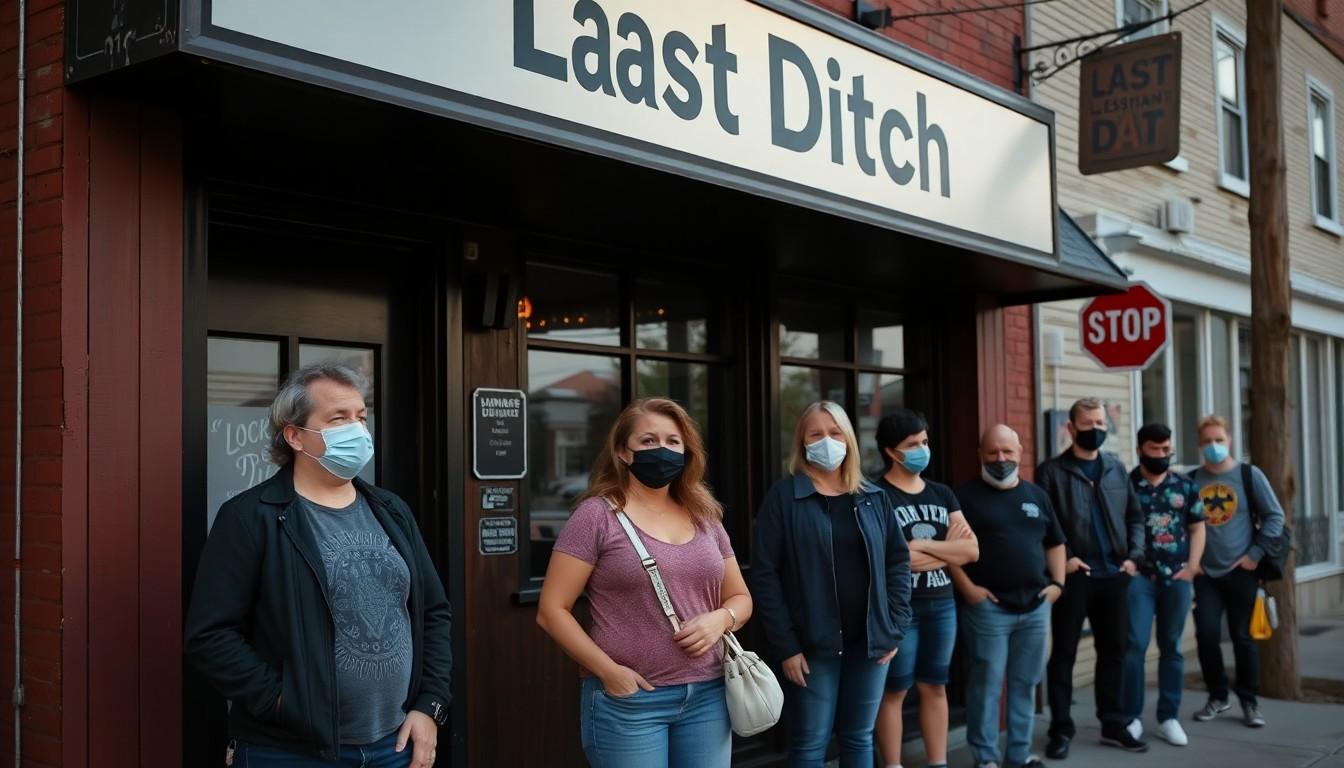
A small lesbian bar in Greenfield, Massachusetts, has become the unlikely centre of a national debate after making masks optional on Saturdays. The Last Ditch says the change was intended to attract more customers and keep the venue open, but the decision has divided its community and drawn intense media attention.
Essential Takeaways
- The venue: Last Ditch is a lesbian bar and arts space in Greenfield, western Massachusetts.
- The policy change: Masks were previously required, with exceptions for eating and drinking; Saturday masking is now optional.
- The backlash: Some patrons described the move as ableist and felt the venue had abandoned its original promise.
- The financial pressure: The bar is reportedly carrying substantial debt and needs more customers to survive.
- The bigger debate: The controversy has become a clash between public health, accessibility, queer community life and the pressures facing small venues.
A tiny bar suddenly found itself under a giant spotlight
Last Ditch was meant to be a local refuge, not an international talking point. Instead, its decision to loosen a strict mask policy turned a modest Greenfield venue into the subject of viral posts, heated commentary and a widely discussed Boston Globe feature.
The story travelled quickly after being discussed on the Blocked and Reported podcast, before spreading across social media and attracting millions of views. The Boston Globe reported that the article brought in at least 1,000 online subscriptions in a single day, making it one of the paper's strongest-performing pieces of the year.
That kind of attention may be flattering for a publication, but it can feel rather different for the people being written about. According to the Greenfield Recorder, some locals were uneasy about seeing their community presented to a huge outside audience, particularly when the story appeared to flatten a complicated local dispute into a cultural spectacle.
What changed at Last Ditch?
Last Ditch opened in April 2025 as a bar and arts venue serving queer customers and their friends. Its original rules required guests to wear well-fitting KN95 masks inside, removing them only briefly to eat or drink.
The Saturday change was a practical attempt to make the venue more welcoming to a broader audience and improve its takings. Yet for customers who rely on strict masking because of health risks, the adjustment felt like a serious loss of protection rather than a minor relaxation.
The disagreement reportedly unfolded during a lengthy community meeting. Some attendees accused the venue of ableism and eugenics, while others supported the change or questioned whether a small bar could remain financially viable under such demanding conditions. AllSides' summary of the coverage reflects that sharp divide, with the policy becoming a proxy for much wider arguments about risk and inclusion.
The economics are as important as the politics
Behind the online uproar is a familiar small-business problem: keeping the lights on. Last Ditch's owner reportedly works several jobs, carries significant debt and has taken extraordinary personal steps to support the venue, including sleeping in a vehicle.
That detail gives the argument a harder edge. A bar can have a strong social purpose and still need paying customers, regular events and enough room in the budget for rent, staff and supplies. Optional masking on one night may be controversial, but the alternative could be fewer visitors or, ultimately, closure.
Hoodline's account highlights the tension between the bar's original health precautions and the pressure to grow its audience. It's an uncomfortable choice, especially for a venue whose identity is built around making people feel safe. A community space can't serve anyone if it doesn't survive, but survival can also change the very character people came to protect.
Why the Boston Globe story caused such a reaction
Several people interviewed locally felt the national coverage lacked enough context. Meaghan Cuevas, who appeared in the Boston Globe story, said she supported the policy change but was surprised by the direction of the article and how the venue was portrayed.
Luke Rotello, co-chair of the Western Massachusetts Club of the Communist Party USA, argued that the coverage treated the people involved as a spectacle and failed to reflect the region's wider diversity. The organisation later issued a statement condemning the article and calling for solidarity among queer and trans people in western Massachusetts.
The criticism wasn't limited to the article's subject matter. The bar also faced fresh frustration after an apology posted on Instagram reportedly lacked alt-text, an accessibility feature that helps visually impaired users understand images. In a dispute already focused on inclusion, that small omission became another flashpoint.
What this says about queer venues and public health
The controversy lands at the intersection of several pressures facing independent queer venues. These spaces often provide belonging that mainstream nightlife doesn't, but they may operate on slim margins and depend on a relatively small local audience.
There is also no universal answer to the masking question. For some customers, removing the rule makes a venue feel more usable and socially relaxed. For others, optional masking removes the basic condition that made visiting possible in the first place. Both responses can be sincere, which is why the argument has proved so difficult to settle.
The Greenfield Recorder reported that local opinion was split, with some residents wishing the town had remained a quieter, lesser-known refuge. That may be the most human part of the story. A small community can be proud of its visibility while still feeling bruised when the outside world arrives all at once.
Last Ditch now has attention many venues would envy, but publicity isn't the same as stability. Its future will depend less on viral headlines than on whether it can build a policy and business model that enough of its community can live with.
It's a reminder that keeping a vital community venue open is rarely as simple as choosing between safety and freedom.
Source Reference Map
Story idea inspired by: [1]
Sources by paragraph:
- Paragraph 1: [2], [3]
- Paragraph 2: [2], [4]
- Paragraph 3: [4], [5]
- Paragraph 4: [2], [3]
- Paragraph 5: [4], [5]
- Paragraph 6: [2], [4]
- Paragraph 7: [5], [6]
- Paragraph 8: [4], [5]
- Paragraph 9: [2], [4]
- Paragraph 10: [4], [5]
- Paragraph 11: [3], [5]
- Paragraph 12: [4], [7]
- Paragraph 13: [2], [4]
- Paragraph 14: [3], [5]
- Paragraph 15: [4], [5]