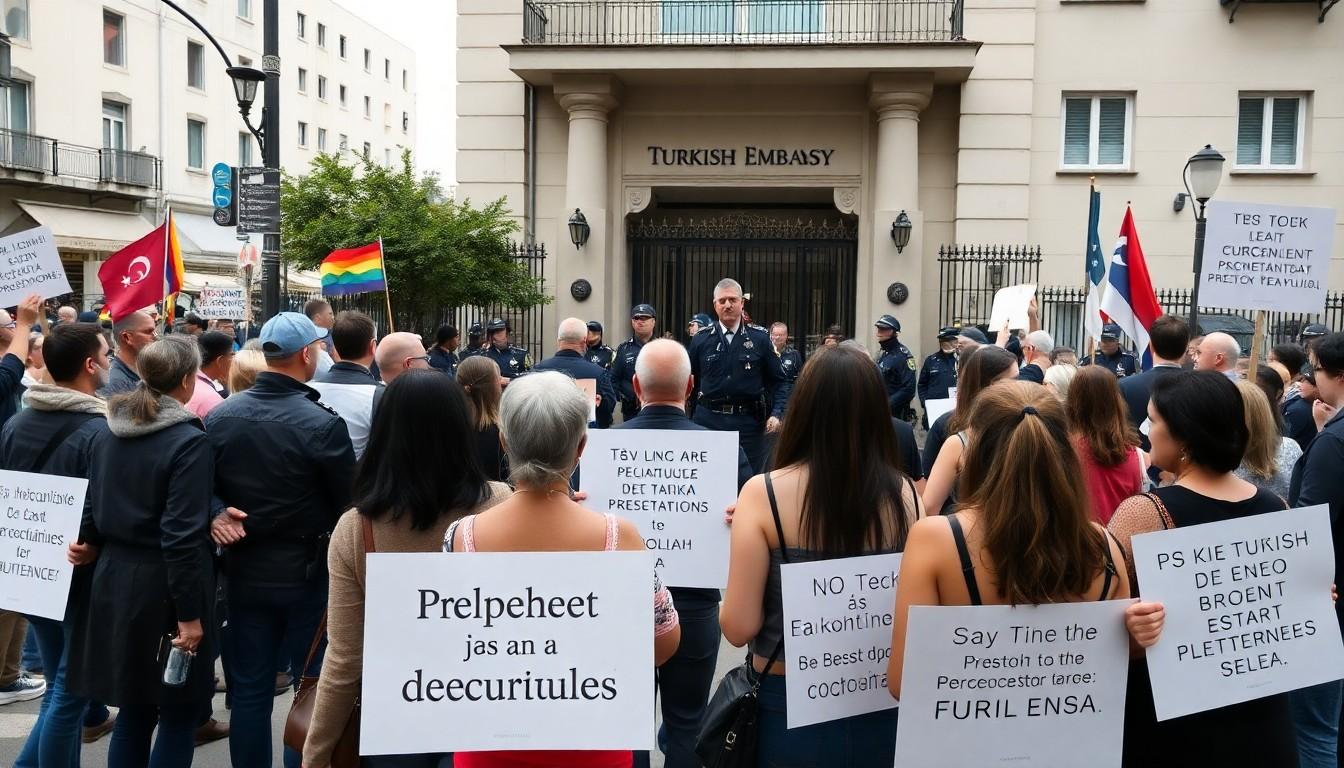
Protesters gathered outside Turkey's embassy in Athens on Friday, calling for an end to mass arrests, raids and restrictions targeting LGBTQI+ people and activists in Turkey. The demonstration brought together Greek, Turkish and Kurdish LGBTQI+ groups, turning a tense diplomatic setting into a vivid show of cross-border solidarity.
Essential Takeaways
- A public demonstration: Crowds gathered outside the Turkish Embassy in Athens with flags, placards and chants.
- Growing concern: Rights organisations report arrests, raids, Pride restrictions and pressure on LGBTQI+ groups in Turkey.
- Police tension: Organisers said officers ordered protesters to move and warned that force could be used.
- Shared demands: Demonstrators called for detainees’ release and protection of freedom of expression and assembly.
- Regional solidarity: Turkish and Kurdish migrant LGBTQI+ groups joined Greek organisations at the protest.
Athens becomes a stage for LGBTQI+ solidarity
The strongest image from Friday's protest was also the simplest: a crowd outside a diplomatic mission, holding signs and flags while chanting for freedom. According to Avgi, the gathering in Athens was organised by LGBTQI+ groups in support of Turkey's LGBTQI+ community after a fresh wave of arrests and alleged repression.
The action wasn't presented as a distant foreign-policy dispute. Organisers framed it as a warning about what happens when intolerance, nationalism and political opportunism are allowed to shape public life. Reports from the International Planned Parenthood Federation and LGBT Nation describe a wider crackdown involving activists, venues and online voices.
Turkish and Kurdish migrant LGBTQI+ groups also attended, adding a personal dimension to the demonstration. For many participants, this wasn't abstract solidarity from afar but support for friends, relatives and fellow campaigners across the Aegean.
Why the latest crackdown has raised alarm
Rights groups say the pressure in Turkey has been building through several channels. These include restrictions on Pride events, arrests of activists, raids on organisations and limits on public expression, according to the International Federation for Human Rights and the World Organisation Against Torture.
The pattern matters because it reaches beyond one march or one organisation. When authorities target community groups, meeting places and public demonstrations at the same time, ordinary visibility becomes risky. Even a social gathering can start to feel like a political act, which is precisely the chill activists say they are facing.
The Washington Post reported that the crackdown has drawn international condemnation, while campaigners have warned that LGBTQI+ people are being used as a convenient political target. It's a grimly familiar tactic: present a minority as a threat, then use fear to rally support.
Protesters say police pressure intensified the mood
The atmosphere outside the embassy became more strained when, according to a protest organiser quoted by Avgi, police restricted access to the road in front of the building and urged demonstrators to relocate. The organiser said officers warned of possible violence and that riot police were nearby.
Protesters reportedly refused to disperse immediately. They later tried to move in an orderly way, with organisers saying they wanted to avoid injuries while maintaining the demonstration. That detail is telling: even a peaceful solidarity rally can become a careful exercise in crowd management when police pressure rises.
The episode also underlined one of the protest's central demands, the right to gather freely. The International Federation for Human Rights and the World Organisation Against Torture have both raised concerns about arbitrary detention and restrictions on LGBTQI+ human rights defenders in Turkey.
The demands go beyond releasing detainees
The demonstrators called for an immediate end to arrests, prosecutions and violence against LGBTQI+ people in Turkey. They also demanded the release of those detained and stronger protection for freedom of speech and peaceful assembly.
The campaigners' message was broader still. They opposed the influence of nationalism, religious extremism and populism, arguing that these forces can weaken rights across borders. The International Planned Parenthood Federation has similarly highlighted the risks facing LGBTQI+ and feminist activists amid the current pressure.
That wider framing helps explain why the protest took place in Athens rather than remaining confined to Turkish politics. Participants were defending a principle that feels increasingly practical: rights are safest when people defend them before they disappear from public view.
A regional warning with international consequences
The response to Turkey's actions has now moved well beyond local advocacy networks. International rights organisations have called attention to mass detention, raids and pressure on civil society, while overseas media coverage has brought the issue to a wider audience.
The Athens protest offered a human-scale answer to that international criticism. There were no grand policy announcements, just people standing together, carrying signs and refusing to let the story fade into diplomatic language. Sometimes that is where solidarity starts, with a visible crowd and a message that cannot be quietly filed away.
For LGBTQI+ communities across the region, the outlook remains uncertain. But the gathering showed that repression in one country can prompt organised resistance in another, and that borders don't have to limit support.
Rights are easier to protect when people stand up for them early.
Source Reference Map
Story idea inspired by: [1]
Sources by paragraph:
- Paragraph 1: [2], [3]
- Paragraph 2: [4], [5]
- Paragraph 3: [1], [7]
- Paragraph 4: [4], [5]
- Paragraph 5: [2], [3]
- Paragraph 6: [7], [4]
- Paragraph 7: [1], [5]
- Paragraph 8: [1], [4]
- Paragraph 9: [5], [6]
- Paragraph 10: [2], [5]
- Paragraph 11: [1], [4]
- Paragraph 12: [2], [7]
- Paragraph 13: [3], [6]
- Paragraph 14: [4], [5]