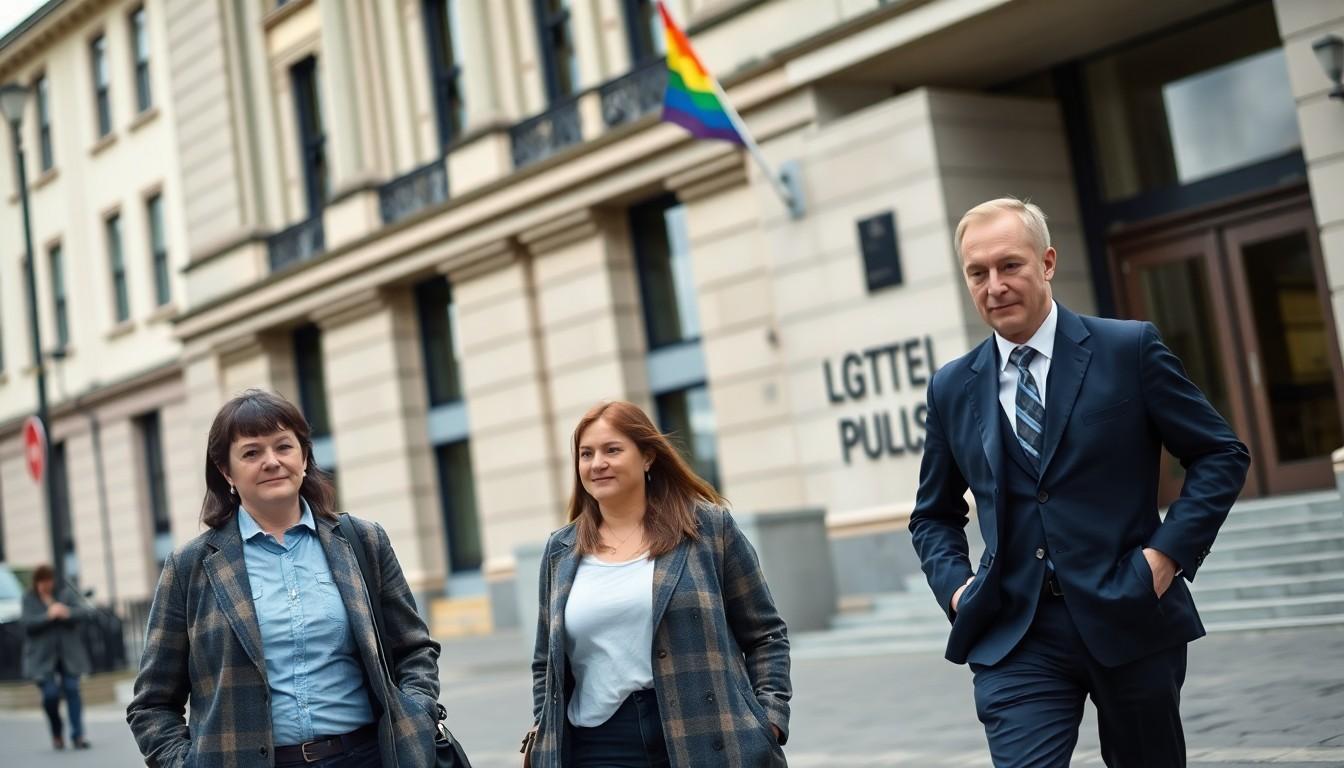
European leaders have approved the Council of Europe’s first LGBTQ+ equality strategy, creating a five-year plan for 2027 to 2032. The move matters because legal protection remains uneven across the continent, while hate speech, disinformation and AI-driven abuse are making public life feel less safe for many LGBTQ+ people.
Essential Takeaways
- A landmark framework: The strategy is the Council of Europe’s first Europe-wide plan focused on equal rights for LGBTI people.
- Four priorities: It targets inclusion, disinformation, violence and stronger legal protections.
- Protection remains patchy: Far more countries cover sexual orientation in hate-speech laws than gender identity, expression or sex characteristics.
- Historical justice is included: The plan supports work to recognise and clear convictions linked to laws that have since been repealed.
- The next milestone: An official launch is planned for 26 January 2027 under Montenegro’s presidency.
A new European roadmap for LGBTQ+ rights
The Council of Europe has adopted its first strategy for equal rights for LGBTQ+ people, setting out an ambitious five-year roadmap for the period from 2027 to 2032. According to the Council of Europe, the plan is designed to strengthen dignity, safety and inclusion across its 46 member states.
Its arrival carries particular weight because it comes 45 years after the European Court of Human Rights delivered its first ruling concerning LGBTQ+ rights. That long arc is worth noticing: progress has moved from individual court cases towards a broader, coordinated plan for governments and institutions. The Council of Europe’s official announcement describes the strategy as a foundation for more consistent action. [2], [3]
At its heart are four priorities. They include promoting equal rights and respect, tackling disinformation, preventing violence and hatred, and improving the legal and institutional systems that are meant to protect LGBTQ+ people. It isn't a single new law, but it gives governments a shared direction. [2], [5]
Why hate-speech protection still varies so widely
The strategy arrives against a backdrop of striking legal differences. Council of Europe material highlights that 35 of its 46 member states have explicit criminal-law protection covering hate speech based on sexual orientation, while only 18 cover gender identity. Just six cover gender expression, and six address sex characteristics. [3]
Only Belgium, Denmark and Malta are identified as having laws that cover all four areas. That unevenness can leave some LGBTQ+ people protected on paper in one part of their identity, but exposed when abuse targets another. The legal map, in other words, still has some very obvious blank spaces.
The European Economic and Social Committee has also stressed the importance of effective equality measures, rather than relying solely on formal rights. That distinction matters in daily life, where protection depends on reporting systems, policing, courts, schools and public institutions working as intended. [6], [7]
AI has made the information fight more urgent
The Council of Europe has singled out disinformation and the misuse of artificial intelligence as growing concerns. Its warning is fairly simple: hostile content can be produced, altered and distributed at speed, allowing anti-LGBTQ+ narratives to reach much larger audiences.
That creates more than an online nuisance. The organisation links this environment with fear, anxiety, depression and withdrawal from public life among LGBTQ+ people. A screen may feel distant, but the effects can follow someone into work, school, healthcare and community spaces. [2], [3]
This is also where the strategy connects LGBTQ+ equality with democracy and the rule of law. Protecting people from manipulated information and targeted hatred isn't just a matter of internet etiquette. It is about whether people can participate openly in society without being pushed into silence.
Historical convictions are part of the conversation
One notable element is the commitment to work with member states on historical convictions for same-sex activity that has since been decriminalised. That gives the strategy a restorative-justice dimension, rather than focusing only on future protections.
Ireland provides a strong example of why that matters. The European Court of Human Rights played a central role in the country’s decriminalisation process through the Norris case in 1988, and campaigners now want other European countries to address the continuing impact of old convictions. The LGBT Restorative Justice Campaign welcomed the strategy’s reference to recognition, pardons and expungement. [2], [4]
For people affected by those laws, a legal change decades ago may not have erased the stigma, records or family pain attached to a conviction. The new language suggests that equality policy is beginning to account for that history more directly.
What happens next for LGBTQ+ equality?
The strategy isn't legally binding in the same way as a domestic statute or court judgment. Even so, Council of Europe strategies can influence national lawmaking, policy decisions and legal arguments. They also give campaigners a recognised benchmark when asking governments to close gaps between rights on paper and protection in practice.
The plan is expected to be formally launched on 26 January 2027 during an event held under Montenegro’s presidency of the Committee of Ministers. That launch will be an early test of how quickly broad commitments turn into practical action, including better reporting routes, stronger enforcement and more consistent safeguards. [2], [3]
The direction is encouraging, but the real measure will be experience on the ground. A strategy becomes meaningful when LGBTQ+ people can speak, work, travel and gather without calculating the personal cost first.
It's a significant roadmap, but its success will depend on turning shared promises into everyday protection.
Source Reference Map
Story idea inspired by: [1]
Sources by paragraph: