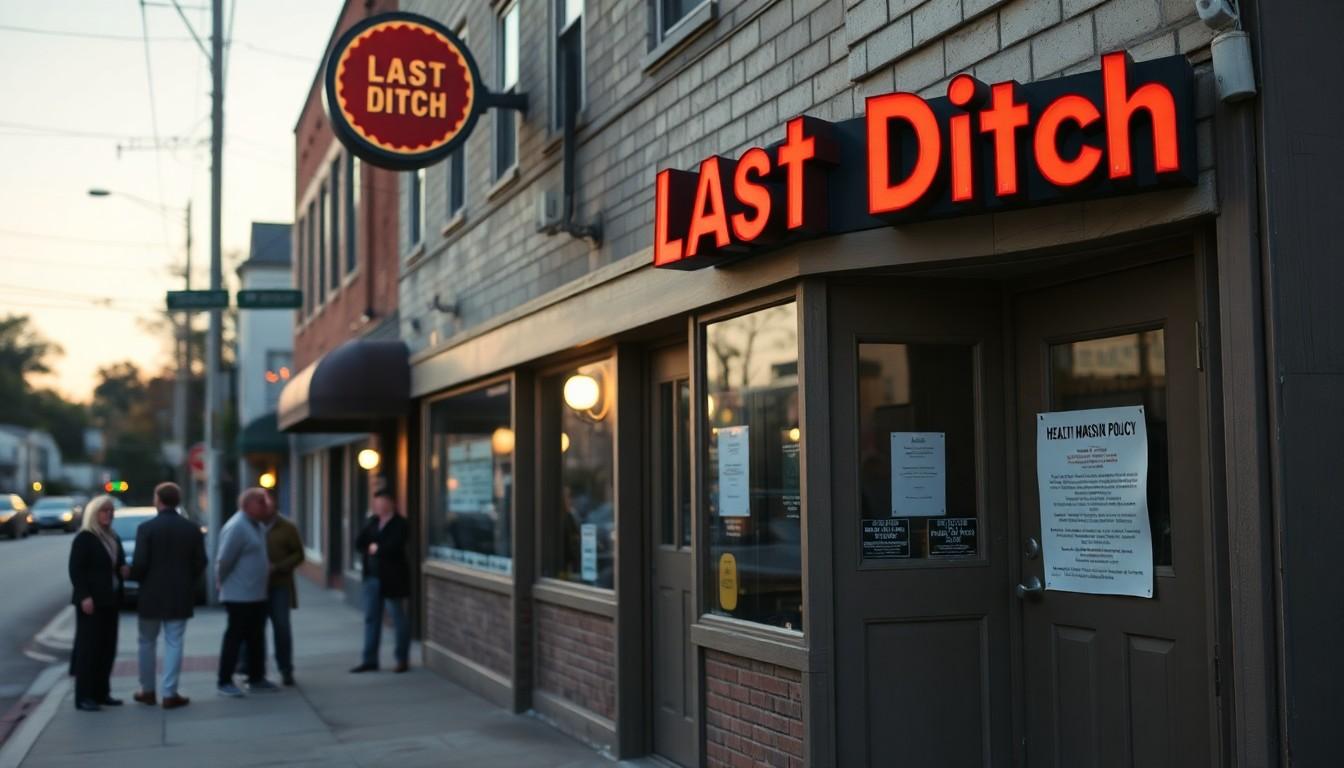
Online attention has turned Last Ditch, a struggling lesbian bar in Greenfield, Massachusetts, into an unlikely national talking point. Its mask policy, financial troubles and intensely political atmosphere have prompted backlash, headlines and a flood of curiosity, raising a bigger question: can an idealistic community venue survive when its rules become the main event?
A tiny bar, suddenly under a giant spotlight
Last Ditch is small, cash-strapped and, until recently, largely unknown outside western Massachusetts. Then a Boston Globe feature about its mask-rule controversy sent the bar ricocheting across social media, where the combination of a lesbian venue, $10 Negronis and elaborate pandemic precautions proved almost irresistibly shareable.
The story gained traction because it sounded less like ordinary nightlife reporting and more like a scene from an offbeat sitcom. Accounts of masked celebrations and unusual opening-night antics gave the controversy a vivid, slightly surreal edge, while the bar’s financial struggles added a more serious layer. The Boston Globe reportedly gained around 1,000 subscribers from the attention, according to coverage of the article’s impact.
For a venue that was already fighting to stay open, becoming a national punchline is a complicated kind of publicity. It may bring customers and donations, but it can also make the bar’s most divisive feature impossible to escape.
Why the mask policy became the main attraction
The dispute centres on Last Ditch’s decision to maintain mask requirements for some events while loosening them on selected Saturdays. That change angered patrons who saw masking as an important safety measure, while others considered the rules excessive or out of step with everyday life in 2026.
Coverage from LGBTQ Nation and TMZ framed the backlash as a clash between a venue’s original health commitments and the practical demands of running a bar. Masks are awkward in any drinking environment, of course, but in a small room where people are chatting, singing and ordering cocktails, the rule becomes impossible to ignore. It changes the mood before anyone has even reached the bar.
There’s also a question of trust. Customers who supported Last Ditch because of its strict approach may feel that a partial relaxation represents a retreat. Meanwhile, people who never accepted the policy may see the change as proof that the original arrangement was unsustainable.
A familiar problem for activist-led spaces
Last Ditch’s predicament fits a broader pattern in politically progressive and queer institutions. A venue can begin with a clear mission and a strong sense of shared purpose, but the same intensity that creates loyalty can make compromise difficult. Every operational decision becomes a statement about values.
The bar’s reported debt makes that pressure sharper. LGBTQ Nation and the New Boston Post both focused on the financial burden facing the venue, suggesting that the mask dispute cannot be separated from the basic economics of keeping a lesbian bar alive. Rent, staffing, stock and insurance don’t become less demanding because a business has a noble purpose.
That’s the uncomfortable truth behind the viral jokes. A community venue may want to serve everyone, but it still needs enough customers to pay the bills. When rules narrow the audience, even for understandable reasons, the cash register notices.
What the backlash says about modern nightlife
The Last Ditch story has travelled so widely because it combines several internet-ready ingredients: identity, public health, subcultural conflict and a policy change that can be explained in a single sentence. Know Your Meme documented how the controversy became an online event in its own right, with the bar’s name turning into shorthand for a much wider argument.
Some coverage has treated the story as an example of ideological overreach, while other accounts have presented the criticism as hostile to a vulnerable community space. Neither framing fully captures the practical difficulty. A bar can set conditions for entry, but customers can also decide that those conditions no longer suit them.
That tension is especially visible in queer nightlife, where venues often carry emotional importance far beyond their commercial role. For many customers, a lesbian bar isn’t simply somewhere to drink. It’s a place to meet friends, feel visible and enjoy a room designed with them in mind. That makes disagreements feel personal, but it also means the venue has more to lose when the atmosphere becomes combative.
Can Last Ditch turn attention into survival?
The best outcome for Last Ditch would be to convert its sudden fame into steady, paying support rather than another cycle of online outrage. Clear communication would help: customers need to know which nights are mask-optional, what protections remain in place and whether the policy may change again.
The bar could also benefit from separating its mission from one single rule. Accessibility, safety and queer community can remain central even if the exact mask policy evolves. The New Boston Post and Legal Insurrection both highlighted the intensity of the reaction, but attention alone won’t solve the venue’s debt or fill its tables on quieter nights.
For now, Last Ditch has become famous for a controversy that may ultimately be less important than its survival. The internet loves a bizarre argument, but local bars live or die by repeat customers. A packed room, a workable policy and enough money in the till would be a far happier ending than another viral post.
A small bar can’t control the internet, but it can still decide what kind of room it wants to be.
Source Reference Map
Story idea inspired by: [1]
Sources by paragraph:
- Paragraph 1: [2], [4]
- Paragraph 2: [3], [5]
- Paragraph 3: [6], [7]
- Paragraph 4: [2], [3]
- Paragraph 5: [4], [5]
- Paragraph 6: [3], [6]
- Paragraph 7: [2], [7]
- Paragraph 8: [5], [6]
- Paragraph 9: [7], [4]
- Paragraph 10: [2], [3]
- Paragraph 11: [5], [6]
- Paragraph 12: [7], [2]
- Paragraph 13: [3], [5]
- Paragraph 14: [6], [7]
- Paragraph 15: [2], [4]
- Paragraph 16: [3], [5]
- Paragraph 17: [6], [7]
- Paragraph 18: [2], [3]