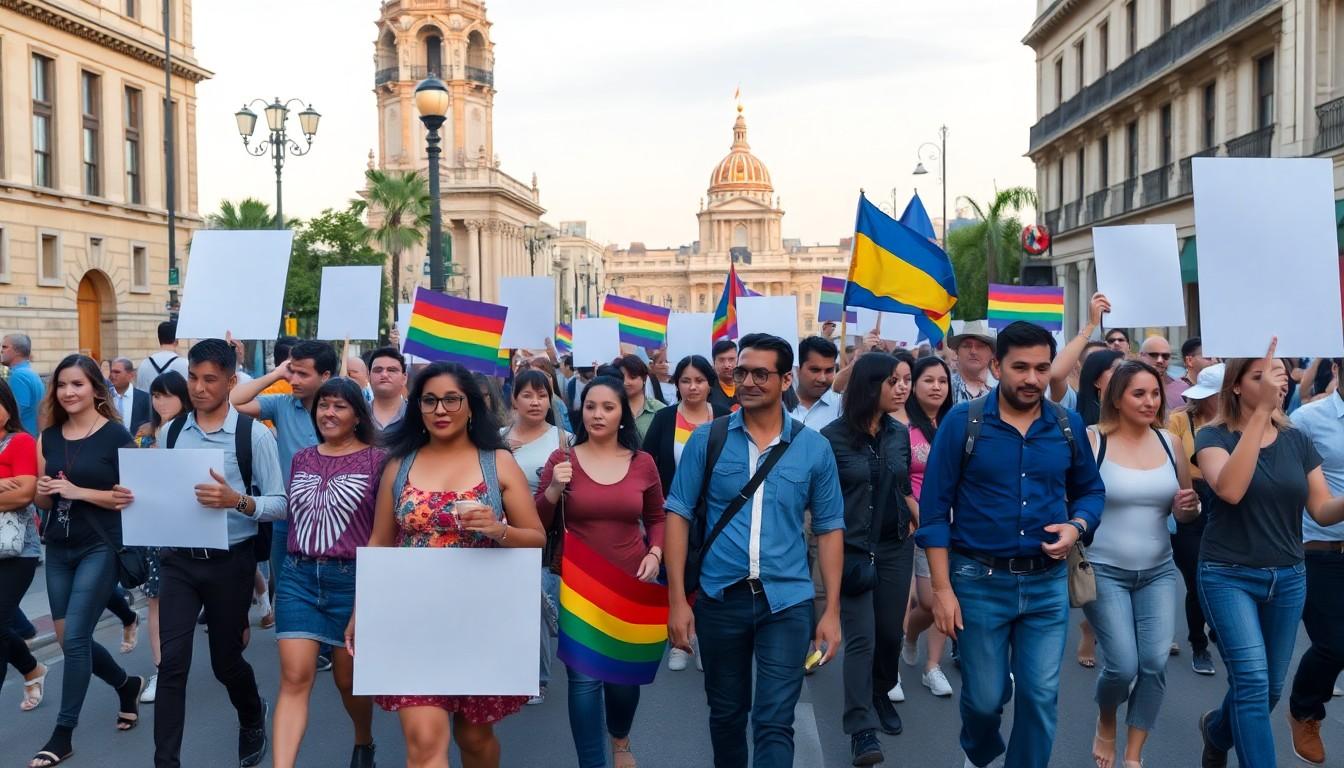
Organisers are calling people to Montevideo’s Plaza Cagancha this Friday at 6pm for the annual Diversity March, travelling towards Plaza 1 de Mayo. This year’s message, “Live with dignity, exist with pride”, puts everyday equality firmly centre stage, from healthcare and employment to education, housing and safety.
Essential Takeaways
- The route: Participants will gather at Plaza Cagancha before marching towards Plaza 1 de Mayo.
- The central demand: Organisers want practical improvements in LGBTI+ people’s lives, not only public statements.
- This year’s tribute: The march is named after actor and drag performer Luis Magallanes, known as Dulce Polly.
- Practical support: The pre-march programme includes workshops, information stands, rapid tests and vaccination advice.
- The atmosphere: Speeches and demands will share space with music, performance and community celebration.
A march that wants more than warm words
The strongest message from this year’s Montevideo Diversity March is that legal recognition alone doesn't guarantee an easy, safe life. Organisers say people still face discrimination in schools, medical settings, workplaces and public spaces, leaving many with the exhausting feeling that progress exists on paper but hasn't reached the street. Industry and civic reporting on earlier marches also shows how the event has become one of Uruguay’s major public demonstrations. [2], [6]
That tension gives the slogan its edge. “Live with dignity” is a deliberately basic demand, while “exist with pride” carries the movement’s familiar mix of resistance, joy and visibility. According to coverage by La Diaria, the organising coalition wants to move beyond what it describes as repeated analysis and official discourse, pressing instead for changes people can feel in daily life. [6]
Why healthcare, work and education are central
The campaign’s priorities are notably practical. Organisers are highlighting access to respectful healthcare, employment, education and housing, including better professional training and more dignified treatment in clinics. For many people, a poor experience at the first point of care can mean delaying help until a problem becomes considerably more serious. [6], [7]
The same concern runs through education and work. Uruguay has legislation designed to support trans people, but campaigners say implementation remains uneven, with gaps around study grants, employment quotas and public coordination. Earlier reporting on the march has also underlined how the movement links visibility with wider social and economic rights, rather than treating Pride as a purely cultural occasion. [2], [5]
A national movement with a Montevideo problem
Although the march takes place in the capital, one of its key concerns is the divide between Montevideo and the rest of Uruguay. Specialist healthcare, some surgeries and higher education opportunities remain concentrated in the capital, which can turn a basic right into a costly journey. [6], [7]
That issue matters because equality can look very different depending on where someone lives. A law may be national, but access to a trained professional, a supportive service or a relevant institution can still depend on geography. The result is a quieter form of exclusion, and one that is easy to miss from the city centre.
Remembering Luis Magallanes, the performer behind Dulce Polly
This year’s march is also a tribute to Luis Magallanes, the actor and teacher widely known in Uruguay’s artistic and diversity communities as Dulce Polly. He took part in the first Diversity March in 2005 and died in January, making the dedication both a public remembrance and a gesture towards the people who built the movement over many years. [6]
There’s something especially fitting about honouring a drag performer at an event that refuses to separate protest from celebration. Music, costumes, performance and dancing aren't decorative extras here; they’re part of how the community stays visible and finds energy for another year of campaigning.
What to expect before and after the march
The “pre-march” programme begins at Plaza Cagancha from 10am on Thursday and Friday, with information stalls, local craft sellers, workshops, artistic interventions, DJs and live music. A health area is also scheduled, offering advice on preventing sexually transmitted infections, rapid HIV and other STI testing, vaccinations and information about HIV PrEP. [1], [5]
After the march, organisers have announced performances by Dani Umpi, Andy Falcone, Kevin Royk and Agustina Giovio, alongside the collective reading of the declaration. Previous coverage of the event has highlighted the importance of checking the route and planned traffic diversions, so visitors should allow extra time and check local updates before setting off. [3], [4]
For anyone attending, comfortable shoes, water and a charged phone are sensible basics. More importantly, the event offers a reminder that celebration and campaigning can sit side by side: a lively square can also be a serious demand for safer, fairer lives.
It's a march for pride, but this year its sharpest question is simple: when will promised rights become everyday reality?
Source Reference Map
Story idea inspired by: [1]
Sources by paragraph: