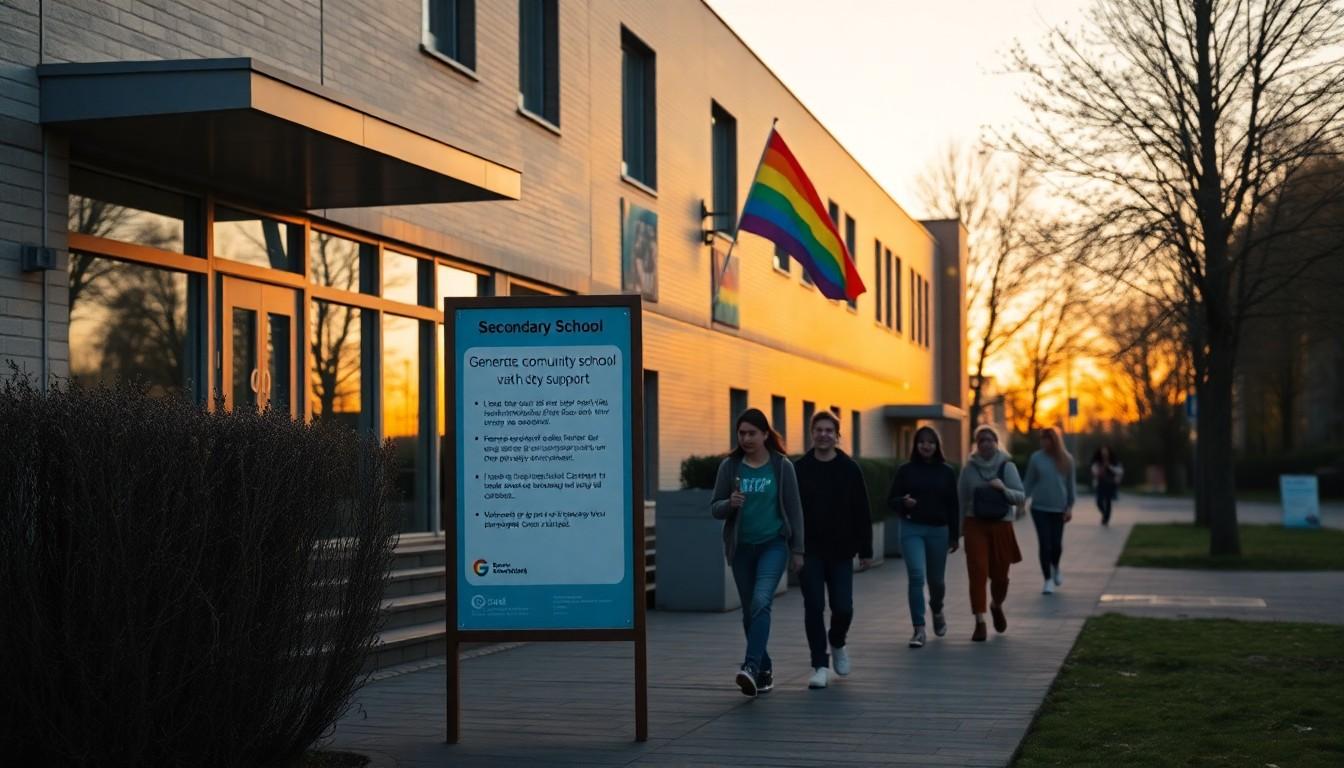
Schools and communities across the Netherlands are facing a troubling shift: acceptance of homosexuality among teenagers has fallen sharply, particularly among boys. New research is prompting LGBTQ+ organisations and local authorities to call for stronger support in classrooms, youth clubs and public life, where everyday safety can depend on more than a single awareness day.
Essential Takeaways
- Acceptance has dropped: Positive attitudes towards homosexuality fell substantially among Dutch secondary-school pupils between 2021 and 2025.
- Boys show the steepest decline: Support among boys fell from 40 per cent to 22 per cent, while the figure for girls dropped from 78 per cent to 51 per cent.
- Daily safety matters: LGBTQ+ pupils need teachers and staff to challenge slurs and bullying consistently, not only during visible campaigns.
- Local action is growing: Municipalities are being urged to work with schools, youth workers, sports clubs, police and LGBTQ+ organisations.
- Visibility still helps: Events such as Paarse Vrijdag and Pride walks can offer solidarity, provided they lead to longer-term support.
A sharp reversal in young people's attitudes
The latest figures have landed with uncomfortable force. Research covered by Trimbos and the Health Behaviour in School-aged Children study shows that positive attitudes towards homosexuality among Dutch teenagers have fallen markedly in just four years.
The decline is especially pronounced among boys in secondary education. According to reporting by RTL Nieuws and NL Times, the proportion expressing a positive attitude fell from 40 per cent in 2021 to 22 per cent in 2025. Among girls, acceptance fell from 78 per cent to 51 per cent.
Those numbers aren't abstract for pupils wondering whether it's safe to talk about a crush, hold hands or simply dress as they like. As Trimbos reports, the findings point to a wider change in the social climate around young people, rather than one isolated incident.
Why the classroom is the real test
A rainbow flag in a corridor can be encouraging, but the tougher test arrives on an ordinary Monday morning. If a slur goes unchallenged, or a pupil learns that reporting harassment leads nowhere, a school's public message quickly loses its weight.
COC Midden-Gelderland has warned municipalities that insecurity can shape everyday choices, from hiding a relationship to changing clothes to avoid unwanted attention. The concern is shared by researchers and policymakers, who have been examining why LGBTQ+ acceptance among young people is weakening.
The Dutch government launched research into the trend in 2024, while newer reporting suggests the issue is visible in cities as well as smaller communities. That matters because a young person's experience often depends less on national messaging than on the adults and peers immediately around them.
A problem with more than one cause
There isn't a single switch that explains the change. Researchers and campaigners point towards a mix of social media influences, polarised public debate, peer pressure and changing ideas about gender and sexuality.
NL Times has also reported earlier concerns about acceptance among young people in Amsterdam, suggesting the pattern isn't confined to one region. Meanwhile, the HBSC findings underline how attitudes can vary by gender, age and social setting.
That makes the issue harder to tackle, but it also explains why a one-off assembly won't be enough. Schools need clear behaviour policies, confident staff training and reliable routes for pupils to ask for help. Youth organisations, sports clubs and cultural groups have a role too, since much of teenage social life happens outside the classroom.
What municipalities and schools can do now
COC Midden-Gelderland has called on local authorities to bring schools, youth workers, sports associations, cultural institutions, police and LGBTQ+ groups around the same table. The practical goal is simple: make support visible, consistent and easy to find.
Schools can start with basics that are surprisingly powerful. Staff should know how to respond to homophobic language, pupils should understand how to report concerns, and leaders should track whether anti-bullying policies work in practice. Campaign days can help, but they shouldn't become a decorative splash of purple followed by silence.
Paarse Vrijdag remains one useful way to show solidarity, particularly for pupils who feel isolated. Yet, as the COC's local campaign makes clear, symbolic support has greatest value when students can trust teachers to act after the event has ended.
Visibility is rising, but confidence must follow
Several Dutch municipalities are pairing public events with broader programmes. Arnhem is planning a Roze Jaar featuring activities from October 2026 to June 2027, while Doetinchem is due to hold its first Pride Walk in October.
Those events can help communities feel seen and give young people a reassuring sense that they aren't alone. But visibility only works when it connects to everyday life: safer schools, supportive youth services and adults who don't look away when prejudice appears.
The next step is likely to be less about grand declarations and more about persistence. Acceptance is rebuilt through hundreds of small interventions, repeated until respect feels ordinary rather than exceptional.
A safer school begins with consistent support, not just a colourful calendar date.
Source Reference Map
Story idea inspired by: [1]
Sources by paragraph:
- Paragraph 1: [2], [3]
- Paragraph 2: [4], [5]
- Paragraph 3: [2], [3]
- Paragraph 4: [6], [7]
- Paragraph 5: [3], [4]
- Paragraph 6: [5], [6]
- Paragraph 7: [2], [3]
- Paragraph 8: [4], [5]
- Paragraph 9: [2], [6]
- Paragraph 10: [3], [4]
- Paragraph 11: [2], [5]
- Paragraph 12: [3], [6]
- Paragraph 13: [2], [4]
- Paragraph 14: [5], [7]
- Paragraph 15: [3], [6]
- Paragraph 16: [2], [4]