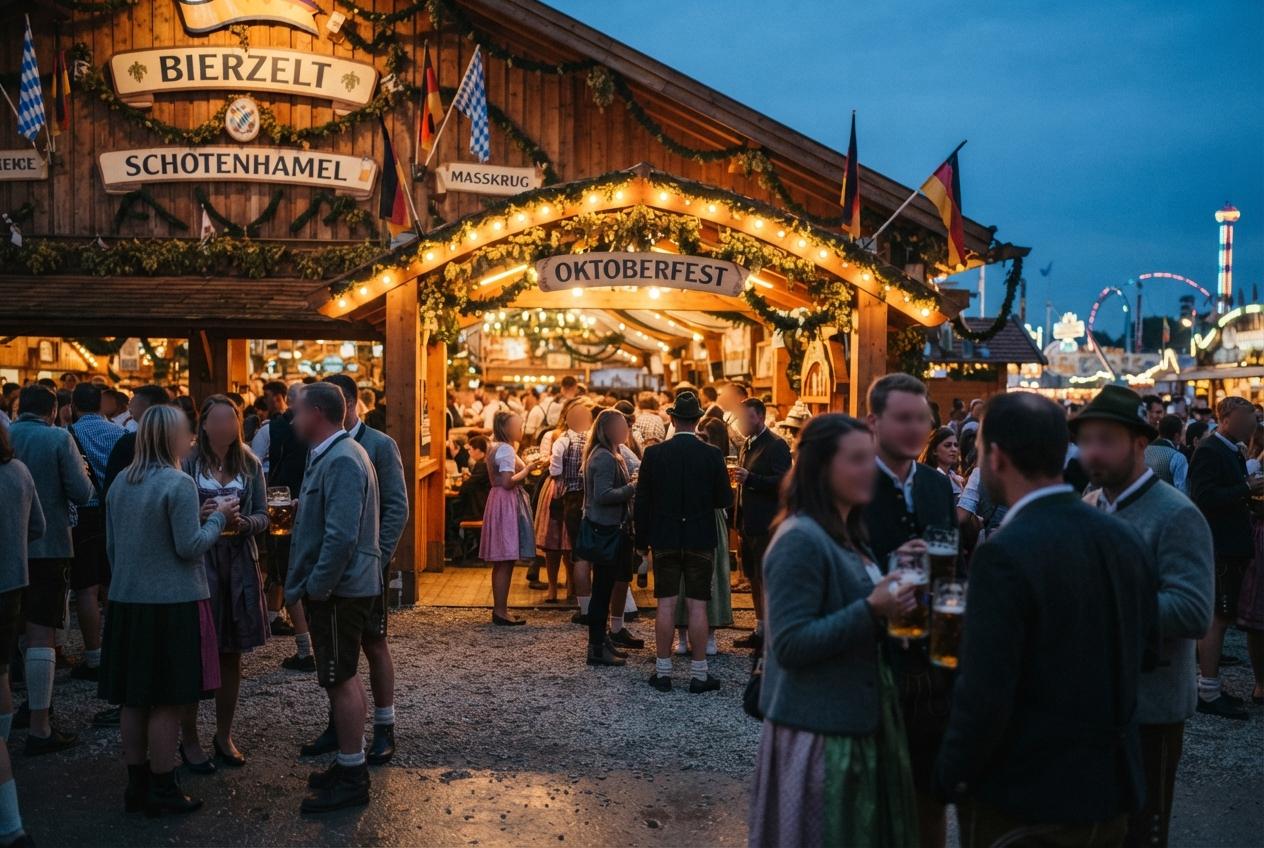
Visitors have given Munich's Oktoberfest a fresh Monday highlight, as around 700 FLINTA people gathered at the Bräurosl tent for a colourful celebration of community, visibility and inclusion. With free beer, a rainbow flag and plenty of dirndls, the first event suggests this could become the next big queer Wiesn tradition.
Essential Takeaways
- A new celebration: The Bräurosl hosted its first dedicated FLINTA Monday for women, lesbians, intersex, non-binary, trans and agender guests.
- Huge demand: Organisers planned for 700 people, but interest reportedly stretched well beyond that capacity.
- A visible statement: A rainbow flag was raised in the tent alongside speeches about solidarity and democratic freedoms.
- A possible annual fixture: The organisers and hosts are already discussing expanding the event, potentially to a larger part of the tent.
- A broader Wiesn shift: The gathering builds on Oktoberfest's established queer events while giving women and gender-diverse visitors their own space.
A packed tent and a powerful first impression
The strongest image from the Bräurosl was also the simplest: a traditional Oktoberfest tent filled with women and gender-diverse guests, many in colourful dirndls and leather trousers, raising glasses together. According to the Abendzeitung, the atmosphere was emotional as well as exuberant, with the rainbow flag adding a vivid splash of colour above the celebration.
The event brought together about 700 FLINTA guests, although organisers said demand could have filled considerably more places. For many attendees, that level of interest was proof that the occasion answered a real need rather than simply adding another date to the festival calendar.
From Rosa Sonntag to Rosa Montag
The new Monday event follows the long-running Rosa Sonntag at the Bräurosl, which is especially popular with gay men. That tradition has become one of the best-known queer moments at Oktoberfest, but the FLINTA gathering offers a different emphasis and a different sense of ownership.
As reported by tz, the idea grew after organisers approached major beer tents about creating a dedicated event for women and gender-diverse people. The Bräurosl team responded enthusiastically, turning an informal proposal into a full-scale Wiesn gathering.
That progression matters. Oktoberfest is famous for its rituals, but traditions don't appear fully formed. They start with someone asking whether there might be room for something new, then gather momentum when people recognise themselves in the idea.
Why visibility mattered as much as the beer
The day wasn't only about Bavarian food, music and steins. Organisers also framed it as a public show of queer visibility at a time when inclusion and democratic values feel increasingly contested. The event's political message remained warm rather than heavy, woven into a day built around friendship and celebration.
Ad-hoc-news described the occasion as an explicitly lesbian and queer Wiesn event, highlighting how it gave attendees a setting where they could celebrate without feeling like a small minority within a much larger crowd. That distinction is easy to underestimate until you've experienced the difference between being present and feeling properly welcomed.
One attendee told the Abendzeitung that previous visits to Rosa Sonntag could leave women sharing only a few tables among a crowd dominated by gay men. The new Monday changed that balance completely. For her and many others, it felt like a moment of history in the making.
What makes the FLINTA event different?
FLINTA is an umbrella term covering women, lesbians, intersex, non-binary, trans and agender people. In practical terms, the Bräurosl gathering created a space centred on those communities, while still keeping the recognisable pleasures of the Wiesn intact: brass bands, traditional dress, beer and noisy communal cheering.
That combination is part of the appeal. This wasn't a separate festival on the edge of Oktoberfest, but a celebration inside one of its famous tents. The setting gave the event a sense of cultural weight, while the relaxed atmosphere kept it from feeling overly formal or staged.
There was also a quietly reassuring detail in the wider reaction. Some visitors who hadn't expected to find themselves at a queer event initially felt surprised, but settled into the atmosphere. As the Abendzeitung reported, one traditional music group said the experience became enjoyable once they understood the occasion. Inclusion, at its best, can be both meaningful and disarmingly ordinary.
Could Rosa Montag become an Oktoberfest fixture?
The signs are encouraging. Organisers said the initial allocation was quickly overwhelmed, while Bräurosl hosts indicated they would like to continue the event in future. Munich's deputy mayor Mona Fuchs also backed the idea of establishing it as a lasting tradition.
The next step could be expansion. Organiser Sina Scherer suggested that a whole tent might eventually be possible, while the hosts spoke of reserving at least part of the Monday schedule for the event. That would give the gathering more room to grow without losing its friendly, community-led character.
For now, the first edition has done something important: it has shown that the Wiesn's queer calendar can become more varied without becoming less joyful. A rainbow flag, a packed tent and a few hundred raised glasses made the argument rather convincingly.
A new Oktoberfest tradition may already be taking shape.
Source Reference Map
Story idea inspired by: [1]
Sources by paragraph:
- Paragraph 1: [2], [4]
- Paragraph 2: [3], [5]
- Paragraph 3: [4], [6]
- Paragraph 4: [2], [3]
- Paragraph 5: [5], [7]
- Paragraph 6: [2], [4]
- Paragraph 7: [3], [5]
- Paragraph 8: [2], [6]
- Paragraph 9: [4], [7]
- Paragraph 10: [2], [3]
- Paragraph 11: [4], [5]
- Paragraph 12: [2], [3]
- Paragraph 13: [4], [7]
- Paragraph 14: [2], [5]
- Paragraph 15: [3], [4]