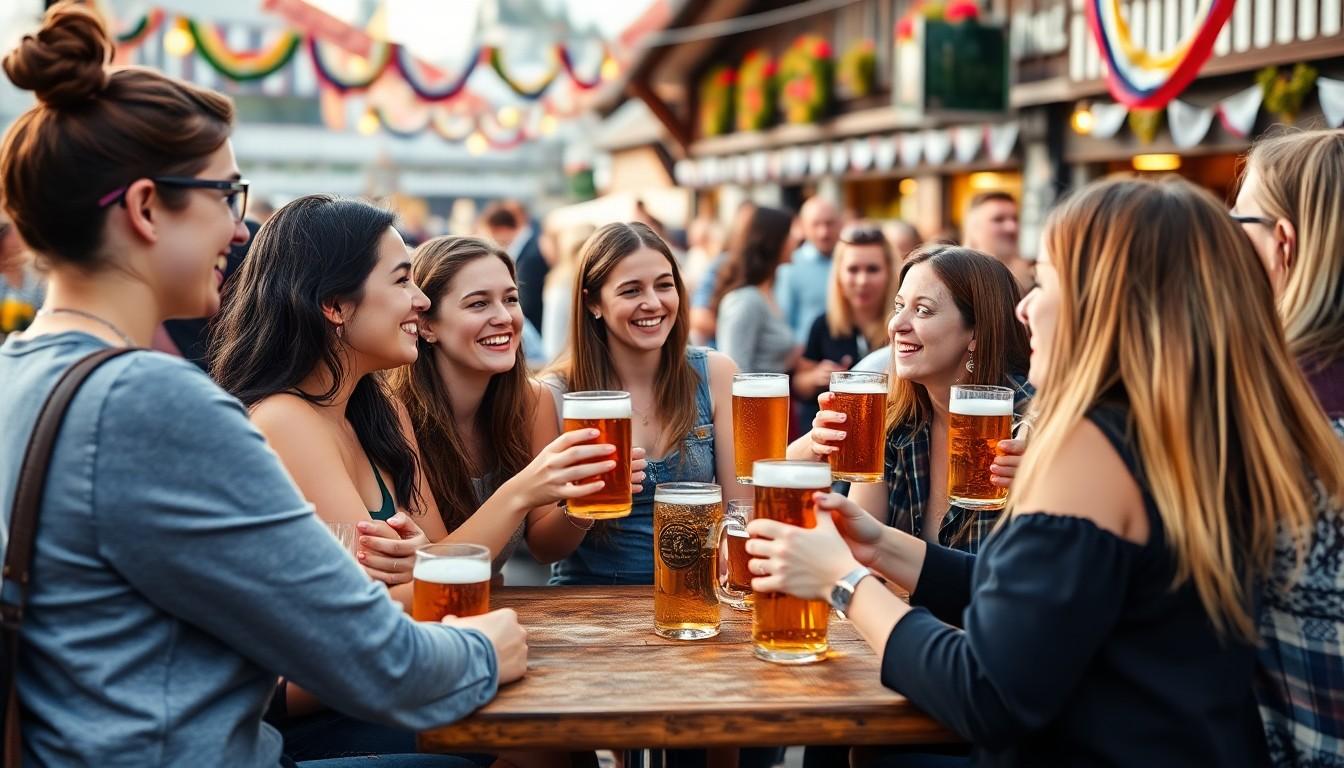
Visitors are turning Munich’s Oktoberfest into a more inclusive celebration, with “Bier, Boobs, Brezn” creating a dedicated space for lesbian women and FLINTA people. The event matters because it gives a traditionally male-dominated queer gathering a fresh balance, while keeping the familiar beer, pretzels, music and communal tables of the Wiesn.
Essential Takeaways
- A new queer gathering: Around 700 lesbian women and FLINTA guests are expected at the Bräurosl tent.
- A shift at the Wiesn: The event follows the long-running Rosa Sunday, where men make up roughly 90 per cent of attendees.
- More than a party: Organisers want queer women to be visible in a mainstream public setting, not only in dedicated clubs or community venues.
- A familiar Oktoberfest formula: Guests can expect shared tables, beer, food, dancing and the easy social energy of the fairground.
- Demand is growing: Organisers say interest in queer Oktoberfest events is outpacing available space.
Why this Oktoberfest event feels different
There’s nothing especially quiet about a packed Munich beer tent, but visibility can still be surprisingly uneven. That’s the thinking behind “Bier, Boobs, Brezn”, a new Oktoberfest gathering designed to put lesbian women and FLINTA people centre stage.
The event is being organised by Lost Girls, alongside Busenfreundin, and is listed as part of the 2026 FLINTA Wiesn programme. Details on the organisers’ event pages point to a deliberately social format rather than a formal conference or campaign: come together, share a table and enjoy the festival without having to search the crowd for familiar faces.
That simple idea has real weight. According to Stern, organiser Sina Scherer believes queer women have lost many of the spaces where they once met naturally, particularly in Munich’s Glockenbachviertel. The Wiesn, with its enormous public audience, offers a chance to make that community visible somewhere unexpected.
From Rosa Sunday to a broader queer Wiesn
The Bräurosl has hosted Rosa Sunday for more than four decades, according to the tent’s operators. It has become one of Oktoberfest’s best-known queer traditions, drawing thousands of gay men for a famously exuberant day of singing, embracing and raising steins.
But the balance has been markedly uneven. Stern reported that about 90 per cent of Rosa Sunday’s guests are men, which helps explain why organisers are extending the programme with additional events for women and FLINTA visitors.
Listings from Gay-Mag also place the gathering within the wider Rosa Wiesn tradition, the umbrella term often used for queer Oktoberfest celebrations. That broader context matters, because this isn’t an attempt to replace an established party. It’s more like adding another table to a very large, very noisy room.
What guests can expect from the FLINTA Wiesn
The appeal is partly that the event doesn’t try to turn Oktoberfest into something it isn’t. Scherer told Stern that the intention is to retain the classic Wiesn rituals: eating, drinking, dancing, meeting new people and enjoying a communal atmosphere.
The Lost Girls listings present the 2026 events as dedicated FLINTA gatherings, including a collaboration with Busenfreundin and a VIP option. Those listings suggest that guests are being offered different ways to take part, whether they want the full tent experience or a more specially arranged evening.
Practical details are worth checking before travelling. Event pages can set out entry conditions, timings, ticket categories and any VIP arrangements, while the broader Rosa Wiesn listings help place each party within the busy Oktoberfest calendar. A little planning is sensible here: the best tables at the Wiesn rarely reward last-minute optimism.
Why dedicated spaces still matter
Munich’s beer festival brings together generations, nationalities and all sorts of lifestyles, which is precisely why organisers see it as a useful place for queer visibility. As Scherer explained in comments reported by Stern, queer life shouldn’t be confined to queer clubs, festivals or community centres.
There’s also an economic history behind the gender imbalance at nightlife events. The Nordbayern report highlighted the argument that women’s and lesbian venues have often struggled because of different drinking patterns, venue costs and unequal incomes. A reserved Oktoberfest table can be an expensive proposition, so access is shaped by more than enthusiasm alone.
That makes a dedicated event feel practical as well as symbolic. It creates a clear meeting point, reduces the awkwardness of hunting through a crowded tent and lets guests spend their energy on the fun part: finding friends, joining a singalong and deciding whether one more pretzel is genuinely necessary.
A lively sign of where queer events are heading
The growing programme reflects a wider change in how queer events are organised. Rather than relying only on permanent venues, communities are increasingly taking over mainstream cultural spaces for specific occasions, bringing visibility into places where everyone already gathers.
The Lost Girls calendar shows how that model can expand, with several FLINTA-focused Wiesn dates and formats listed for 2026. Meanwhile, the established Rosa Wiesn tradition continues to provide a larger framework for queer visitors at Oktoberfest.
There’s a reassuringly ordinary quality to the whole idea. No reinvention is required, just a packed table, a cold drink, loud music and the feeling that you belong there. For many guests, that may be the most important detail of all.
The result is a more varied queer Oktoberfest, one that leaves room for old traditions while making space for new ones.
Source Reference Map
Story idea inspired by: [1]
Sources by paragraph:
- Paragraph 1: [2], [4]
- Paragraph 2: [3], [6]
- Paragraph 3: [5], [7]
- Paragraph 4: [2], [4]
- Paragraph 5: [3], [5]
- Paragraph 6: [6], [7]
- Paragraph 7: [2], [4]
- Paragraph 8: [3], [5]
- Paragraph 9: [6], [7]
- Paragraph 10: [2], [4]
- Paragraph 11: [3], [5]
- Paragraph 12: [6], [7]
- Paragraph 13: [2], [4]
- Paragraph 14: [3], [5]
- Paragraph 15: [6], [7]
- Paragraph 16: [2], [4]
- Paragraph 17: [3], [5]
- Paragraph 18: [6], [7]