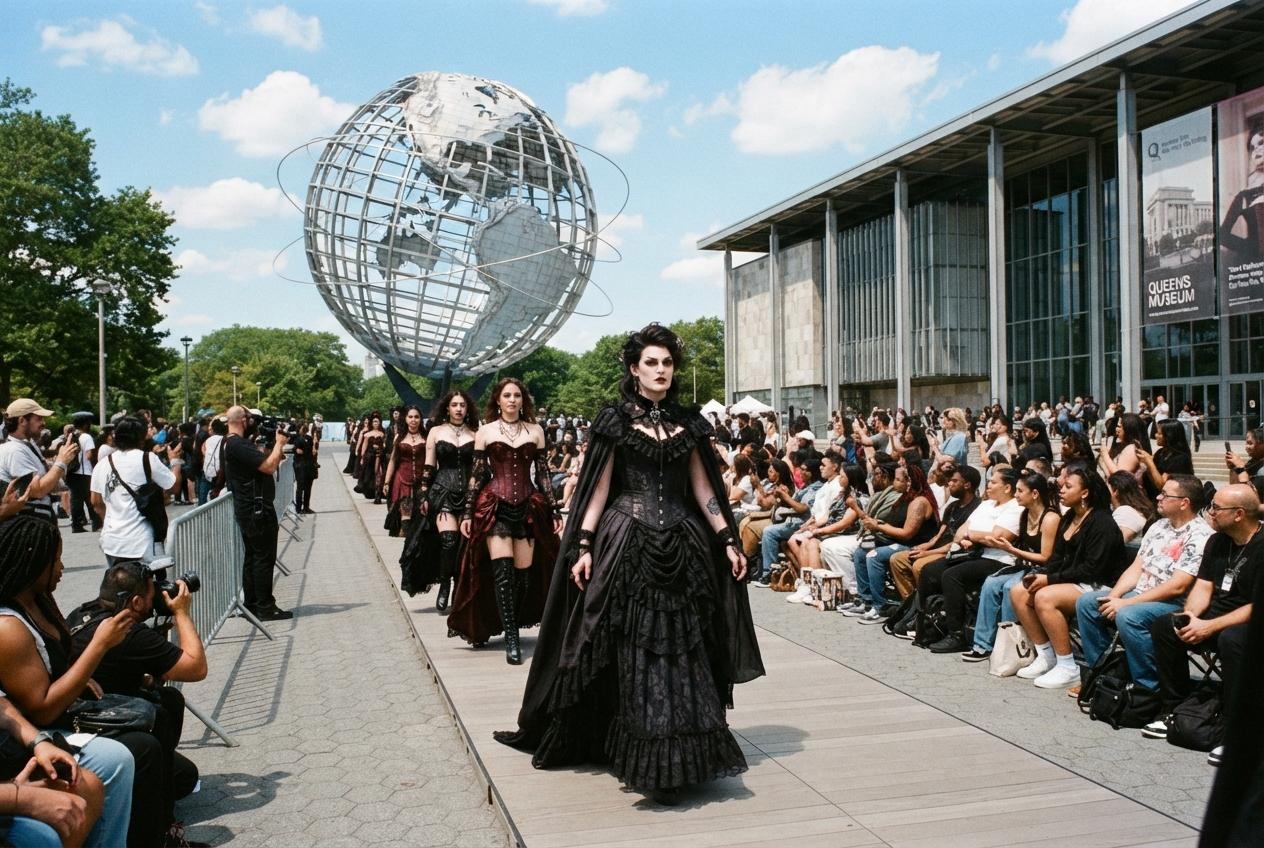
Fashion watchers gathered in Queens for Luar Spring Summer 2027, where Raúl Lopez turned the Unisphere at Flushing Meadows Corona Park into a stage for memory, identity and rebellion. The collection’s dramatic tailoring, aged lace and cacao-inspired prints made this one of New York Fashion Week’s most talked-about shows, with a deeply personal story stitched into every look.
Essential Takeaways
- A powerful setting: The show took place beneath the Unisphere, near places tied to Lopez’s childhood.
- Historical silhouettes: Strong shoulders, full breeches, narrow jackets and elongated trousers shaped the collection.
- Rich, tactile fabrics: Aged lace, velvet, moiré, jacquard and painterly textiles gave the clothes a weathered depth.
- A surreal edge: Chalk-white faces and vampire-inspired styling added theatrical drama without eclipsing the fashion.
- Accessories took centre stage: New bags, ripped gloves, curled ostrich feathers and brand collaborations expanded Luar’s visual world.
Luar’s Spring Summer 2027 show made Queens part of the story
The most striking thing about Luar Spring Summer 2027 wasn’t just the clothes. It was the sense that the entire show had been pulled from the neighbourhood around it, then magnified beneath the cool metallic curve of the Unisphere.
Raúl Lopez staged the collection in Flushing Meadows Corona Park, close to Flushing High School and Corona, where he studied and where his family lived. Coverage from Vogue and Fashionista placed the show among New York’s key Spring 2027 runway moments, with the public setting giving the presentation an unusually open, communal feeling.
Rather than hiding behind a closed venue, Luar let nearby park visitors watch from benches and the edges of the official guest area. It was a small but telling gesture. This was fashion as lived experience, not just a polished image sent out into the world.
A collection built around history, identity and reclamation
The title, Christopher Street Columbus, brought together two very different parts of Lopez’s personal and cultural history. Christopher Street evokes the queer New York spaces that shaped his coming-of-age, while Columbus points towards the complicated history of colonisation connected to his Dominican background.
That tension gave the show its emotional charge. According to runway coverage from Who What Wear and Now Fashion, the collection treated dress as a tool for revisiting identity, survival and resistance, rather than as a simple exercise in nostalgia.
The result was serious, but never solemn. Luar’s language remained bold and slightly unruly, with silhouettes that looked ready for a portrait, a night out or a dramatic entrance. There’s plenty of history here, but it arrives with attitude.
Medieval shapes get the Luar treatment
The clothing drew on 15th- and 16th-century forms, although Lopez pushed those references well away from costume. Monumental shoulders, full breeches, tight jackets, spiral sleeves and long, severe trousers created a wardrobe that felt both archaic and sharply modern.
Wallpaper’s New York Fashion Week review roundup and Vogue’s runway coverage highlighted the collection’s sculptural proportions. The shoulders were especially important, making the body look broader and more commanding, while narrow tailoring brought the eye back towards the waist and legs.
That contrast kept the looks from becoming heavy. A voluminous upper half met a lean trouser or jacket, while curved sleeves and elongated lines added movement. It’s a useful reminder that historical inspiration works best when the designer borrows its structure, not just its surface decoration.
Aged lace, cacao and beautifully strange textures
The fabrics gave the collection much of its atmosphere. Lopez developed custom lace in Portugal and treated it to look old, while silk pieces carried images of cacao pods photographed in the Dominican Republic. Jacquards suggested the fruit in a later, darker state of decay.
Brown and black striped velvet, dyed lace, moiré and painterly textiles deepened the palette. Fashionista and Kendam both drew attention to the collection’s layered material language, which made even familiar shapes feel slightly mysterious.
There’s something particularly effective about the cacao references. They connect the clothes to land, labour and memory, but they also bring a warm, earthy colour story to a runway otherwise filled with gothic drama. The fabrics look touchable, almost edible in places, before the darker details pull them back into something more haunted.
Vampires, feathers and accessories with bite
The show introduced a surreal story about vampires travelling on Columbus’s voyage. Models appeared with chalk-white faces, bringing a ghostly quality to the runway without turning the presentation into pure theatre.
That balance matters. The make-up was memorable, but the clothes remained the main event. Ripped gloves revealed jewelled fingers, while curled ostrich feathers added movement and a flicker of extravagance. Runway images from Vogue and Now Fashion show how those details helped the collection move between historical fantasy and contemporary street-level drama.
Accessories also reinforced Luar’s growing identity. New bags appeared alongside collaborations with MCM, Kenner and Cadbury, creating a mix of luxury, nostalgia and pop-cultural familiarity. It’s an unusual combination, but that friction is part of the appeal. Luar doesn’t seem interested in making every reference behave politely.
Why Luar Spring Summer 2027 stands out
Many runway shows use location as decoration. Luar used Queens as part of the argument. The park, the nearby schools and the visible public audience all connected the collection to Lopez’s own history, making the setting feel as important as the soundtrack or styling.
Reviews from Who What Wear, Wallpaper and Fashionista positioned the show within a wider New York conversation about spectacle, identity and place. But Luar’s strength was its specificity. This wasn’t a vague celebration of New York. It was one designer returning to a landscape that helped shape him, then asking what its histories mean now.
The collection leaves a strong impression because it feels both personal and performative. You can admire the huge shoulders, velvet and dramatic gloves on their own, but they become more compelling when viewed through the show’s larger questions. Fashion can be armour, memory and mischief all at once.
Luar’s Spring Summer 2027 collection proves that the strongest runway stories don’t simply reference the past. They argue with it.
Source Reference Map
Story idea inspired by: [1]
Sources by paragraph: