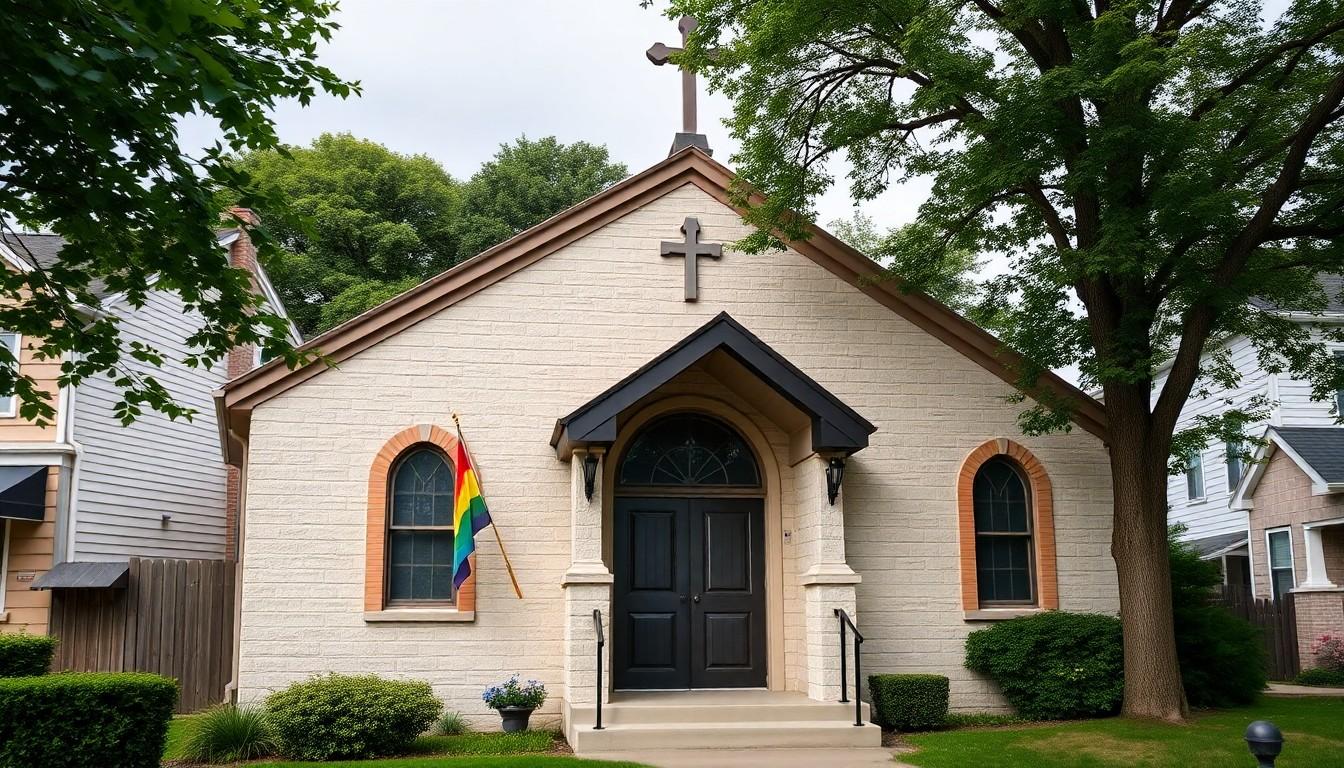
Queer Catholics are finding ways to hold sexuality and spiritual life together without choosing between them. For many, including writer Madalyn Goff, Catholicism remains a formative home while queerness becomes a source of honesty, freedom and belonging. Their stories matter because they challenge the assumption that faith and identity must stand on opposite sides.
Essential Takeaways
- Faith can remain meaningful: Some queer Catholics continue to draw comfort, ritual and identity from Catholic tradition.
- Shame is not the whole story: Personal reflection can replace fear with greater self-understanding and compassion.
- Identity needn't be split: Goff describes queerness and Catholicism as distinct but connected parts of one life.
- Community still matters: Personal conviction can be sustaining, but welcoming churches and support networks remain important.
- Reconciliation takes time: There isn't a single route to feeling whole, and the process can be ongoing.
A familiar faith, seen differently
For Madalyn Goff, Catholicism wasn't simply a Sunday practice. It was an early language for understanding love, responsibility, forgiveness and the world around her. That deep familiarity made the conflict with her queerness particularly painful, because walking away from the Church could feel like walking away from part of herself.
The Advocate has published several first-person accounts of LGBT Catholics wrestling with that same inheritance. Their experiences differ, but many describe a mixture of tenderness and tension: candles, hymns and familiar prayers on one side, while fear and self-questioning sit quietly beside them.
That emotional split can be exhausting. As Goff's story suggests, the turning point may come when a person stops treating honesty as a spiritual failure and begins to see it as part of faith's deeper work.
When guilt gives way to honesty
Early religious teaching can leave queer people wondering whether they must become less visible, less truthful or somehow less themselves. For Goff, that pressure took the form of prayers for change, shaped by the belief that queerness was a problem to solve rather than a part of her life to understand.
Research and personal accounts collected through DePauw University show how religious identity and sexual identity can remain intertwined, even during periods of doubt or distance. That is important context: leaving a church building doesn't necessarily mean leaving behind its symbols, stories or moral vocabulary.
Over time, Goff came to understand that her prayers had not been answered through a transformation of identity. Instead, she found greater peace by questioning the assumption that she needed fixing. It's a quiet shift, but a powerful one.
Queerness and Catholicism don't have to cancel each other out
The central idea in Goff's reflection is not that the tension disappears. Rather, she learns to interpret both parts of herself as ways of reaching towards love, truth and belonging.
That approach echoes other queer Catholic testimonies in The Advocate, where writers describe faith less as a set of tidy answers and more as an ongoing relationship. For some, Catholicism's emphasis on grace and forgiveness becomes newly meaningful after years spent negotiating shame.
It also challenges a familiar all-or-nothing narrative. A person can criticise institutional teaching, feel hurt by exclusion and still find value in prayer, sacrament or tradition. Human identity is rarely as neat as a debate headline suggests.
Finding support beyond the pews
Personal reconciliation can be deeply sustaining, but it shouldn't obscure the need for safer and more welcoming communities. The Human Rights Campaign's resources for LGBT Catholics have highlighted the importance of practical guidance, affirming congregations and spaces where people don't have to explain their right to belong.
That support can take several forms, from an inclusive parish and a trusted priest to an LGBT Catholic group or a friend who understands the emotional history involved. The right setting won't erase every difficult question, but it can make those questions less lonely.
For anyone exploring queer Catholic identity, a gentle starting point is to separate faith itself from the voices that have caused harm. Keep the practices that bring peace, question teachings that produce fear and seek people who treat dignity as non-negotiable.
A faith that keeps evolving
Goff doesn't claim to have solved every contradiction. Her position is more honest than that: she remains Catholic, remains queer and continues learning how to hold both with care.
That ongoing process appears in wider accounts of gay Catholic life, including reflections reported by National Catholic Reporter. Reconciliation is often less like reaching a final destination and more like building a livable understanding, one conversation and one prayer at a time.
There is something quietly hopeful in that. For many queer Catholics, wholeness isn't granted by an institution or proved through perfect certainty. It grows when people refuse to abandon the parts of themselves that make life truthful.
It's possible to carry faith as an anchor while allowing identity to remain free.
Source Reference Map
Story idea inspired by: [1]
Sources by paragraph: