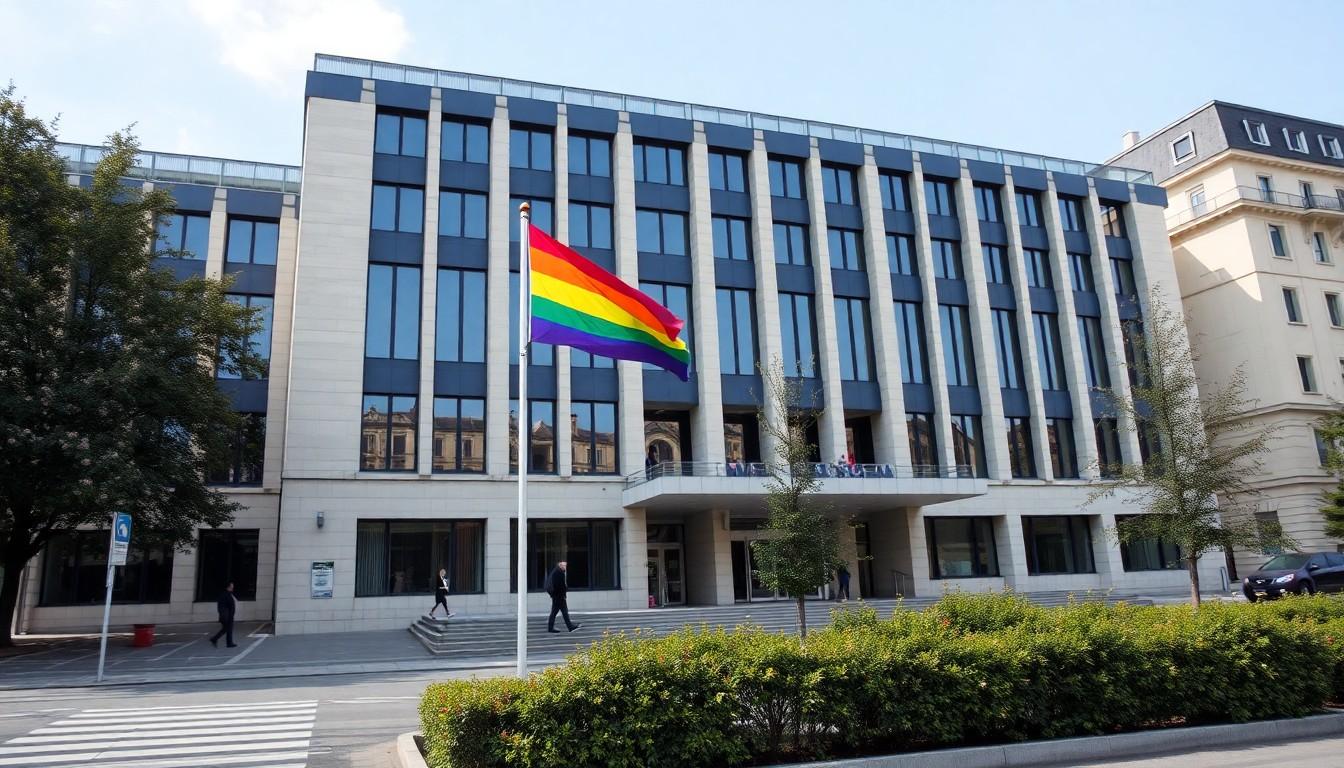
Hungary’s new government is moving to dismantle parts of the country’s anti-LGBT legal framework after a landmark EU court ruling, but campaigners warn that important barriers remain. The proposed changes could ease restrictions on books, media, advertising and education, while leaving constitutional language and Pride-related limits untouched.
Essential Takeaways
- A major legal step: Proposed amendments would remove several restrictions on depicting or discussing sexual and gender diversity.
- EU pressure mattered: The Court of Justice of the European Union ruled that Hungary’s 2021 law breached fundamental rights.
- Child protection remains focused: The revised framework would target pornography, grooming, exploitation and genuinely age-inappropriate material.
- Key gaps survive: Restrictions in the Family Protection Act, constitution and assembly law would remain.
- Pride is still vulnerable: Campaigners say the government must remove the legal basis for blocking LGBT-related demonstrations.
Hungary begins undoing the Orbán-era LGBT crackdown
Hungary’s government has taken a significant step towards dismantling laws that treated LGBT visibility as a danger to children. The proposed legislation, submitted to Parliament on 14 September, would delete several restrictions from rules covering child protection, broadcasting, advertising and education.
That matters because the 2021 law reached far beyond pornography or explicit sexual material. It restricted content that was seen to portray or promote homosexuality and gender diversity to children, making ordinary representation vulnerable to censorship. According to Human Rights Watch, the new bill marks a move away from that approach. [2]
The change follows months of legal and political pressure. The European Union’s top court found that Hungary’s restrictions stigmatised LGBT people, marginalised them and breached EU law. [3]
The EU court ruling changed the argument
In April, the Court of Justice of the European Union rejected Hungary’s attempt to justify the restrictions through the language of child welfare. The judgment made clear that protecting children can't be used as a blanket excuse for discrimination or for suppressing basic rights. [4]
The ruling was particularly important because it challenged the law’s central premise: that seeing LGBT people or learning about sexual and gender diversity is inherently harmful. The Guardian reported that the court considered the measures incompatible with core European values and fundamental rights. [5]
That distinction is now reflected in the proposed reforms. Instead of treating LGBT identity as suspect, the revised rules would focus on material with a clear safeguarding concern, including sexual exploitation, grooming, pornography and content unsuitable for a child’s age. It's a more sensible line, and frankly a more workable one for schools, parents and broadcasters.
The reforms are welcome, but the legal clean-up isn't complete
The biggest concern is that the bill doesn't remove every anti-LGBT provision. Section 5/A of Hungary’s Family Protection Act reportedly contains similar restrictions on content available to children, and those measures would remain in place. [2]
The proposed legislation also leaves constitutional wording untouched. Article XVI of Hungary’s Fundamental Law has been used to support restrictions affecting LGBT people, while separate provisions in the Freedom of Assembly Act have helped authorities restrict Pride marches and other LGBT-related gatherings.
Hungarian rights groups have therefore welcomed the direction of travel but called for a broader overhaul. The Hungarian Helsinki Committee, the Hungarian Civil Liberties Union, Háttér Society and Amnesty International Hungary have all argued that removing a few clauses isn't enough to dismantle the wider framework. [6]
What this means for schools, media and families
For educators and publishers, the reforms could reduce uncertainty around books, classroom discussions and age-appropriate information about LGBT lives. Under the old system, the risk wasn't limited to explicit content. A story, advert or lesson that simply acknowledged same-sex relationships or gender diversity could attract scrutiny.
That has created a chilling effect, with organisations left guessing about what might be considered a prohibited portrayal. IGLYO said the court ruling was an important test of whether Hungary would turn its pro-European commitments into meaningful protection for young people and LGBT communities. [7]
Parents may notice the difference less through one dramatic change than through the quiet return of ordinary representation. A school book, a television storyline or a public information campaign shouldn't become controversial merely because LGBT people appear in it. The real test will be whether the remaining laws continue to make that normal visibility risky.
Budapest has the numbers to finish the job
The government now has a parliamentary supermajority, giving it the political capacity to go further. That means campaigners aren't simply asking for a symbolic gesture. They want the remaining provisions removed, including the constitutional language and assembly rules that can still be used against LGBT rights.
The European court decision has provided a clear legal route, while domestic rights groups have set out the practical next steps. Euronews reported that the ruling placed renewed pressure on Budapest to bring its laws into line with EU standards. [4]
For Hungary’s LGBT community, the proposed changes may offer relief, but not yet security. A law can be softened on paper while public events, education and free expression remain exposed. The government has opened the door; now it needs to walk through it.
A partial repeal is progress, but full equality requires removing every remaining legal tool for discrimination.
Source Reference Map
Story idea inspired by: [1]
Sources by paragraph: