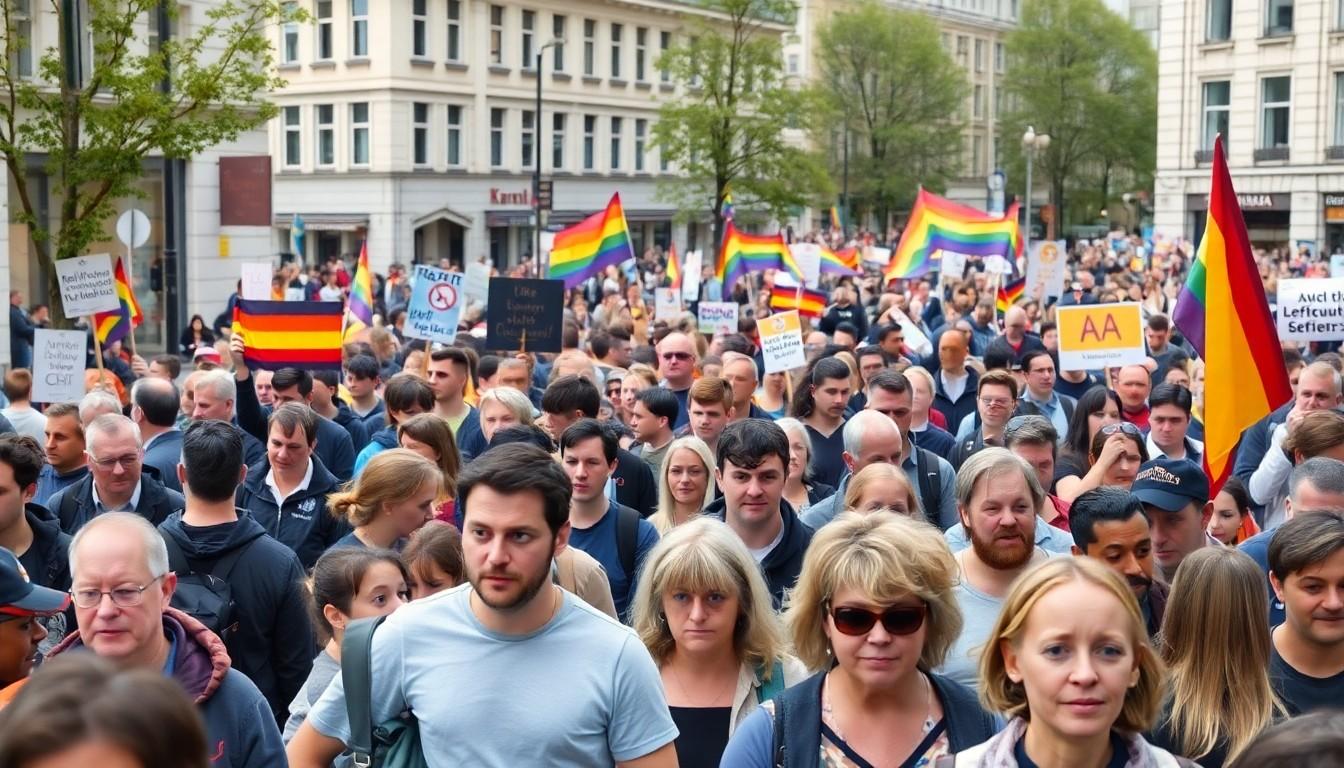
More than 100,000 people took to the streets across Germany, combining CSD celebrations with demonstrations for diversity as concern over the AfD’s growing strength intensified. The message was colourful, regional and resolutely peaceful: democratic resistance matters, especially when elections and political rhetoric leave minorities feeling exposed.
Essential Takeaways
- A nationwide response: Demonstrations stretched well beyond Berlin, bringing together communities across eastern and western Germany.
- CSD at the centre: Marches in Halle and Wismar linked queer rights with the wider fight for an open society.
- Peaceful visibility matters: Public protest signals that minorities and democratic institutions won't be left alone.
- Numbers aren't everything: Local participation may matter more than one national headline figure.
- A broader challenge: Campaigning for diversity could reach more people than focusing only on an AfD ban.
More than a crowd, a visible act of solidarity
The most striking thing about these demonstrations wasn't simply the scale. It was the sight of people choosing bright banners, music and collective movement over the usual political gloom. In a tense atmosphere, that kind of public confidence can feel quietly powerful.
Earlier demonstrations against the far right have also drawn substantial crowds. Zeit reported that around 35,000 people took part in one protest, while a separate gathering in Weimar brought roughly 1,000 people together. Those events underline a pattern: resistance isn't confined to one major city or a single political moment. [2], [3]
Why regional protests carry extra weight
A national total can be impressive, but geography tells the more revealing story. When demonstrations appear in smaller towns and across different regions, they challenge the idea that opposition to the far right belongs only to an urban, left-wing bubble.
That matters as Germany heads into important state-level political contests. Results from Bavaria and Hesse showed how much influence regional elections can have on the national conversation, while also reminding voters that political change is often experienced locally first. [4], [5]
For people watching from outside Germany, the lesson is familiar. Democracy isn't protected only in parliament; it's also defended in town squares, on high streets and at community events where neighbours decide whether to remain visible.
CSD marches make the message personal
The CSD processions in Halle and Wismar gave the weekend's protests a particularly direct focus. Queer rights aren't an abstract constitutional footnote for those affected. They're bound up with family life, safety, public space and the simple freedom to be seen without fear.
That combination of celebration and protest is one of the strongest features of Pride-style demonstrations. The atmosphere can be joyful, but the demands are serious. A rainbow flag, a handmade placard and a packed route can turn political solidarity into something people can see and feel.
The need for that visibility looks sharper as far-right parties gain ground. Reporting on the AfD's later success in Saxony-Anhalt described supporters celebrating a historic result, while profiles of regional leader Ulrich Siegmund highlighted the movement's ability to turn frustration into political momentum. [6], [7]
Is an AfD ban enough?
Calls for banning the AfD may attract attention, but they don't automatically build a broad democratic majority. Some voters see such demands as necessary protection; others view them as a move that bypasses persuasion, particularly close to an election.
That leaves campaigners with a harder, but potentially more productive, task. They need to make the case for diversity in practical terms, from protecting queer people and minorities to defending fair public institutions and resisting political violence.
The evidence from the demonstrations suggests that positive, concrete messages may travel further than warnings alone. People can rally around safety, dignity and equal rights more readily than around a single procedural demand. It won't solve the political problem overnight, but it gives the movement somewhere to go.
The next test is keeping people involved
One weekend of protest won't reverse an election result or settle Germany's argument over the AfD. Still, public action can strengthen networks, reassure vulnerable communities and make intimidation less effective.
The challenge now is consistency. Demonstrators need to remain engaged between election campaigns, while political parties and civic groups must show that democratic values connect with everyday concerns such as housing, work, public services and security.
That may sound less dramatic than a giant march, but it's where lasting change is built. A packed street can lift spirits; sustained local organising is what keeps the hope alive.
It's a small victory when people refuse to disappear, but it's an important one.
Source Reference Map
Story idea inspired by: [1]
Sources by paragraph: