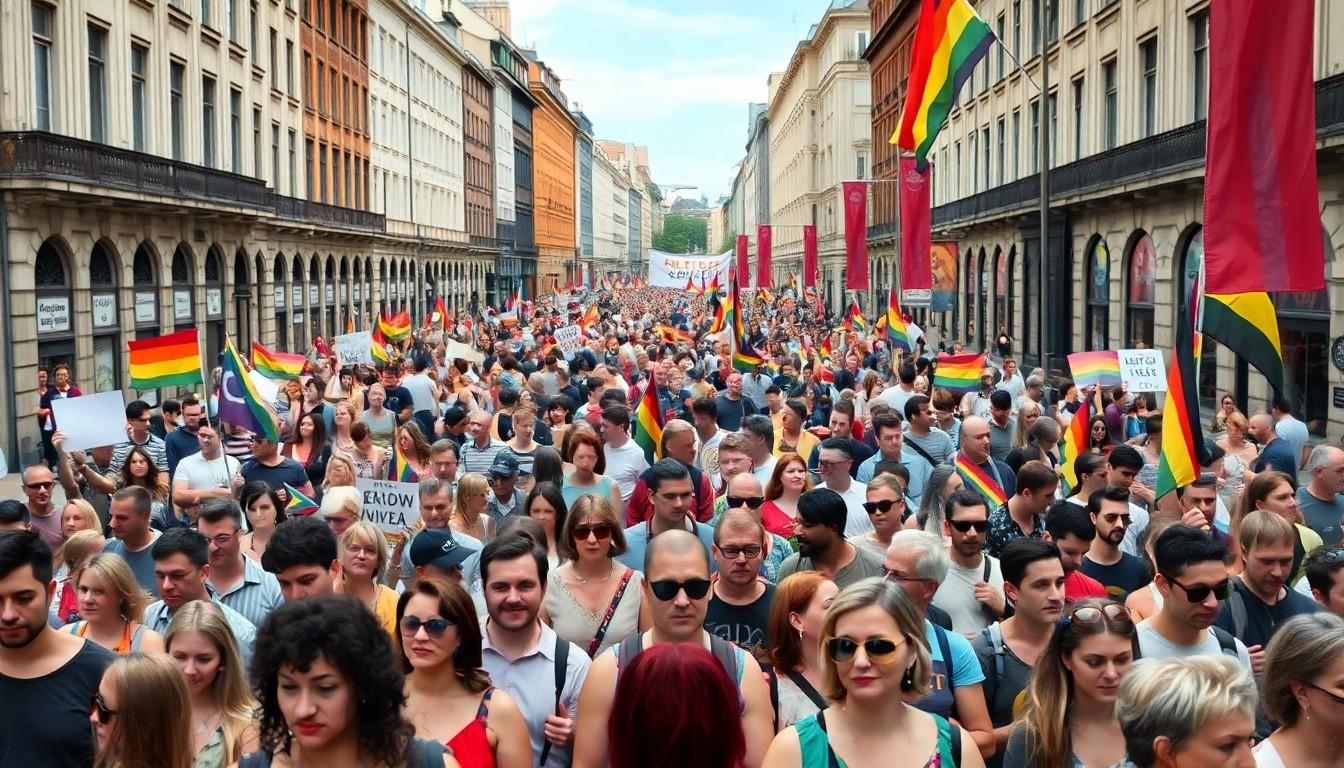
Crowds in Halle and Wismar have made queer visibility a powerful response to the far right, just days before and after key regional elections. With the AfD winning 43.8 per cent in Saxony-Anhalt, and polling strongly in Mecklenburg-Vorpommern, these colourful marches matter far beyond one weekend.
Essential Takeaways
- Halle saw a record crowd: Around 8,000 people joined the CSD or its street festival, roughly four times last year's turnout.
- Wismar stayed visible: About 2,000 people marched through the coastal city despite fears of far-right disruption.
- The election changed the mood: Queer organisers linked rising AfD support with concerns about safety, funding and public space.
- Counter-protests were limited: Right-wing mobilisation remained small in both cities, although police maintained a visible presence.
- Solidarity offered practical comfort: Participants described the marches as a rare feeling of safety during an anxious political moment.
Halle's biggest Pride march becomes a political answer
The loudest message in Halle wasn't coming from a campaign stage. It rose from a moving crowd wrapped in rainbow flags, paper signs and shimmering bubbles, with pop music rolling through the streets. According to the taz, around 8,000 people took part in the city's CSD or attended the accompanying festival, making it the largest event of its kind there. [4]
That turnout came less than a week after the AfD won 43.8 per cent of the vote in Saxony-Anhalt. Anadolu Agency reported that the result marked a record performance for the party in the state, sharpening fears about what its influence could mean for minorities and civil society. [3]
For many marchers, the event was therefore more than a celebration. It was a public show of defiance, and a chance to stand close to people who understood the same unease. As one participant told the taz, seeing so many people gather created a feeling of safety. [4]
Why the election result feels personal
The political shock is especially sharp for queer people living outside the most progressive urban centres. The taz reported that some participants from rural Saxony-Anhalt were questioning whether they could still feel safe going out in the evening, while teachers described a sudden change in the atmosphere at school. [7]
Research on the AfD's local support helps explain why the reaction isn't simply about party politics. A study published through SSOAR examined the party's local representation and found that its appeal is shaped by regional conditions, identities and community narratives, rather than by one single national issue. [7]
That matters because political language can eventually become everyday pressure. The taz noted that the AfD's state programme attacks what it calls rainbow ideology and proposes a more traditional family model, while opposing the visibility of rainbow symbols in places such as schools. [5]
Wismar marches under a watchful eye
Around 350 kilometres north, Wismar's CSD carried a different kind of tension. Roughly 2,000 people joined the procession, filling the Baltic city with hard electronic music, flags and a determined sense of occasion. Local reporting from Wismar described the event as taking place amid concern about possible protests by right-wing groups. [4]
The fears weren't abstract. The region has a long record of extremist activity, and previous Pride events nearby attracted sizeable neo-Nazi counter-demonstrations. Organisers responded with heightened security advice, including asking people to travel in groups and keeping the route private until shortly before the march. [4]
In the end, the expected counter-protest failed to materialise in large numbers. A few far-right activists appeared, but the main event continued. That's encouraging, although it would be a mistake to confuse a quieter day with a problem solved.
From anger to practical resistance
The marches also revealed a change in how organisers are thinking about resistance. Speaking to the taz, participants argued that slogans alone won't be enough if services close, harassment increases or people feel forced to leave their communities. They pointed instead to networks, mutual support and de-escalation skills. [7]
That instinct fits the broader national picture. Axios reported that the AfD's breakthrough has intensified debate about Germany's so-called firewall, the reluctance of established parties to co-operate with the far right. [2] The question is no longer only whether parties will work with the AfD, but how local institutions, schools and community groups will protect people in the meantime.
There was also a clear contrast between celebration and alarm. Le Monde reported that AfD supporters welcomed the election result as a moment of renewed unity, while coverage in France described the victory as a shock with consequences beyond Germany's borders. [5] On the streets of Halle and Wismar, that political divide was no abstract argument. It was visible in who felt able to gather, speak and be seen.
A bright weekend, but not an easy one
The relative calm at both CSDs offered organisers a welcome breather. Police were present, hostile groups remained small, and thousands of people got to dance, march and share a rather necessary moment of joy. The taz described Halle's event as largely undisturbed, despite the tense political backdrop. [4]
Still, the outlook remains uncertain. Polling before the Mecklenburg-Vorpommern election placed the AfD in the lead, with the governing SPD close behind, according to the taz. [6] That made Wismar's CSD feel like both a celebration and a public test of whether democratic solidarity could hold under pressure.
The most hopeful detail came from the people who refused to surrender their connection to home. One Halle activist who had previously left because of fear said she planned to return. It's a small but powerful reminder that Pride can be joyful, defensive and deeply local all at once.
These CSDs show how public visibility can become a form of protection when politics grows darker.
Source Reference Map
Story idea inspired by: [1]
Sources by paragraph: