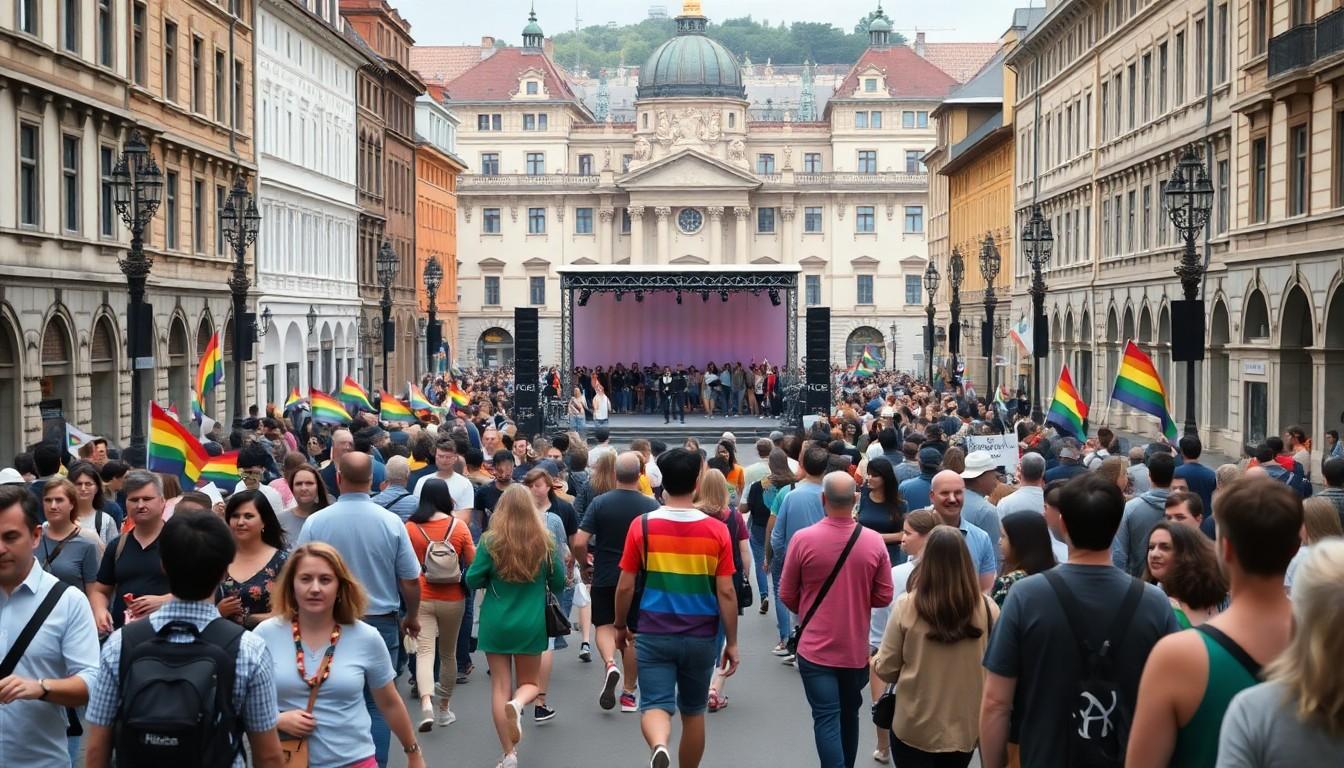
Hundreds joined Pécs Pride in southern Hungary for a calm, colourful march supporting human rights, freedom of assembly, identity and acceptance. Organised as the closing event of the Freedom of My Identity festival, the procession travelled from Uránváros towards the city centre, bringing visibility and solidarity to the streets.
Essential Takeaways
- A city-wide procession: The route covered roughly five kilometres, beginning in Uránváros and ending at Kossuth Square.
- A human-rights focus: Organisers highlighted identity, free love, acceptance and the right to gather peacefully.
- Part of a wider festival: Pécs Pride closed the week-long Freedom of My Identity programme.
- A calm public event: Police provided security as the march passed through central streets, including Király Street.
- A visible statement: Organisers said recent events made it especially important to stand up for diversity and European values.
Pécs Pride brings a message of visibility to the streets
The strongest image from this year's Pécs Pride was also the simplest: people walking together through the city in broad daylight, with the route linking a former mining district to the historic centre. The march set off from Uránváros at 2pm before heading towards central Pécs. According to QLit, the procession formed part of a wider effort to make LGBTQ+ people and their supporters more visible in public life. [2], [4]
That route mattered. Uránváros is closely associated with the city's industrial and mining heritage, while the march's arrival in the centre placed its message directly among the everyday rhythms of shops, pavements and café terraces. It was a reminder that debates about equality aren't abstract when they unfold on familiar streets. [3], [4]
A peaceful five-kilometre route through Pécs
The procession moved north towards the city centre, passing along Király Street, one of Pécs's key pedestrian thoroughfares, before reaching Kossuth Square. There, speakers were expected to address the crowd from a stage. The event proceeded under police protection and was reported as calm. [2], [4]
For a march like this, the atmosphere is part of the message. A steady walk, a bright banner and the gentle noise of a crowd can say plenty without turning the event into confrontation. Reports on earlier Pécs Pride marches also placed emphasis on peaceful participation and public visibility. [5], [6]
Why the Freedom of My Identity festival matters
Pécs Pride was organised as the final day of the Diverse Youth Network's Freedom of My Identity human-rights festival. The programme gave the march a broader setting, connecting the public procession with conversations about identity, dignity and equal treatment. The organisation's festival materials describe a programme built around human-rights education and community participation. [7]
That wider context is important because Pride is rarely just a single afternoon. Workshops, talks and community events can offer the quieter space needed for people to ask questions, share experiences and find support. The march then becomes the most visible part of a longer week of engagement. [4], [7]
Diversity and European values take centre stage
Organisers said recent developments made it particularly important to stand up for diversity and European values. Their message placed freedom of assembly alongside self-expression, acceptance and the right to live openly. Those themes have appeared repeatedly in reporting around Pécs Pride and similar Hungarian events. [2], [5]
The language may sound familiar, but its meaning changes with the moment. When public gatherings face greater scrutiny, simply showing up can feel like a meaningful act of solidarity. As PinkDex reported about a previous Pécs Pride, the event also attracted international diplomatic attention, underlining the wider interest in Hungary's LGBTQ+ rights debate. [6]
What the march says about Pécs
Pécs has become an important regional setting for Pride in Hungary, giving communities outside the capital a platform of their own. The city's distinctive mix of university life, cultural activity and industrial history makes the event feel rooted rather than imported. It belongs to the local streets, local communities and people who choose to take part. [3], [4]
The outlook is likely to remain shaped by the same tension: organisers want a welcoming public celebration, while participants also want to defend basic freedoms. For many marchers, that combination is the point. Pride can be joyful, but it can also be quietly determined, especially when visibility still carries personal weight. [5], [7]
Pécs Pride shows how a peaceful walk can turn visibility into a shared civic statement.
Source Reference Map
Story idea inspired by: [1]
Sources by paragraph: