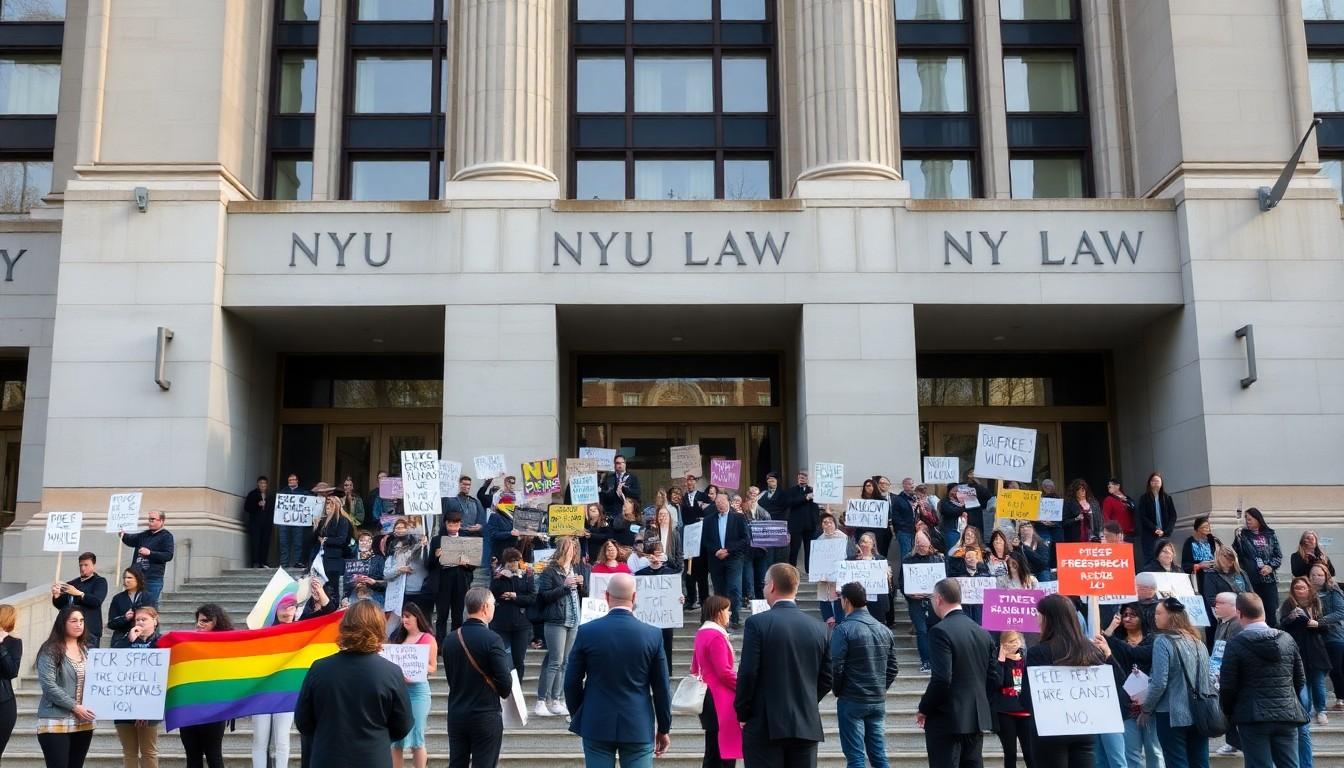
Students at New York University have clashed over a campus talk on sex-based rules in women’s sport, turning a legal discussion into a wider argument about protest, inclusion and academic freedom. The episode matters because universities are increasingly being asked to balance open debate with the safety and dignity of LGBTQ+ students.
Essential Takeaways
- A contested lecture: NYU Law hosted a Federalist Society event examining whether sports teams can be organised by sex.
- Student opposition: Critics said the discussion promoted anti-trans and anti-LGBTQ+ views, while supporters framed it as a legal policy debate.
- A rival event: Students organised a separate discussion supporting transgender participation in sport and public life.
- The wider issue: The dispute reflects a growing national argument over transgender athletes, free speech and university speaker policies.
- A familiar tension: Protest is protected, but attempts to silence or disrupt speakers can raise difficult questions about campus rules.
A sports law lecture becomes a campus flashpoint
The sharpest detail is perhaps the smallest one: a modest law-school audience, surrounded by a much larger controversy. Jim Campbell, chief legal counsel at the Alliance Defending Freedom, spoke at NYU about the constitutional case for organising sport on the basis of sex, with recent Supreme Court litigation providing the legal backdrop.
The event was listed by NYU Law as a discussion of the 14th Amendment and sex-based athletic categories. On paper, that sounds like a conventional law-school debate. In practice, the subject sits at the intersection of identity, fairness and personal safety, so the temperature rose quickly. NYU’s event listings show how the university has continued to host programming on sports law and policy, even as the issue remains politically charged. (According to NYU Law.)
Students opposed to the talk argued that giving Campbell a platform legitimised discrimination against transgender people. Others viewed the event as precisely the kind of contentious legal discussion universities should make room for. That disagreement is now almost as important as the sporting question itself.
Why transgender participation has become such a divisive issue
Arguments over transgender athletes have moved well beyond changing rooms and playing fields. They now involve constitutional interpretation, state legislation, school policies and the meaning of equal treatment. ESPN has reported on growing pressure around transgender participation in women’s sport, showing how disputes once handled by governing bodies have become national political campaigns. (According to ESPN.)
Supporters of sex-based categories typically point to physical development, competitive balance and the protection of opportunities for female athletes. Opponents argue that blanket exclusions can stigmatise transgender people and deny them meaningful participation in public life. Neither side sees the issue as a minor technical adjustment, which explains why campus events can feel intensely personal.
That emotional charge matters in a university setting. A seminar room may be designed for careful argument, but students still experience the subject through their own bodies, identities and communities. The result is a debate where legal language and lived experience often collide.
Protest, counter-programming and the limits of disruption
Students responded with a petition calling on NYU Law not to platform what they described as anti-LGBTQ+ hate speech. A separate counter-event, focused on transgender inclusion in sports and wider public life, offered students a way to challenge the speaker without relying solely on cancellation.
That approach is common on campuses: counter-programming keeps the argument visible while giving opponents their own microphone. NYU has a long history of public events and debates across legal and policy subjects, including sports-law programming involving academics and practitioners. (NYU Law has published details of its sports-law colloquia.)
But protest can become more complicated when demonstrators try to stop an event from taking place. ABC News has previously reported on arrests connected with protests involving conservative speakers at NYU, illustrating how quickly campus expression can shift from signs and chants to police intervention. (According to ABC News.)
The practical dividing line is usually straightforward, even if applying it isn't. Students can criticise a speaker, demonstrate outside a venue and organise a competing event. Deliberately preventing an audience from hearing the talk is more likely to breach institutional rules.
What NYU's free-speech dilemma reveals
NYU's position is familiar: universities should host speakers representing a broad range of views, particularly when the subject concerns law and public policy. That principle is easiest to defend when institutions also make space for those affected by the debate, rather than treating inclusion as an afterthought.
For students, however, neutrality can feel anything but neutral. If a speaker argues for excluding people like them from a public activity, an invitation may look less like academic openness and more like institutional approval. That perception helps explain why petitions often focus not only on the speaker's argument, but also on the university's responsibility to protect its community.
The challenge is to distinguish disagreement from harassment. NYU's wider academic and public programming shows that the institution routinely treats difficult issues as suitable for debate. The question is whether it can do so while making students feel heard rather than simply told to tolerate the discomfort.
How universities can handle divisive speakers better
The most useful response isn't necessarily cancellation. Universities can publish clear event rules, explain why a speaker has been invited and provide equal access to alternative viewpoints. They can also brief attendees on what counts as protected protest, disruption and harassment before the doors open.
That clarity matters because students shouldn't have to guess where the boundaries are, while speakers shouldn't be able to treat a campus as a consequence-free stage. FIRE has repeatedly argued that institutions need to educate students about the difference between protest and disruption, especially where campus speech climates are already tense. (According to FIRE's campus free-speech research.)
There is also a basic human point. A person can oppose a policy without treating another student as a political abstraction, and a university can defend free inquiry without dismissing the fear or frustration that a topic creates. That balance is difficult, but it's the standard institutions should be aiming for.
The debate over transgender athletes will continue in courts, legislatures and sporting bodies. On campuses, the best test may be whether students leave with sharper arguments, rather than simply louder slogans.
A small lecture has exposed a very large question: who gets heard, and how can everyone else remain part of the conversation?
Source Reference Map
Story idea inspired by: [1]
Sources by paragraph:
- Paragraph 1: [2], [3]
- Paragraph 2: [2], [7]
- Paragraph 3: [3], [4]
- Paragraph 4: [3], [7]
- Paragraph 5: [2], [5]
- Paragraph 6: [3], [4]
- Paragraph 7: [4], [7]
- Paragraph 8: [2], [7]
- Paragraph 9: [3], [4]
- Paragraph 10: [5], [7]
- Paragraph 11: [2], [6]
- Paragraph 12: [3], [4]
- Paragraph 13: [2], [7]
- Paragraph 14: [3], [6]
- Paragraph 15: [4], [5]
- Paragraph 16: [2], [7]
- Paragraph 17: [3], [4]
- Paragraph 18: [2], [6]