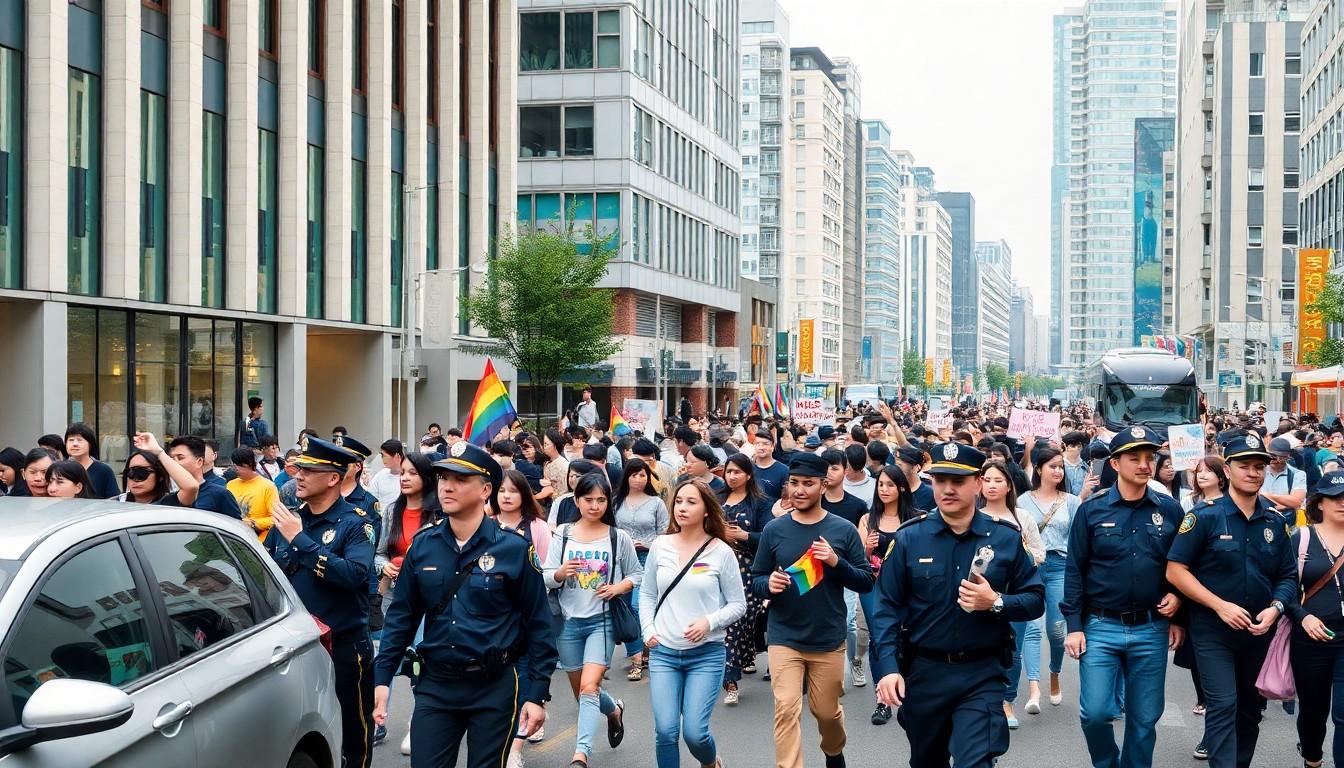
Crowds gathered in central Daegu for the 18th Daegu Queer Culture Festival, while opposing groups held a nearby rally, creating a tense but largely managed day of speeches, stalls and street marches. The event mattered beyond its colourful public face, highlighting South Korea's continuing debate over LGBTQ+ rights, public space and the practical impact of major demonstrations.
Essential Takeaways
- Two events, one city centre: The festival and an opposing rally took place in nearby parts of central Daegu.
- A full programme: Organisers offered 68 stalls, performances, speeches and an afternoon parade.
- Large police presence: Around 700 officers and 46 vehicles were deployed to prevent clashes and manage traffic.
- Travel disruption: Road closures and diversions caused congestion and inconvenience for public transport users.
- A wider national debate: Recent court decisions and Pride events elsewhere in South Korea show that disputes over LGBTQ+ gatherings are still unfolding.
Daegu's city centre became a stage for competing messages
The most striking feature of the day was its proximity. Festival-goers gathered near 2.28 Memorial Central Park, while opponents met around Banwoldang Intersection, turning a busy stretch of Daegu into a highly visible contest over rights, identity and public space.
The festival's slogan, "Sapil Qjeong", used a play on the Korean phrase meaning that history ultimately moves towards justice. Organisers said the message reflected their hope for equality, dignity and a society without discrimination, according to Newsis.
The atmosphere combined the familiar energy of a Pride event with the sharper edge of a public dispute. Stalls opened from midday, followed by performances, formal addresses and participant speeches before the parade moved through the city.
A parade, 68 stalls and a clear call for equality
For supporters, the event was about making LGBTQ+ people visible rather than asking them to remain private. The programme gave visitors several ways to take part, from browsing stalls and listening to speakers to joining the march through central streets.
Nam Kyung-hye of the Daegu Human Rights Office said at the festival that people should be able to live safely as themselves, without exclusion or discrimination. She also warned that prejudice still leaves some people hiding their identities or dealing with emotional harm, Newsis reported.
That emphasis reflects the broader shape of Pride events in South Korea. They often operate as cultural festivals and rights campaigns at the same time, with music and colour alongside direct appeals for legal and social protection. The result can feel celebratory, but it rarely feels politically neutral.
Opponents raised familiar objections about law and public disruption
The opposing rally began with prayer and worship before speakers criticised same-sex relationships and legislation aimed at preventing discrimination. Organisers said they wanted the festival moved away from the city centre, citing concerns about businesses, transport disruption and young people's welfare.
Those arguments have appeared repeatedly in disputes over public Pride events. Opposing groups have also used petitions and formal complaints to challenge organisers' access to prominent civic spaces, while festival supporters argue that moving events out of sight would limit equal participation in public life.
The disagreement is not confined to Daegu. National reporting has documented similar clashes over venue access, while international LGBTQ+ coverage has highlighted the scale of both Pride gatherings and counterprotests in Seoul. That makes the Daegu event part of a much larger conversation, rather than an isolated local quarrel.
Police planned for a tense afternoon
Authorities deployed roughly 700 officers and 46 pieces of equipment to separate the groups, protect participants and keep vehicles moving. Despite that preparation, several central routes were partially closed, including sections near Jungangno and Banwoldang.
The closures affected drivers and bus passengers, with congestion building around the event areas. For anyone travelling through central Daegu, the practical lesson was simple: on days like this, checking route changes before setting out can save a frustrating wait in a stationary bus or taxi.
Large demonstrations always create a balancing act. Public gatherings need room to happen safely, but city centres are also workplaces, shopping areas and transport corridors. The challenge for organisers and authorities is to protect both the right to assemble and the public's ability to move around.
Why the next festivals will remain closely watched
A recent court decision involving use of a city hall plaza in Incheon showed that venue disputes can become legal as well as political. Meanwhile, the size of Seoul's Pride celebrations and counterprotests suggests that public interest, and public tension, isn't fading.
For Daegu's organisers, the day's parade was a statement that LGBTQ+ people belong in the centre of civic life. For opponents, the same streets represented a place where they could challenge the festival and campaign against proposed equality measures.
That uneasy coexistence may define future events. Pride in South Korea is becoming more visible, but visibility brings both solidarity and confrontation. For residents, the hope is that future gatherings can be handled with less disruption and fewer opportunities for hostility.
The bigger question is whether public space can accommodate disagreement without treating anyone's existence as a problem.
Source Reference Map
Story idea inspired by: [1]
Sources by paragraph:
- Paragraph 1: [2], [4]
- Paragraph 2: [3], [5]
- Paragraph 3: [4], [6]
- Paragraph 4: [2], [7]
- Paragraph 5: [5], [6]
- Paragraph 6: [3], [7]
- Paragraph 7: [2], [4]
- Paragraph 8: [5], [6]
- Paragraph 9: [3], [7]
- Paragraph 10: [2], [4]
- Paragraph 11: [5], [7]
- Paragraph 12: [6], [7]
- Paragraph 13: [2], [5]
- Paragraph 14: [3], [6]