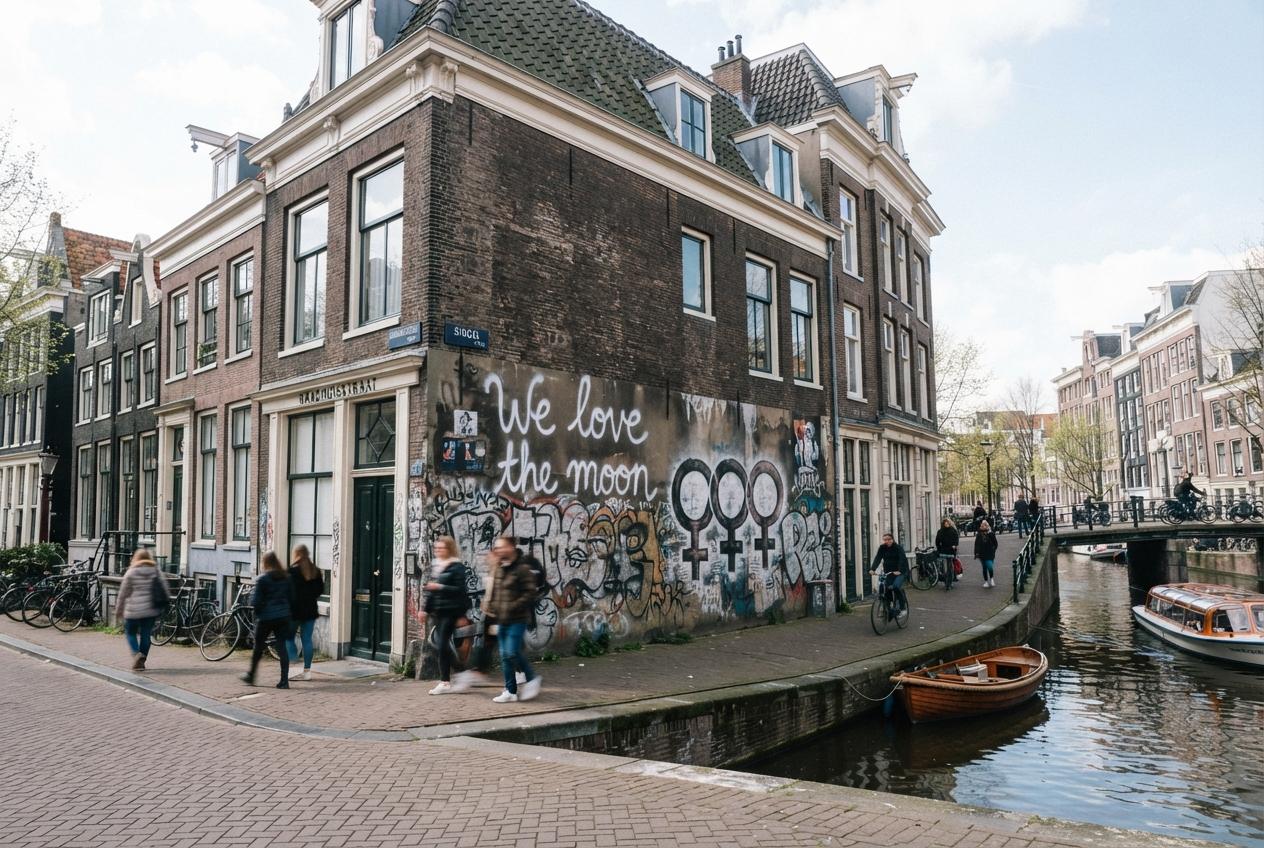
A vivid personal memory opens a window on Lesbian Nation, the radical feminist network that helped women in the Netherlands imagine a different kind of life. From purple ink on an Amsterdam wall to women’s cafés, demonstrations and shared bedrooms, this story reveals how movements are often made by people history barely names.
Essential Takeaways
- A personal history: The account focuses on lived experience rather than presenting a complete institutional history.
- A striking first encounter: The words “We love the moon” and linked woman symbols introduced the writer to Lesbian Nation.
- A wider world: Lesbian Nation offered an alternative to conventional student, family and social life.
- An international movement: The organisation formed part of a broader lesbian-feminist current that emerged in the 1970s.
- A local Amsterdam setting: Women’s venues, demonstrations and city walls became important spaces for visibility and connection.
One painted wall, and a door into another life
The most powerful detail is also the simplest: purple ink sprayed across a wall, declaring “We love the moon” beside three linked woman symbols. It feels playful, secretive and boldly public all at once. According to the personal account, that small act became an introduction to Lesbian Nation and to a community the writer hadn’t known existed.
The wall stood at the corner of Raadhuisstraat and the Singel in Amsterdam, on a building that has since disappeared. Amsterdam’s changing streetscape gives the memory an added poignancy. The words are gone, the building is gone, but the image still carries the excitement of discovering an alternative map of your own city.
Lesbian Nation was more than a name
Lesbian Nation emerged from the radical lesbian-feminist politics of the early 1970s, particularly in the United States, where activists argued that lesbian life could be understood as a political and cultural choice as well as a sexual identity. Reference works describe it as a separatist organisation associated with the idea of creating communities centred on women and free from male power.
That language could sound uncompromising, and it was. Yet the movement also answered a practical need: women wanted places where they could meet, organise, flirt, argue, create and simply relax without having to explain themselves. In the Netherlands, the idea gained its own character through local groups and networks, as the IHLIA LGBT Heritage archive records.
The Dutch story happened in ordinary rooms
Large demonstrations make good photographs, but movements are usually sustained in smaller spaces. Women’s cafés, cramped meeting rooms, kitchens and bedrooms allowed relationships to develop away from official organisations and public attention. The personal account deliberately looks from the edge of meetings and into everyday lives, where much of the real work took place.
That focus matters because many participants never became public figures. Amsterdam’s lesbian and feminist history includes graffiti, protests and confrontations with authority, but it also includes informal gatherings and friendships that rarely entered newspapers or archives. The city’s own historical material on the 1970s and 1980s shows how activism could be both highly visible and intensely personal.
Why these memories still feel immediate
Lesbian Nation’s appeal lay partly in its promise of an entire world alongside the one people already knew. For someone moving through student life and teacher training, the discovery suggested that identity didn’t have to remain private or fit neatly into existing institutions. There were other women, other customs and another vocabulary for belonging.
The phrase “Lesbian Nation” did plenty of work in just two words. It suggested territory without borders, citizenship without paperwork and a culture built through recognition. Dutch reference sources describe the term as part of a lesbian-feminist vocabulary that helped name experiences mainstream language often ignored.
What survives after the slogans fade?
The Amsterdam wall may have vanished, but the instinct behind it remains recognisable. People still create community through signs, venues, archives, social groups and stories passed between generations. The formats change, but the need to find evidence that you aren't alone is remarkably steady.
That’s why personal recollections such as this one matter alongside formal histories. They preserve the texture of a movement: the colour of the ink, the feel of a café table, the uncertainty before entering a new world. As IHLIA’s account of the Dutch Lesbian Nation shows, the history is not only in the organisations that can be listed, but also in the women who made a life around them.
A movement can begin with something as small as a few words on a wall.
Source Reference Map
Story idea inspired by: [1]
Sources by paragraph: