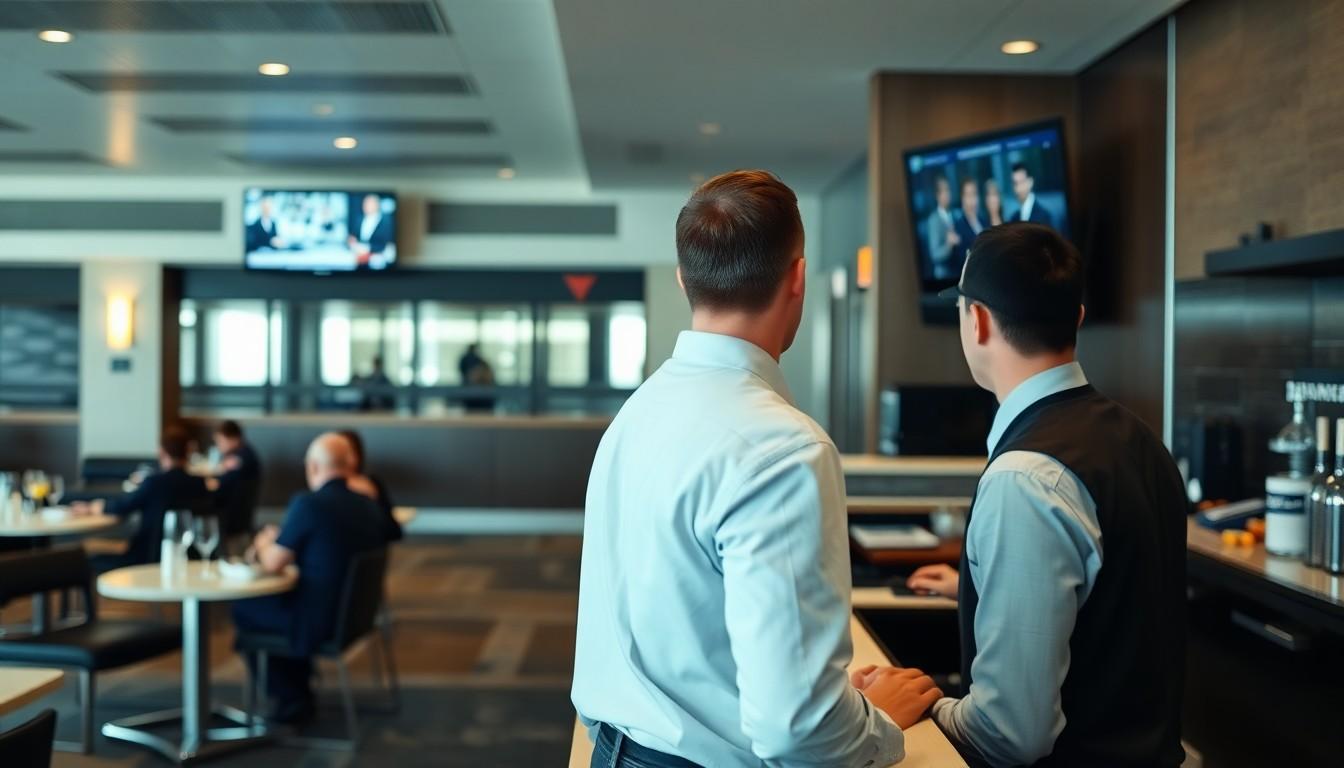
Travellers are questioning Delta’s lounge culture after a visitor claimed staff at Ronald Reagan Washington National Airport were repeatedly exposed to anti-LGBTQ+ commentary on Fox News. The allegation, shared during Pride Month, has prompted wider debate about workplace comfort, customer service and who controls the screens in shared airport spaces.
Essential Takeaways
- The allegation: A traveller said every television in a Delta Sky Club was showing Fox News during a June visit.
- The concern: She claimed a bartender, who identified as queer and trans, said staff couldn’t change the channel.
- The unanswered question: There’s no confirmed evidence showing whether the programming came from Delta policy, local management or an individual decision.
- The complaint: The traveller said she contacted Delta but received no response before posting about the experience online.
- The setting: The incident reportedly took place at Reagan National Airport’s Delta lounge, a space designed for travellers to eat, work and unwind.
A quiet lounge became an uncomfortable stop
Airport lounges usually promise calm: a soft chair, a cold drink and a few minutes away from boarding announcements. But that atmosphere can shift quickly when every screen is carrying contentious political coverage, particularly for staff who can’t simply leave at the end of a programme.
According to The Mary Sue, traveller Alexis Rose said she visited the Delta Sky Club at Ronald Reagan Washington National Airport on 1 June after flying from Los Angeles to Washington, DC. She claimed the lounge televisions were all tuned to Fox News and that the coverage included remarks about LGBTQ+ people she found offensive.
Rose said she asked whether the channel could be changed. The response she described made the situation feel more serious than a simple customer preference. She claimed a bartender told her they weren't permitted to switch away from Fox News.
What the traveller says happened
Rose said the coverage included discussion of same-sex marriage and transgender people, including language she interpreted as calling for transgender identity to be eradicated. As a lesbian traveller, she found the commentary particularly difficult to ignore in a room where employees were working nearby.
The Mary Sue reported that Rose understood the bartender to be queer and trans. That detail shaped her reaction, because the issue wasn't merely what guests were watching over lunch. It was the possibility that an LGBTQ+ employee might have to hear hostile commentary throughout a shift without control over the television.
Still, the available account leaves important points unresolved. There’s no independent confirmation of the exact broadcast, who selected the channel or whether the bartender's alleged restriction came from Delta, the lounge operator or an informal local rule.
Why the screen matters in shared spaces
Television choices in public areas can seem minor, but they quietly set the tone of a workplace and a customer environment. A sports channel may feel broadly neutral; a highly partisan news channel can make a lounge feel less like a neutral retreat and more like someone else's political living room.
Delta has publicly promoted Pride-related initiatives, while its chief executive, Ed Bastian, has also featured in the airline's corporate communications. Those public commitments don't establish what happened at the DCA lounge, but they help explain why travellers may expect a consistent approach to inclusion across Delta-branded spaces.
The airline's Sky Club network has grown into an important part of its premium travel offer. Delta has also highlighted the DCA club's local character and hospitality, including its association with regional food and design coverage reported by WTOP. That makes the alleged programming decision feel especially jarring: the lounge is meant to reflect welcome and ease, not tension.
A complaint that went nowhere, according to Rose
Rose said she submitted a formal complaint on the day of the visit and waited for a response. She later claimed that around six weeks passed without a reply, prompting her to publish the story on TikTok instead.
That lack of follow-up became part of the controversy. Even where an airline can't immediately verify an allegation, a clear acknowledgement can reassure a customer that the concern has been logged and reviewed. Silence, by contrast, leaves plenty of room for frustration to grow.
For travellers who experience something similar, the practical move is to record the lounge location, date, approximate time and names or job descriptions where possible. Keep the complaint factual, ask for a case reference and use both the airline's formal channel and the lounge's operator if the club is managed separately.
What happens next for Delta's lounge experience?
Rose said she plans to return to the DCA lounge on future trips and see whether the situation has changed. That may put renewed attention on a question many airport operators rarely discuss openly: who decides what plays on workplace screens, and can employees raise concerns without putting themselves in an awkward position?
There has been no verified explanation in the material available here from Delta addressing the specific allegation. Until there is, the fairest reading is that Rose's account raises a legitimate question rather than proving a company-wide policy.
A lounge should make people feel looked after. That includes the people serving the coffee as well as those drinking it.
It's a small screen choice, but it can shape the whole room.
Source Reference Map
Story idea inspired by: [1]
Sources by paragraph:
- Paragraph 1: [6], [7]
- Paragraph 2: [3], [6]
- Paragraph 3: [3], [4]
- Paragraph 4: [3], [5]
- Paragraph 5: [4], [7]
- Paragraph 6: [6], [7]
- Paragraph 7: [3], [4]
- Paragraph 8: [3], [5]
- Paragraph 9: [4], [5]
- Paragraph 10: [6], [7]
- Paragraph 11: [3], [5]
- Paragraph 12: [3], [6]
- Paragraph 13: [3], [4]
- Paragraph 14: [3], [5]
- Paragraph 15: [3], [6]
- Paragraph 16: [4], [5]