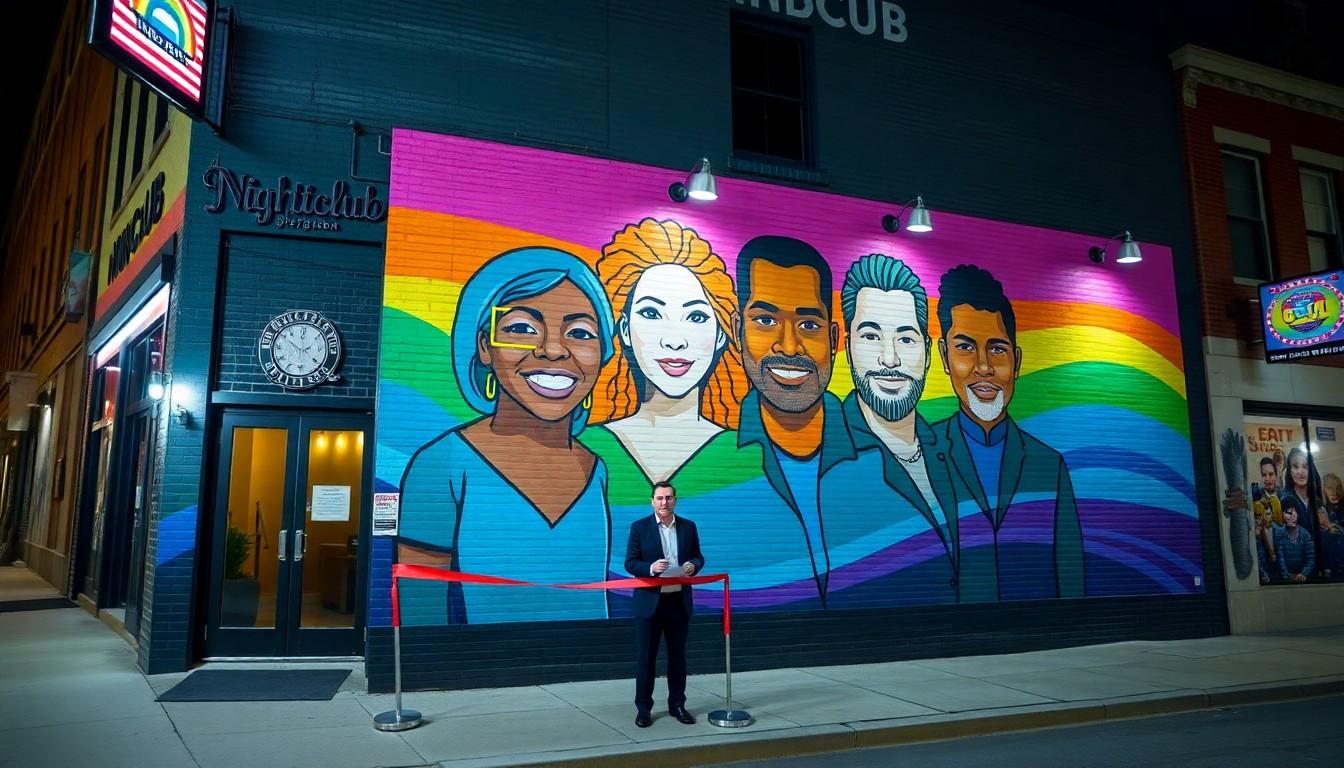
Visitors to Philadelphia’s Gayborhood can now find a striking new LGBTQ+ mural celebrating five people whose activism, care and courage shaped the city. Created by Santiago Galeas and commissioned by Mural Arts Philadelphia, the colourful tribute turns a nightclub wall into a place of memory, pride and public history.
Essential Takeaways
- A prominent new landmark: The mural stands beside Voyeur Nightclub on Saint James Street, in the centre of Philadelphia’s LGBTQ+ district.
- Five lives remembered: Gloria Casarez, Michael S. Hinson Jr., Nizah Morris, Dawn Munro and Tyrone Smith are depicted.
- Flowers carry meaning: Each person is paired with a bloom chosen to reflect their life, identity or legacy.
- A city-backed project: Mural Arts Philadelphia commissioned the work as part of its long-running public art programme.
- More than decoration: The piece connects Philadelphia’s LGBTQ+ history with the community’s present and future.
A colourful new marker in Philadelphia’s Gayborhood
The new mural is hard to miss. Painted across the side of Voyeur Nightclub at 1221 Saint James Street, it brings vivid colour and a strong sense of welcome to one of Philadelphia’s best-known LGBTQ+ neighbourhoods.
Titled In Pride, In Power, In Memory, the work was created by artist Santiago Galeas and unveiled during a ribbon-cutting ceremony at the end of Pride Month. According to Mural Arts Philadelphia, the project adds another layer to a district already shaped by nightlife, activism and community memory.
There’s something especially fitting about placing the artwork beside a venue. It doesn’t sit quietly in a gallery or behind glass. Instead, it greets people heading out for the evening, meeting friends or simply walking through the Gayborhood.
Five people, five powerful legacies
The mural honours Gloria Casarez, Michael S. Hinson Jr., Nizah Morris, Dawn Munro and Tyrone Smith, each of whom made a distinctive contribution to Philadelphia’s LGBTQ+ community.
Casarez was a civil rights leader and organiser who helped establish Entity Shelters and the Philly Dyke March. Hinson was a leading AIDS and housing advocate, as well as a founder of the Colours Organization, SELF, Inc., Philly Black Pride and the Black and Gay Men’s Leadership Council.
Morris, a Black transgender entertainer, is remembered through her connection to Morris Home, while Munro was a scientist, performer and trans activist involved in organising for Trans Day of Remembrance. Smith, who died in February 2025 aged 82, was a respected LGBTQ+ campaigner, mentor and adviser to Philadelphia mayors. These details have also been highlighted by 6abc and the Philadelphia Gay Calendar.
The result feels personal rather than symbolic in the abstract. These aren't distant historical figures, but people whose work touched housing, health, nightlife, protest and everyday community life.
Why the flowers matter
Flowers give the mural much of its emotional punch. They soften the portraits, but they don't make the stories feel delicate. Instead, each bloom adds a small visual biography.
Casarez is shown with marigolds, a flower associated with remembrance and spiritual connection in Mexican culture. Hinson is paired with a sunflower, reflecting the way friends remembered his warmth and instinct to seek light during difficult times.
Morris appears with a lotus, reflecting her Buddhist faith. Munro is represented by Scottish thistle, while Smith's lupine suggests endurance and renewal. Galeas developed these choices after speaking with relatives, friends and loved ones, according to Billy Penn.
Around the five figures are golden ginkgo leaves. Their age and resilience offer a broader message: queer communities have survived pressure, loss and discrimination, and they're still here.
A living piece of Philadelphia LGBTQ+ history
Mural Arts Philadelphia has been creating public artwork across the city since 1984, and its programme now supports dozens of projects each year. That long history matters because Philadelphia's murals often work as both street-level art and informal civic storytelling.
This project joins a wider effort to make LGBTQ+ history visible in the places where it happened. Philly Voice and the Philadelphia Inquirer have both reported on the mural's connection to local queer history, including the people and organisations that helped shape the city's community infrastructure.
For visitors, it offers a simple way to engage with that history. A walk through the Gayborhood becomes more than a tour of bars, restaurants and shops. The walls themselves begin to explain who built the community and why those foundations still matter.
A tribute with its eyes on the future
At the unveiling, Philadelphia councilmember Rue Landau described the mural as a reminder that today's progress rests on the work of earlier generations. She also connected the five subjects with the city’s current LGBTQ+ leadership and its continuing responsibility to remember.
That balance is what gives the artwork its force. It acknowledges grief and unanswered questions, particularly in Morris's case, while also celebrating organising, friendship, creativity and persistence.
For anyone visiting Philadelphia, the mural is worth seeking out slowly rather than treating it as a quick photo stop. Look at the flowers, notice the leaves and consider the names. Public art can be beautiful, but the best examples leave you with something to carry away.
It's a bright new landmark with a serious message: memory is part of how communities keep moving forward.
Source Reference Map
Story idea inspired by: [1]
Sources by paragraph:
- Paragraph 1: [2], [5]
- Paragraph 2: [3], [4]
- Paragraph 3: [6], [7]
- Paragraph 4: [5], [6]
- Paragraph 5: [2], [3]
- Paragraph 6: [4], [7]
- Paragraph 7: [3], [6]
- Paragraph 8: [2], [4]
- Paragraph 9: [5], [7]
- Paragraph 10: [3], [4]
- Paragraph 11: [2], [6]
- Paragraph 12: [4], [7]
- Paragraph 13: [3], [5]
- Paragraph 14: [2], [4]
- Paragraph 15: [5], [6]
- Paragraph 16: [3], [7]
- Paragraph 17: [2], [4]