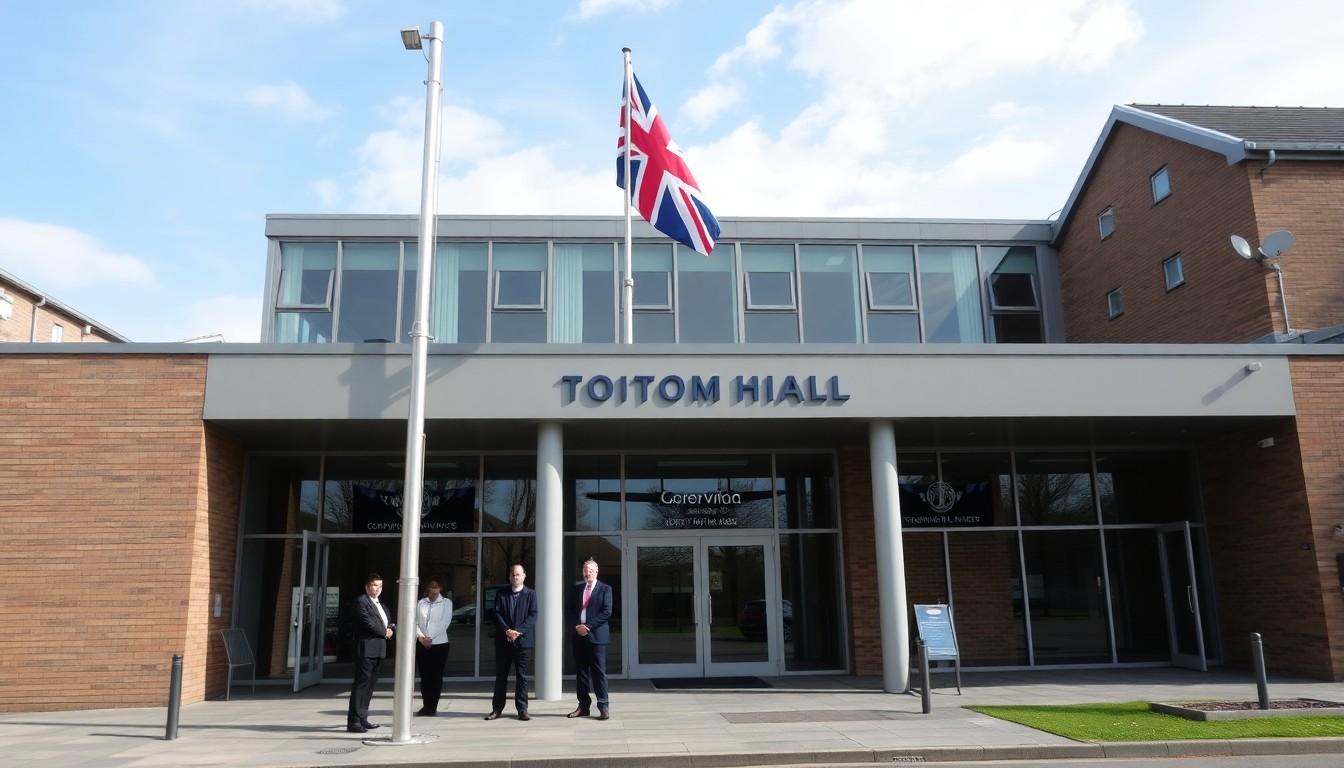
Kirklees Council has adopted a new flag-flying policy that excludes Pride flags from town halls and other civic buildings, limiting displays to national, civic and selected commemorative flags. The Reform-led authority says the move creates a consistent approach, while critics argue it sends a political message about inclusion across the West Yorkshire borough.
Essential Takeaways
- Pride flags excluded: They aren't listed among the approved flags for council buildings.
- Permitted displays narrowed: The policy covers the Union Flag, St George's flag, the civic flag and selected named days.
- Policy applies borough-wide: Town halls and other council-managed civic buildings with flagpoles are covered.
- Council defends consistency: Reform leader Sarah Wood says the approach highlights shared national and community symbols.
- Critics see a wider signal: Opponents say removing commemorative flags can appear to distance the authority from particular causes.
Kirklees tightens the rules on flags
The most striking change is also the simplest: Pride flags will no longer be flown from Kirklees Council's town halls or other civic buildings under the new policy. The decision affects public spaces that many residents pass every day, making what might sound like an administrative update feel considerably more visible.
According to the council's published policy information, only specified flags can now be displayed. The Union Flag has priority, while the permitted list also includes the St George's flag, the civic flag and flags linked to named commemorative days. The council's own communications set out the policy as a borough-wide framework rather than a decision for one building alone.
The approved occasions include Yorkshire Day, Armed Forces Day, Merchant Navy Day, Commonwealth Day, National 999 Emergency Services Day, Remembrance Sunday and Holocaust Memorial Day. Pride is absent from that list, as are other campaign or identity-based displays.
Why the Reform-led authority says it made the move
Council leader Sarah Wood described the policy as a straightforward way to focus on symbols she said residents share. In comments reported by the Examiner Live, she said the approach was about celebrating the country and the local community rather than choosing between different causes.
That argument reflects a familiar political divide. Supporters of neutral civic buildings tend to see a short, fixed list as cleaner and easier to apply. Critics, meanwhile, say neutrality isn't always experienced as neutral, particularly when a flag representing a minority community is removed from a public building.
The council's assessment acknowledged that risk, noting concern that removing campaign or commemorative flags could suggest a change in its position on particular causes. Its response was that clear wording in the policy would reduce that uncertainty.
What can still be flown from town halls?
The Union Flag remains the senior symbol under the rules, subject to Royal Protocol. Alongside it, the policy permits the St George's flag and the civic flag, with additional displays tied to the named days approved by the council.
That means flag-flying will still form part of the council's public calendar, but in a much more prescribed way. The policy isn't a complete end to commemorative displays; it's a decision about which occasions qualify and which symbols are considered suitable for council property.
For residents, the practical detail is that the rules cover any council-owned or managed civic building with a flagpole. So the effect won't be confined to one town hall, and local managers won't be free to add Pride or other unlisted flags on an individual basis.
The debate is about symbolism as much as procedure
The decision was reportedly approved without consultation with ward councillors, a detail likely to add heat to an already sensitive debate. Liberal Democrat critics have condemned the policy, according to Kirklees Local TV, while wider reporting has highlighted the political significance of the change under Reform UK leadership.
The council's integrated impact assessment judged the policy to have a neutral effect in relation to race and sexual orientation. It argued that the rules apply equally to everyone and identified no evidence that a racial group would be disproportionately advantaged or disadvantaged.
But formal equality wording doesn't settle how a public gesture feels. A Pride flag can be read as a sign of welcome, while its removal can be read as a retreat, even if the authority insists the rule is applied consistently. That gap between administrative intent and public interpretation is where much of the argument will continue.
What happens next for Kirklees?
The policy now gives the council a clear rulebook, but it may not bring the controversy to an end. Political groups and residents will continue to test whether civic neutrality is best served by a restricted list, or by allowing councils to recognise a broader range of communities and events.
For now, Kirklees joins a growing national conversation about what public buildings should represent. The flagpole may be quiet on some days, but the argument around it is anything but.
It's a small change in council procedure with a very public meaning.
Source Reference Map
Story idea inspired by: [1]
Sources by paragraph:
- Paragraph 1: [2], [3]
- Paragraph 2: [4], [5]
- Paragraph 3: [6], [7]
- Paragraph 4: [2], [7]
- Paragraph 5: [3], [4]
- Paragraph 6: [5], [6]
- Paragraph 7: [2], [3]
- Paragraph 8: [4], [7]
- Paragraph 9: [5], [6]
- Paragraph 10: [2], [7]
- Paragraph 11: [3], [4]
- Paragraph 12: [5], [6]
- Paragraph 13: [2], [7]
- Paragraph 14: [3], [4]