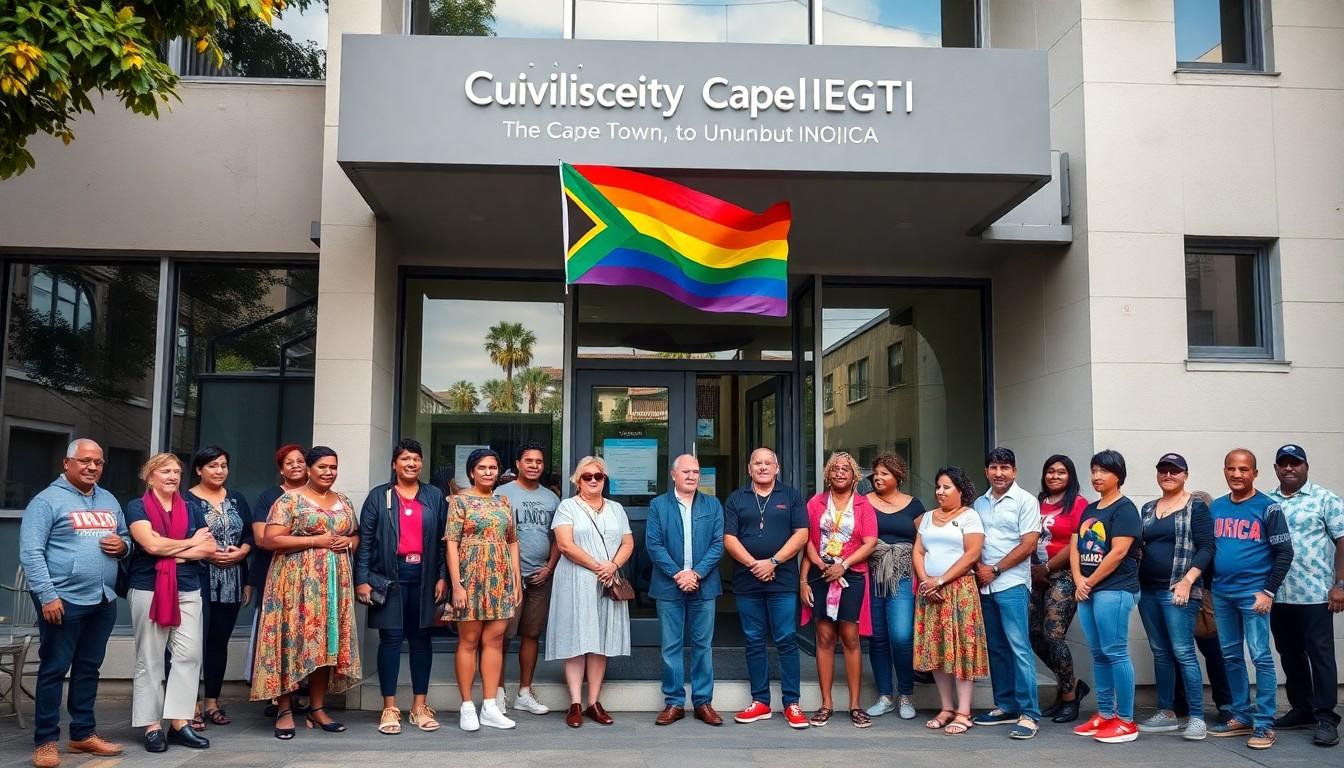
Activists across South Africa are joining forces to challenge growing anti-LGBTQ+ and anti-abortion campaigns, ahead of a planned family-values conference in Cape Town. The new Vimba! We The People coalition says the fight is about more than one event: it’s about protecting constitutional rights, bodily autonomy and a wider, more inclusive idea of family.
Essential Takeaways
- A new alliance: Vimba! brings together LGBTQ+ rights, feminist, legal, labour, faith and racial-justice organisations.
- A key flashpoint: The Pan-African Conference on Family Values is due to take place in Cape Town from 12 to 15 May 2027.
- Rights under scrutiny: Campaigners fear family-values rhetoric could be used against abortion access, sexuality education and LGBTQ+ protections.
- A broader definition: The coalition wants family discussions to include queer people, diverse relationships and different cultural and faith traditions.
- The next test: Vimba!’s influence will depend on whether its launch develops into sustained organising and practical public action.
A new coalition steps into a growing fight
South Africa’s latest rights coalition arrives as the country prepares for an increasingly heated argument about who gets included in the words “family” and “values”. Vimba! We The People has brought together groups from across the LGBTQ+ rights, feminist, legal, education, labour and racial-justice sectors, creating a broad alliance rather than a single-issue campaign.
That breadth matters. According to Mambaonline, the coalition has emerged in response to a wider anti-rights movement that links opposition to LGBTQ+ equality with campaigns against abortion access, comprehensive sexuality education and gender justice. The result is a political landscape where issues that might once have been treated separately now feel closely connected.
Vimba! describes itself as a rallying point for organisations that have often worked on parallel tracks. It’s an ambitious move, but also a practical one: coordinated movements tend to be harder to ignore than isolated voices.
Why the Cape Town conference has become a flashpoint
The Pan-African Conference on Family Values is scheduled for Cape Town between 12 and 15 May 2027. Its organisers say the gathering will promote religious freedom, stronger families and what they describe as biblical and indigenous African values, with Christian leaders, politicians and other advocates expected to attend.
Critics see a sharper agenda beneath that language. Previous reporting by Mambaonline has described concern that family-values campaigns can become vehicles for opposing LGBTQ+ legal protections, reproductive healthcare and inclusive education. For campaigners, the conference is therefore not simply a meeting. It’s a potential platform for a wider political programme.
That concern has already prompted calls for South Africa to reject or stop the event. A public petition hosted on Change.org frames the conference as a hate-driven gathering presented under the softer banner of family values, while other activists have urged President Cyril Ramaphosa’s government to intervene.
The argument over whose family counts
At the heart of the dispute is a deceptively simple question: who gets to define a family? Vimba! argues that “traditional African values” are increasingly being used to portray queer people, reproductive rights and gender equality as foreign ideas, rather than as part of Africa’s own complex social and political experience.
The coalition wants to reclaim the language of family. Its preferred vision includes LGBTQ+ people, different relationship structures, varied cultural traditions and faith communities, rather than treating one model as the only legitimate option.
Mambaonline’s commentary on the debate asks a question that cuts through the slogans: whose family, and whose values? It’s a useful lens because public arguments about tradition can sound comforting while quietly deciding whose dignity receives protection.
Foreign influence adds another layer
The dispute is also tied to money and international networks. Research cited in coverage of the campaign suggests that US Christian Right organisations have increased their activity and spending in Africa, supporting work around abortion, sexuality, religion and family policy.
That doesn’t mean every faith-based organisation shares the same agenda. But it does raise uncomfortable questions when overseas groups describe LGBTQ+ equality and reproductive rights as un-African while actively exporting their own political strategies and funding.
For Vimba!, the issue is therefore about sovereignty as well as rights. The coalition is challenging what it sees as an uneven conversation in which progressive protections are labelled foreign, while conservative campaigning backed by international networks is treated as authentically local.
South Africa’s constitutional protections face a public test
South Africa has some of the continent’s strongest legal protections for LGBTQ+ people, including constitutional protection against discrimination based on sexual orientation. The country also has regional obligations under agreements such as the Maputo Protocol, which addresses the rights and health of women and girls across Africa.
Those safeguards are significant, but activists say they can’t be treated as permanent. Mambaonline has reported growing calls for the government to respond to the planned conference, while petitioners argue that allowing the event to proceed without challenge could help normalise anti-rights messaging.
The practical question is what happens next. Vimba! has named a substantial group of founding organisations, including Access Chapter 2, Gender DynamiX, Iranti, Pan Africa ILGA, Triangle Project, the Southern Africa Litigation Centre and the Women’s Legal Centre. It hasn’t yet published a detailed campaign programme, so its credibility will now be measured by the organising that follows.
A coalition with something to prove
Launching an alliance is the easy-looking part. Building trust between movements, agreeing on priorities and turning a shared warning into visible action is much harder, especially when groups bring different constituencies and tactics to the table.
Still, Vimba!’s timing gives it a clear opening. The 2027 conference has created a common point of concern, and the coalition is using it to argue that LGBTQ+ rights, reproductive freedom, education and democracy belong in the same conversation.
For supporters, the message is straightforward: rights won through decades of activism can be weakened if people assume they’ll always be there. That’s a sobering thought, but it may also be the reason this new coalition has arrived with such a determined voice.
Small words can carry a large political charge, and “family values” is proving to be one of them.
Source Reference Map
Story idea inspired by: [1]
Sources by paragraph:
- Paragraph 1: [2], [3]
- Paragraph 2: [2], [5]
- Paragraph 3: [2], [7]
- Paragraph 4: [3], [4]
- Paragraph 5: [5], [6]
- Paragraph 6: [4], [6]
- Paragraph 7: [2], [7]
- Paragraph 8: [5], [7]
- Paragraph 9: [2], [3]
- Paragraph 10: [4], [6]
- Paragraph 11: [2], [5]
- Paragraph 12: [3], [4]
- Paragraph 13: [2], [5]
- Paragraph 14: [2], [7]