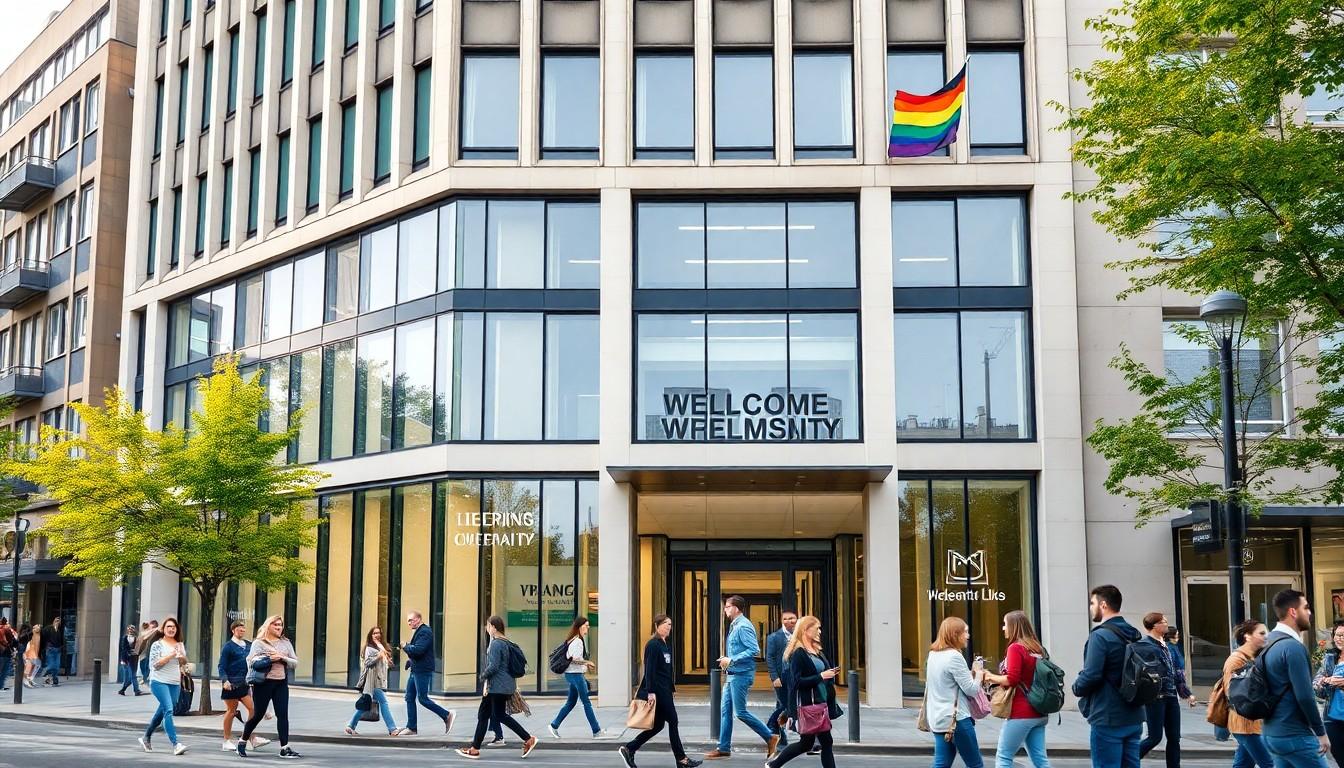
Students seeking the most LGBTQ+ friendly universities in the US now have a fresh guide to compare campus policies, healthcare, housing and local queer life. The 2026 index assesses 1,718 four-year colleges, offering a useful snapshot of where practical support is strongest, especially as older campus guides disappear and protections vary by state.
Essential Takeaways
- A broad new ranking: The index assesses 1,718 four-year US colleges using 12 public data sources.
- Support goes beyond slogans: Scores consider LGBTQ+ centres, gender-inclusive housing, trans protections, healthcare and chosen names.
- Local life matters: Nearby LGBTQ+ venues and the surrounding city’s equality record also affect the result.
- The map is uneven: No Southern university reached the top ten, while New York placed three institutions.
- Johns Hopkins led the published list: Its score was boosted by strong policies and a dense LGBTQ+ scene nearby.
A new way to compare LGBTQ+ friendly universities
Choosing a university is already a major decision. For LGBTQ+ students, the question is often more practical: can you use your name on official records, find inclusive accommodation and access healthcare without having to explain yourself repeatedly?
That’s the thinking behind Out on Campus: The LGBTQ+ College Index 2026, published by Erobella. As reported by The Advocate, the project compares 1,718 four-year institutions across a dozen public sources, rather than relying on a single campus survey. [2]
The result is less a glossy list of supposedly perfect universities and more a checklist of everyday support. A professionally staffed LGBTQ+ centre may matter far more than a rainbow logo, particularly during a difficult first term. [5]
What does the ranking actually measure?
The study looks at written nondiscrimination protections, gender-inclusive housing, transition-related care in student health insurance and whether students can use chosen names and pronouns on official records. It also considers the presence of LGBTQ+ centres and how well those services appear to be staffed. [2]
Then there’s the setting beyond the campus gates. The index factors in LGBTQ+ venues within 10 miles and the city’s score on the Human Rights Campaign’s Municipal Equality Index. That’s a sensible addition because student life doesn’t stop at the edge of the quad. [4]
Still, prospective students should treat any league table as a starting point, not a guarantee. Policies can change, services may be stretched and a university’s written rules don’t always capture the feel of a busy student advice office on a rainy Tuesday.
The 15 universities making the strongest showing
The published top 15 begins with the University of Illinois Chicago at number 15, followed by George Washington University, Western Washington University, The New School and MIT. Several performed strongly on campus rules, while others benefited from lively local LGBTQ+ scenes. [2]
Columbia University, Emerson College and Pace University occupy positions 10 to eight. Pace was helped by its former Campus Pride recognition, while George Washington University stood out for its 100 out of 100 municipal equality score and 16 LGBTQ+ venues nearby. [7]
The upper half includes the University of California San Francisco, Portland State University, Tufts University and the University of Washington. Portland State achieved top marks for campus policies, while Tufts combined strong institutional scores with nearby LGBTQ+ organisations and venues. [2]
Harvard came third, with Johns Hopkins in second. Johns Hopkins’ result was particularly striking for its local concentration of queer venues, including 35 within two miles and 62 within 10 miles, alongside a 39 out of 40 score for inclusive campus policies. [2]
Why the local area can change the student experience
A university may have excellent policies but still feel isolated if the surrounding area offers little community life. Conversely, a campus in a city with established LGBTQ+ organisations, social spaces and support networks can give students more room to find their people.
That helps explain why the index includes city-level data. The local environment can influence everything from finding a welcoming café to accessing community advice, peer support or events beyond university-run programming. [4]
The geographical pattern is hard to miss. No Southern institution made the top ten, while three New York universities did, reflecting the sharp differences in state policy, municipal protections and local infrastructure. The list isn’t a verdict on every student’s experience, but it does show how much place still matters.
Campus Pride’s absence leaves a gap
The new ranking arrives after the Campus Pride Index, long used as a reference point for LGBTQ+ campus life, was discontinued after 18 years. Campus Pride had also highlighted safer, more welcoming institutions and documented the ways colleges could improve their support. [3]
That history matters because rankings do more than hand out badges. They make hidden differences easier to spot, from whether a school has a clear trans-inclusive policy to whether its LGBTQ+ centre has the staff and budget to offer meaningful help. Campus Pride’s past work also drew attention to institutions that fell short, rather than simply celebrating the best performers. [6]
For applicants, the sensible approach is to compare the index with the university’s own website, student health plan and housing information. Ask whether protections apply across all departments, check how recently policies were updated and look for current student groups rather than relying on a dated prospectus.
What prospective students should check next
Start with the basics: chosen-name systems, gender-inclusive housing, health insurance exclusions and the process for reporting discrimination. It’s also worth checking whether the LGBTQ+ centre is permanently staffed, what it offers during holidays and whether it supports trans students, international students and students of colour.
Next, investigate the city. Search for community centres, clinics, social groups and venues within a realistic travel distance. A university can rank well overall, but the practical details, including public transport and opening hours, may decide whether support is genuinely accessible.
The broader lesson is encouraging but cautious. More universities are measuring inclusion in concrete terms, yet students still need to read the small print. A supportive campus should feel like more than a reassuring website promise; it should make daily life a little safer, easier and less lonely.
It's a useful shortlist, but the right campus is the one whose support works in real life.
Source Reference Map
Story idea inspired by: [1]
Sources by paragraph:
- Paragraph 1: [2], [5]
- Paragraph 2: [2], [4]
- Paragraph 3: [5]
- Paragraph 4: [2]
- Paragraph 5: [2], [4]
- Paragraph 6: [2]
- Paragraph 7: [2], [7]
- Paragraph 8: [2]
- Paragraph 9: [2]
- Paragraph 10: [4]
- Paragraph 11: [3]
- Paragraph 12: [6]
- Paragraph 13: [3], [5]
- Paragraph 14: [2], [4]
- Paragraph 15: [5]
- Paragraph 16: [4]
- Paragraph 17: [2], [5]
- Paragraph 18: [3], [6]
- Paragraph 19: [2], [5]
- Paragraph 20: [4]
- Paragraph 21: [2], [5]