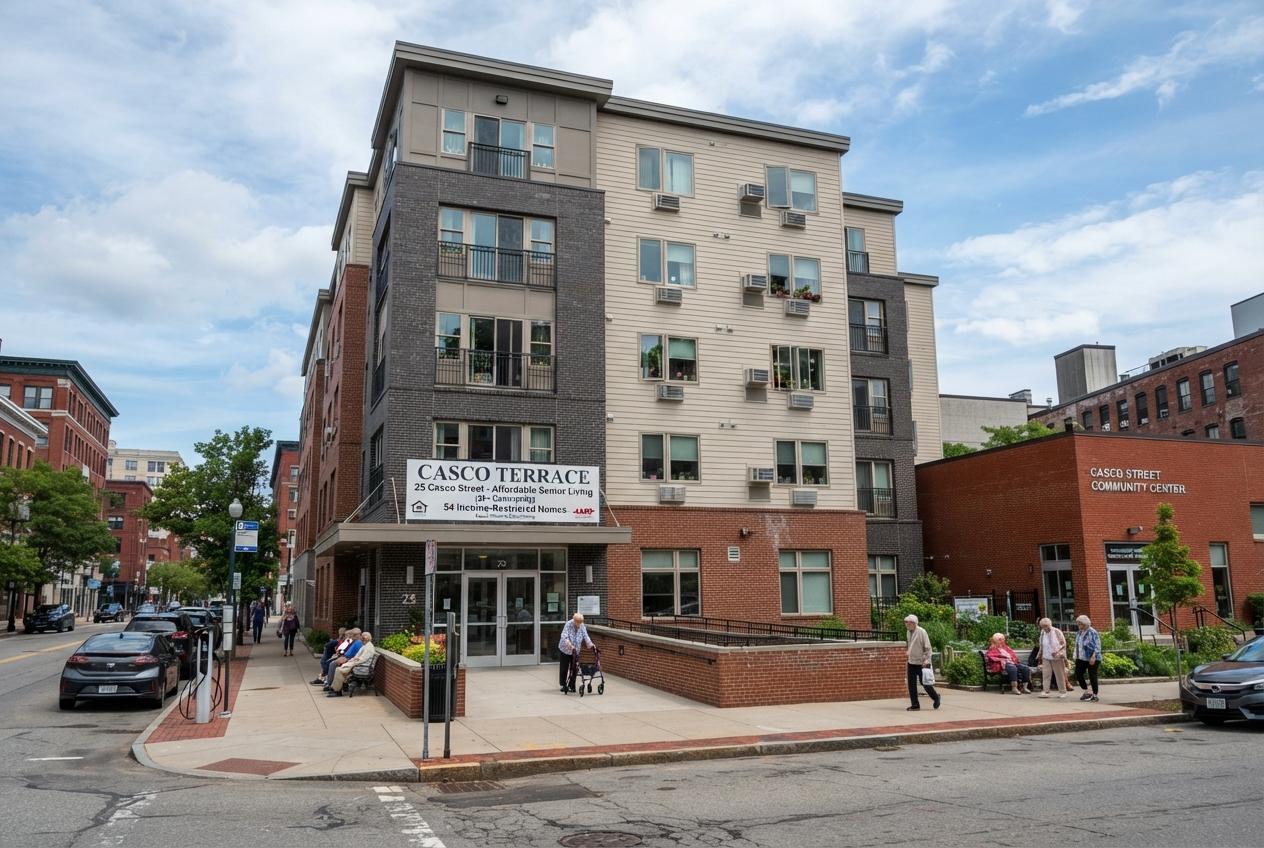
Shoppers and neighbours are noticing a new, deliberately welcoming building in downtown Portland , Equality Commons has opened, offering 54 income-restricted apartments and on-site programming aimed at LGBTQ+ older adults, a timely addition amid a tight market for affordable senior housing.
Essential Takeaways
- Location and size: Equality Commons sits at 25 Casco Street in Portland’s Arts District, a five-storey, roughly 43,000 sq ft building with 54 apartments and ground-floor commercial space.
- Unit mix and feel: Studios, one-bedrooms and two-bedrooms range from about 500 to 837 sq ft; the building includes a community room, laundry, secure bike storage and space for a café with outdoor seating.
- Accessibility and tech: Nineteen accessible units were built, broadband supports telehealth, and electrical infrastructure could allow rooftop solar and Level 2 EV chargers later.
- Affordability rules: At least 60% of units are reserved for households at or under 50% of area median income, with the remainder at 60% AMI; rents are set under Low-Income Housing Tax Credit limits.
- Community focus, open eligibility: The development is intended to be LGBTQ+-affirming and sits beside the Equality Community Center, but anyone meeting age and income rules may apply and residents sign a non-discrimination pledge.
What Equality Commons brings to Portland’s housing scene
Equality Commons arrives with a clean, intentional vibe , the building was constructed on a former parking lot and designed to feel like a neighbourhood hub rather than a box of units. The developers put thought into shared spaces, a small café and outdoor seating so residents will have places to meet and linger. According to local reporting, leasing is underway and more than 250 people are already on the waiting list, which tells you how thin affordable senior housing is in the city.
The project was planned as part of a wave of affordable developments chosen for financing by MaineHousing, and it’s managed by the Portland Housing Authority. That mix of public and private backing helped move the build forward, and the result is a building that aims to blend housing stability with social supports.
Why the LGBTQ+ focus matters (and how it works in practice)
Organisers describe Equality Commons as Maine’s first affordable senior housing community designed with LGBTQ+ older adults in mind. The adjacent Equality Community Center will offer programming, social events and connections to health and wellness services, which can be crucial for seniors who worry about loneliness or discrimination. Residents will be asked to sign a non-discrimination pledge, a step organisers say they will enforce to protect the atmosphere.
At the same time, the housing itself is not legally reserved for LGBTQ+ people. Anyone aged 55 or older who meets income and screening criteria can apply. That approach attempts to balance creating an affirming environment while complying with public-funding rules that bar identity-based residency requirements.
Money matters: how the project was paid for
Equality Commons was financed using a patchwork of tools developers often rely on: state and federal low-income housing tax credits, a commercial loan, and tax increment financing from the city. Investors supplied federal tax-credit equity and community loan funds added backing. That combination is typical for affordable housing projects, but it also means rents and eligibility are tied to AMI (area median income) calculations and LIHTC rent limits, which change annually.
For prospective tenants, that translates into concrete numbers , for 2026 the income cap for a single-person household at 50% AMI is listed at about $48,700, with rent caps varying by unit size. There are also 11 project-based vouchers for people with special needs, reducing rent to roughly 30% of adjusted income for qualifying households.
Design details you’ll notice (and why they matter)
Look closely and you’ll see practical, senior-friendly choices: a higher-than-required number of accessible units , 19 instead of the seven minimum , plus broadband wired for telehealth and infrastructure that could support solar panels and EV charging in future. Those decisions show a longer-term view, recognising that affordability is about more than rent , it’s also about health access, mobility and keeping utility costs manageable.
The presence of communal spaces and a nearby community centre means the building is aiming for social as well as physical accessibility. For seniors who prefer smaller, quieter units but still want company, that mix can be calming.
What this means for older Mainers and the city
Portland still faces a shortage of affordable options for older residents on fixed incomes, and the strong demand for Equality Commons highlights that problem. The development will be watched closely as a model for pairing subsidised housing with an identity-focused community centre. If it works, the format could be replicated elsewhere; if not, it will raise questions about whether targeted programming is enough to meet broader housing needs.
For anyone thinking of applying, start your paperwork early, check AMI figures for your household size, and consider whether you’d use the on-site services , those help prioritise placements for voucher-assisted units.
It's a small change that can make every chew safer.
Source Reference Map
Story idea inspired by: [1]
Sources by paragraph: