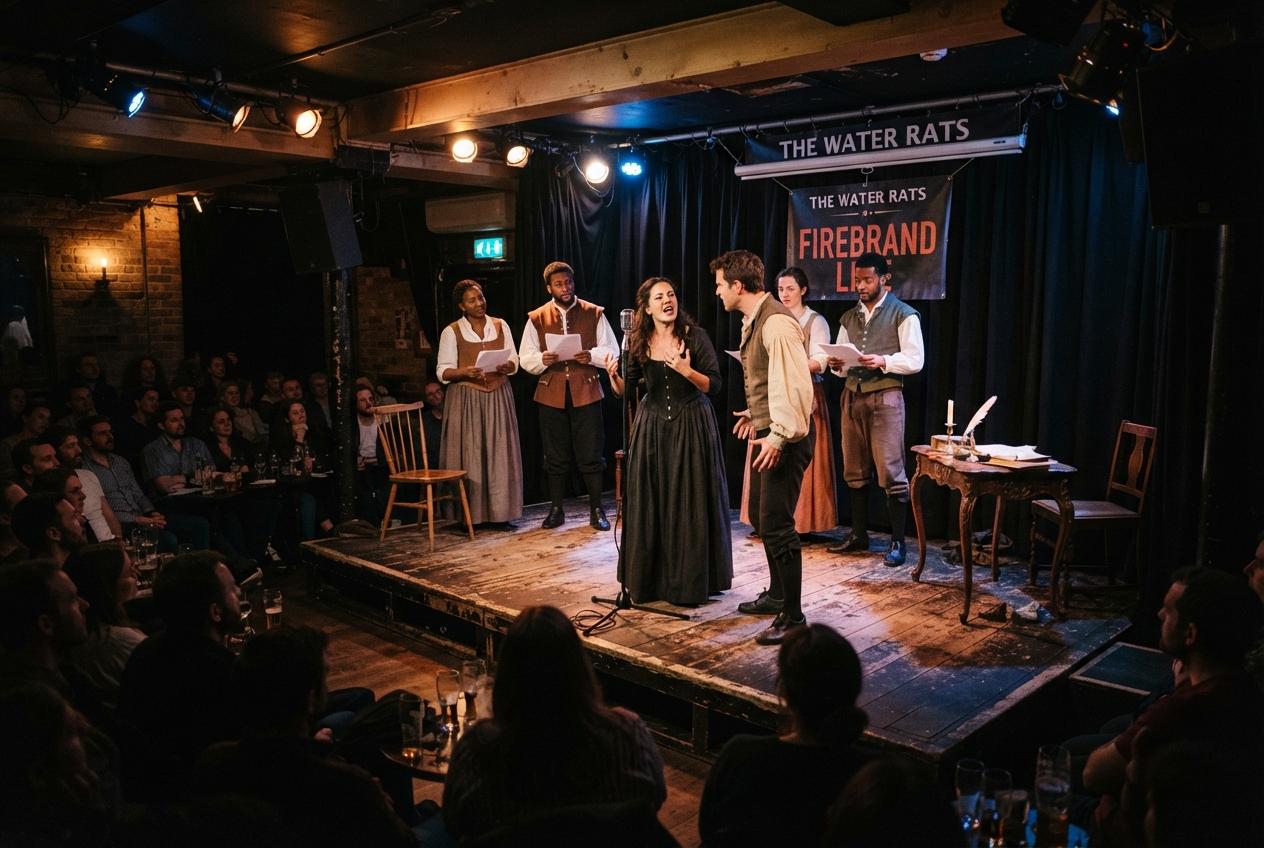
Shoppers of the fringe theatre scene are flocking to Camden to catch Firebrand, a fresh queer musical-in-progress unpacking love, loyalty and identity at the historic Water Rats , a promising first act run that shows why period settings and modern themes still pair so well.
Essential Takeaways
- Strong premise: Based on a true Versailles story, Firebrand mixes historical swordplay with a modern queer romance.
- Standout voices: Caitlyn Calfas (Cecilia) and Lukas Poischbeg (Phillipe) deliver striking, emotionally rich singing.
- Work-in-progress energy: Tonight’s semi-staged, book-in-hand presentation gives a clear sense of potential rather than a finished show.
- Musical textures: Amy Austen’s keyboard accompaniment is sensitive and varied, giving songs both drive and tenderness.
- Room to grow: Lyrics sometimes need tightening and full staging will likely unlock the piece’s theatrical impact.
A bold hook: history, queerness and a sword at the ready
Firebrand opens with an arresting idea , set in the court of Versailles yet explicitly asking “what’s natural?” , and that contrast is deliciously tactile. The action centres on Julie, a sword-wielding protagonist, and her awakening romance with Cecilia; you can almost feel the metal of the blade and the hush of secret glances. Presenting the show as a semi-staged concert with scripts in hand keeps the focus squarely on the writing and voices, and that rawness makes the emotional beats hit cleanly.
Why the Camden Fringe is the right place for this
The Camden Fringe has long been where creative seeds are sown, and Firebrand fits that ecosystem perfectly. A partly-worked show benefits from a festival that rewards experimentation, and the Water Rats’ intimate space makes the audience complicit in the piece’s shaping. According to venue listings, the Water Rats regularly hosts new theatre, which helps explain why a developing musical like this feels at home here.
Performances that suggest a fully formed future production
Even without full staging, the cast sells both character and potential spectacle. Lara Smyth as Julie carries the physicality her role demands, while Caitlyn Calfas brings a velvety vulnerability to Cecilia that lingers after a song ends. Lukas Poischbeg supplies the glamour and lift the queer storyline needs. Kieran Capaldi’s sly Comte d’Armagnac hints at an almost panto-worthy villainy, which promises delicious theatricality when choreography and costumes arrive.
Music and dramaturgy: what’s working and what needs polishing
Amy Austen’s keyboard work is a through-line of steadiness; the arrangements are varied and give emotional texture to the book’s lean moments. Where the piece stumbles is primarily in places where lyrics don’t scan smoothly or scenes need visual invention to feel complete. That’s not a fatal flaw at this stage , it’s exactly why staged readings exist , and with further dramaturgical work the songs should tighten into memorable set pieces.
How Firebrand could look fully staged , and why that matters
Imagine sequins, clashing courtly opulence, and choreographed swordplay; those elements would amplify the show’s themes of hidden communities and defiant love. Full staging would let humour land more theatrically and expand moments that read as dialogue into visceral tableaux. For audiences, that means this run is less an evening of finished entertainment and more an invitation to watch a production find its shape.
Practical tips if you want to catch the show
Book early , the Water Rats is a cosy room and the Camden Fringe calendar fills fast. Expect a semi-staged reading format: it’s ideal for listeners who love musical development and want to see how theatre is made. If you’re new to fringe music-theatre, arrive ready to engage with a work in progress and enjoy the immediacy of live voices without full costuming or choreography.
It’s a small, promising glimpse of a queer historical musical that could, with a bit more finessing, become a real theatrical firecracker.
Source Reference Map
Story idea inspired by: [1]
Sources by paragraph: