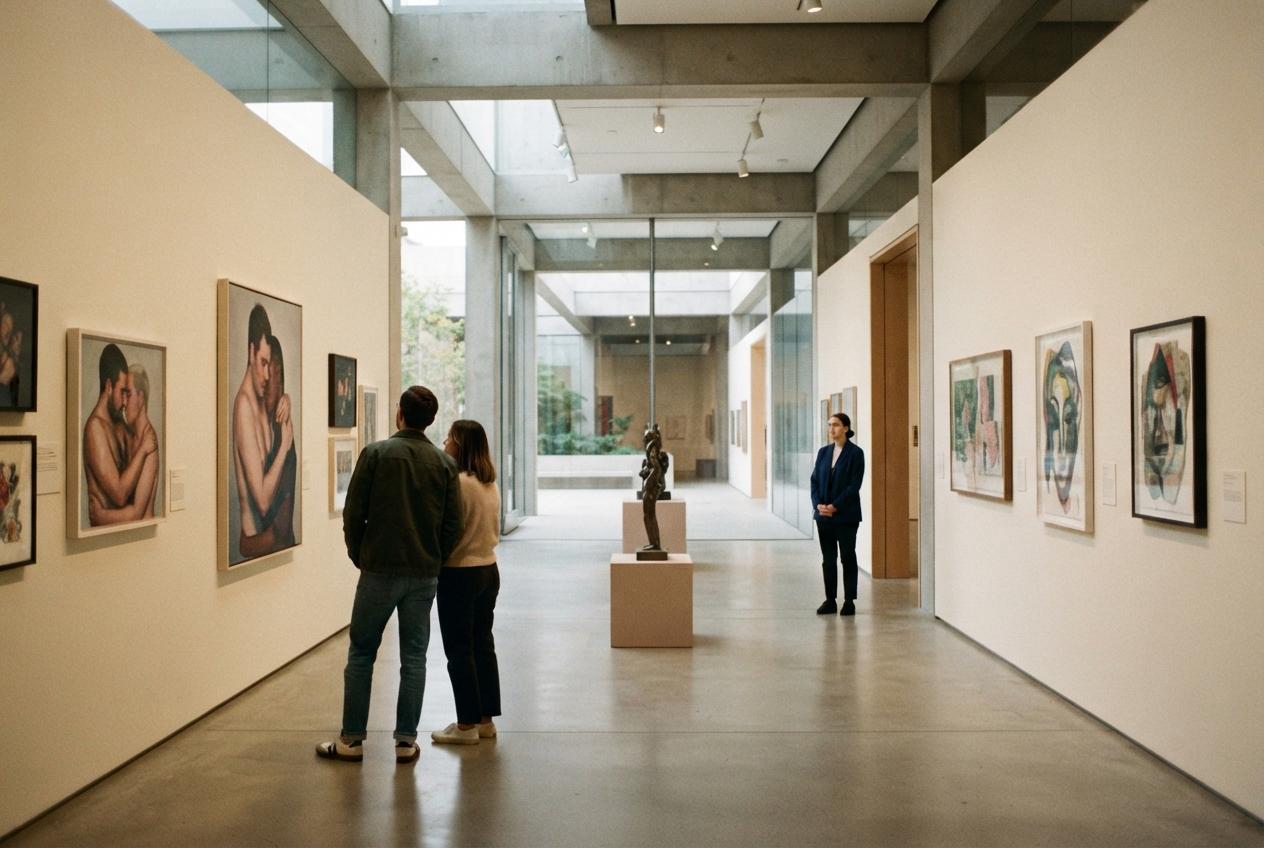
Spotlight the city’s newest art destination: visitors are discovering queer histories threaded through thousands of works at LACMA’s new David Geffen Galleries in Los Angeles, and these 20 highlights make an ideal queer-focused route that mixes ancient myth, modern longing and everyday joy.
Essential Takeaways
- Inventive layout: The David Geffen Galleries reinterpret the museum visit, arranging thousands of works around four water-themed zones for freer, non-chronological exploration.
- Queer through the ages: Works range from classical sculptures with ambiguous gender cues to explicitly homoerotic modern pieces, offering surprising connections across centuries.
- Standouts to see: David Hockney’s large canvases, Francis Bacon’s triptych, Mapplethorpe portraits and mythological scenes like Guido Reni’s Bacchus reward a queer reading.
- Sensory notes: Expect bold colour (Hockney), textured earthwork (Rafa Esparza), precise photographic composition (Mapplethorpe) and the quiet patina of ancient marbles.
- Practical tip: Wear comfortable shoes, follow the water-themed galleries, and allow time to pause , these juxtapositions reveal themselves when you linger.
Why the new layout invites queer readings
The first thing you notice is the view and the airy, elevated galleries; the design nudges you off a linear tour and into serendipity, and queer narratives thrive on those chance encounters. According to LACMA press materials, the David Geffen Galleries open up new sightlines and conversational pairings between works. That means a Hockney beside a Delaney, or a Reni near a modern bench, suddenly feels like a deliberate dialogue rather than museum happenstance. For visitors, that translates into a more playful, intimate experience , and the joy of spotting queer codes that travel across time.
Start with Hockney , colour, sun and a gay utopia
Head to the modern galleries for David Hockney’s monumental Mulholland Drive and his sunlit California scenes, which capture the sensual freedom Los Angeles offered him. Hockney made California into an aesthetic of desire: pools glint, bodies float, and the city becomes a playground. Museum placards and curators have long signalled these works as queer landmarks; seeing them together in BCAM and the new galleries gives them extra resonance. If you’re choosing one “must-see” for atmosphere, make it Hockney’s electric vistas , they smell faintly of pool chlorine in your mind and feel like a warm breeze.
Where portraiture and rivalry make drama , Bacon and Freud
In the Atlantic galleries, Francis Bacon’s Three Studies of Lucian Freud packs an almost cinematic presence: grotesque, intimate and charged. The story behind the triptych , a friendship and rivalry between two titans , adds emotional heft. High-profile donations and headline-making sales have anchored works like this in the museum’s collection, so don’t rush past. Stand close, notice the brushwork, and let the tension between likeness and distortion register. It’s a reminder that queer lives have long fuelled artistic intensity and public fascination.
Classical myths: an alibi for desire
Classical sculpture and myth recur as a safe stage for same-sex desire, and the Mediterranean galleries make that case visually. Guido Reni’s Bacchus, Roman marbles and prints of Hercules or Hyacinthus show how artists used myth as a cover for erotic storytelling. When you look at Bacchus’s carefully idealised form, you’re reading a centuries-old language of moderated sensuality , small details, like posture or scale, carry coded meanings. For queer viewers, these works can read like a wink across history: desire rendered acceptable, revered even.
Queer, Black, brown and bearing witness
LACMA’s new galleries don’t only spotlight canonical European names; they foreground Black and Latinx queer experiences too. Works by Richmond Barthé and Carlos Almaraz, alongside earth-based installations by Rafa Esparza, broaden the story. Barthé’s sculptures combine spirituality and sensuality; Almaraz’s explosive canvases reflect the city’s collisions of identity; Esparza’s adobe walls speak of belonging and fragility in tactile, brown earth. These pieces are sensory anchors , texture, rhythm and smell , and they insist that queer histories are intersectional and place-based.
Photography and bodies , Mapplethorpe’s precise provocations
Gallery 27 houses Mapplethorpe’s portraits of Lisa Lyon, a partnership that redefined how muscularity and femininity could be photographed. Mapplethorpe’s crisp compositions make bodies read as sculpture: equal parts power and vulnerability. For anyone tracing how gender presentation shifts over time, these photographs are a short lecture in posture, gaze and the politics of display. Take a moment to note how the museum frames them; photographic works have a way of stopping conversation and starting a different one.
Closing line
Take your time, let the galleries guide you, and see how queer stories keep appearing where you least expect them.
Source Reference Map
Story idea inspired by: [1]
Sources by paragraph: