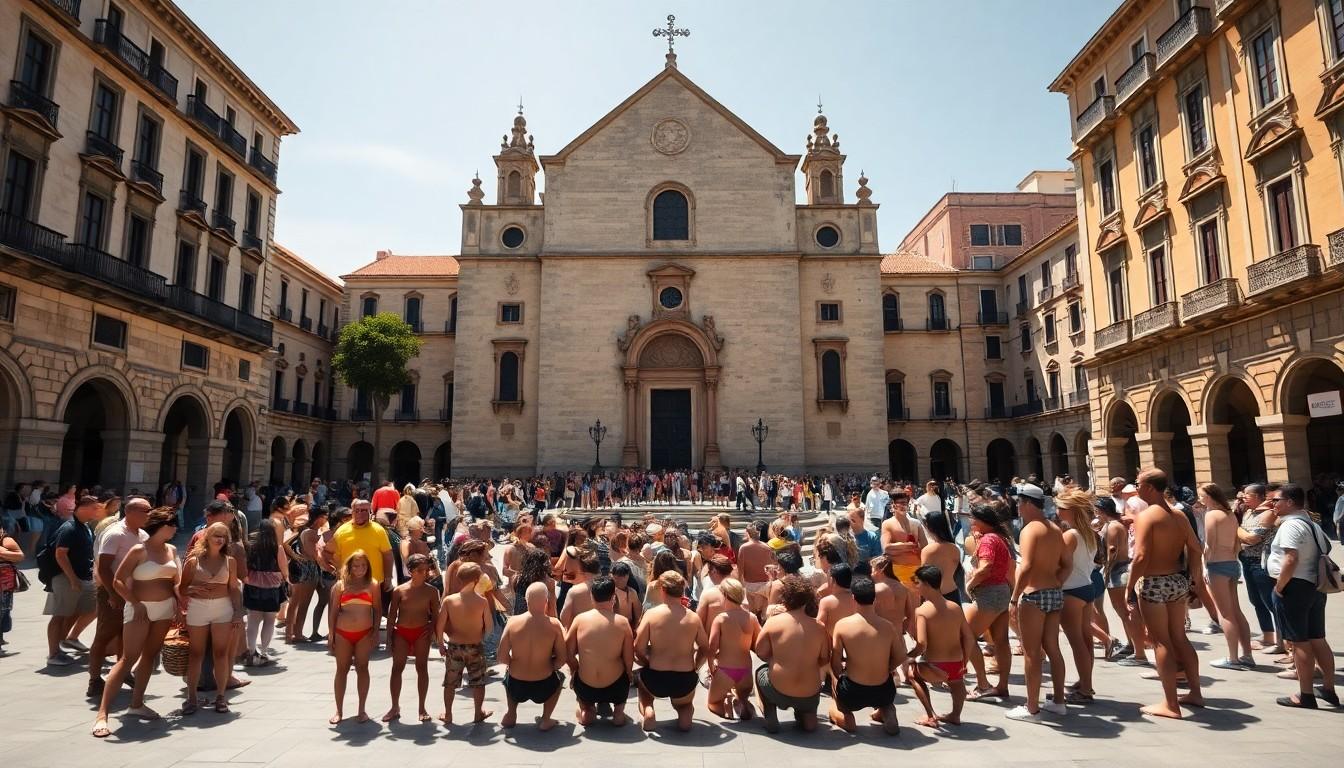
Watchers and worshippers found themselves side‑by‑side in Las Palmas as photographer Spencer Tunick staged Gran Spectrum , a multicoloured, nude public artwork timed to a local feast day , raising questions about public space, inclusion and cathedral access in the Canary Islands.
Essential Takeaways
- What happened: Hundreds of people, bodies painted in Progress Pride colours, posed in Santa Ana Square for Spencer Tunick’s Gran Spectrum photography event.
- Location tension: The performance took place metres from the Cathedral of the Canary Islands and the bishop’s residence, temporarily blocking some worshippers from entering Mass.
- Bishop’s stance: Bishop José Mazuelos told El País he had “no problem” with the performance, framing it as harmless in public life, though he criticised road closures.
- Artist view: Tunick described the event as a statement about LGBTQIA+ identity, public inclusion and artistic progress , and called the shoot a success.
- Atmosphere: Reports say participants were still undressed as some parishioners finally entered the cathedral after police opened a path; reactions ranged from pride to indignation.
How the Gran Spectrum came together and why it felt visually striking
Spencer Tunick has built a career out of mass nude tableaux, and Gran Spectrum followed his familiar formula: hundreds of bodies, painted bright, organised into a living sculpture that reads as colour and texture from above. The painted skins , reds, blues, yellows drawn from the Progress Pride palette , made a quiet, startling visual against the stone of Santa Ana Square. According to RTVE and El País, Tunick directed the crowd from a nearby terrace by walkie‑talkie, shifting poses until the composition felt right. For locals and visitors the scene was cinematic: vibrant skin against the cathedral’s historic façade, and hard to ignore.
Why the timing near a cathedral mattered
This wasn’t just another public art moment because July 26 was the city’s patronal feast day. That morning a Mass for St Anne was due to take place, and a small group of faithful found access obstructed by road closures set up for the shoot. El País reports that bishop José Mazuelos said he didn’t object to the nudity itself, likening it to beach life, but did criticise the closures that temporarily stopped parishioners entering the church. Police later opened a corridor and worshippers entered while some participants remained undressed nearby, a reality that heightened the sense of tension between sacred ritual and public spectacle.
What the bishop’s comments tell us about local politics and culture
Mazuelos’s relatively conciliatory public line , he told El País he had “no problem” and suggested seeing nude bodies on the beach was normal , reads as pragmatic and perhaps political. Infovaticana framed his reaction as seeing the event as city marketing, while local coverage noted his objection focused on logistics rather than the artwork’s message. That distinction matters: it shows how clergy can separate pastoral concerns about worship access from broader cultural debates, and it underlines how civic authorities in the Canary Islands backed the project by closing streets and granting permissions.
Tunick’s goals and the festival context
Tunick linked the work explicitly to LGBTQIA+ inclusion, equality and visibility, calling any public acceptance of naked bodies a step forward. The shoot formed part of Culture & Business Pride 2026, a Canary Islands government festival promoting LGBTQIA+ culture, and organisers arranged spaces for participants to prepare out of sight. Both EFE and Artlyst covered the production logistics and the intention to create images that celebrate queer identity in public space. Tunick has seen projects rejected elsewhere, he says, so Las Palmas signalled a receptive setting for his long‑running experiment with communal nudity as political and aesthetic statement.
What this means for public art, faith communities and future events
The Las Palmas episode is a neat example of overlapping claims on urban space: art, civic celebration, religious ritual and tourism all converged. For planners and event organisers it’s a reminder to co‑ordinate access carefully; for religious communities it’s a prompt to engage with civic partners in advance. For audiences it raises straightforward choices , do you prioritise heritage and worship, or public artistic expression? Local reactions ranged from praise for inclusion to frustration over disrupted Mass, and that split suggests future events will need clearer communication and logistical compromise if they’re to be both bold and considerate.
It's a small clash that says a lot about how cities balance spectacle and sanctuary.
Source Reference Map
Story idea inspired by: [1]
Sources by paragraph: