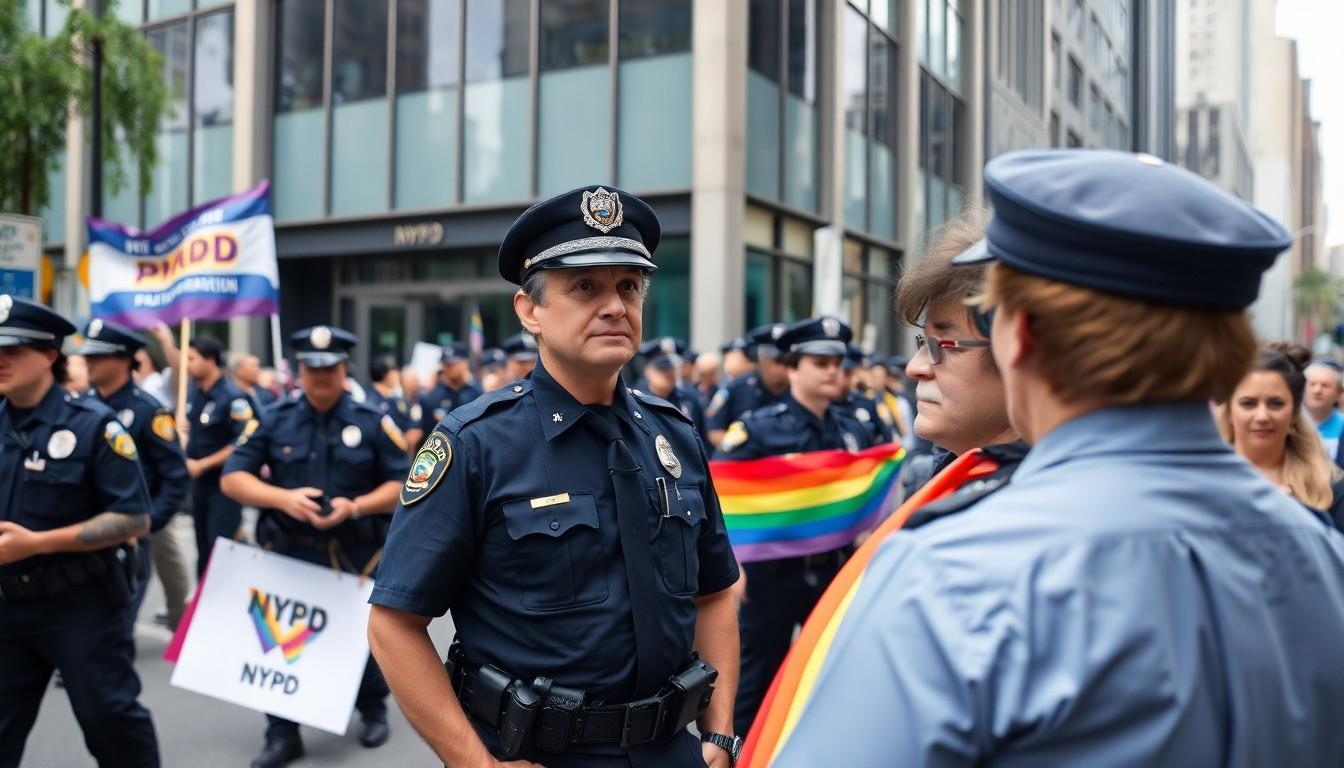
Watchful eyes turned to the sidelines as New York’s top cop stood with armed gay officers during the 57th NYC Pride March, a flashpoint moment after organisers barred uniformed, armed police , a decision that matters to city safety, history and LGBTQ policing debates.
Essential Takeaways
- Visible stance: NYPD Commissioner Jessica Tisch was photographed at the Manhattan Pride parade standing behind barricades alongside armed, uniformed gay officers, giving a public show of support.
- Ongoing ban: Organisers have kept active-duty officers from marching in full uniform with service weapons since 2021, citing tensions and safety concerns.
- Community trauma cited: Activists, including members of Gays Against Guns, point to long-lasting trauma from events like the Pulse nightclub massacre when explaining opposition to armed officers in Pride.
- Split approaches: Some Pride events in other boroughs, such as a Queens march, have allowed uniformed NYPD participation, creating a patchwork of practices across the city.
- Symbols matter: The march paused for a die-in at Stonewall; protesters and signs on the barricades underscored how policing and memory intersect in today’s Pride politics.
Why the sight of Commissioner Tisch with armed gay officers felt so charged
Seeing the city’s top cop beside armed, uniformed LGBTQ officers at a Pride event is the kind of image that lands like a headline , it’s visual, a little awkward and emotionally textured. The photo cues up decades of fraught history: Stonewall’s 1969 raid, recent national protests over policing, and internal tensions within queer communities about law enforcement. According to local reporting, the moment came amid protest signs and chants, and it wasn’t lost on marchers or onlookers.
Backstory matters here. Organisers moved in 2021 to bar active-duty officers from marching with weapons after the George Floyd era intensified scrutiny of police presence at public events. That policy has stuck, and NYPD rules requiring armed uniformed officers to carry their weapons have forced gay officers to choose between marching in uniform and marching at all. That choice helps explain why today’s image feels less like a simple snapshot and more like a cultural checkpoint.
How trauma from Pulse and other attacks shapes organisers’ thinking
Groups like Gays Against Guns, named as a grand marshal this year, have argued their stance is about care and remembrance as much as about policy. For many, the Pulse nightclub massacre remains a raw trauma; organisers say armed officers marching through Pride can reopen wounds and complicate the space’s safety for survivors and loved ones. The parade’s staged “die-in” at the Stonewall Inn , with participants dressed in white and holding photos of the Pulse victims , made that connection unmistakable.
That kind of public grieving is also political theatre: it frames the ban not as anti-police but as pro-survivor and pro-commemoration. If you’re weighing the issue, consider how visible symbols , uniforms, guns, badges , interact with collective memory when choosing where to stand.
Why some boroughs allowed uniformed officers and others didn’t
Not every Pride event in New York played by the same rulebook. In Queens, for instance, organisers permitted NYPD officers to march in full uniform, and Commissioner Tisch publicly criticised Manhattan organisers for keeping the ban in place. That split reflects a broader pattern: local organisers tailor decisions to their communities and recent experiences, so what’s acceptable in one neighbourhood may feel inappropriate in another.
For anyone planning to attend Pride next year, the practical takeaway is simple: check the event’s policy in advance. If your presence as an officer or supporter depends on uniform or weapon restrictions, verify with organisers early and be prepared for different rules in different boroughs.
The political theatre , elected officials, celebrities and the theme “For All of Us”
This year’s march drew a heavy civic turn-out , the mayor, the governor, senators and other officials all took part, and high-profile grand marshals added a celebrity sheen. The organisers leaned into the theme “For All of Us,” invoking Marsha P. Johnson’s legacy about liberation and solidarity. Yet the optics of banning armed officers while naming Gays Against Guns a grand marshal sparked sharp commentary from political figures who said the move was hypocritical.
That tension is part of modern Pride: it’s celebration and protest, community and policy debate wrapped into one long procession. Expect this conversation to keep evolving as activists, police and politicians all try to reconcile safety, symbolism and inclusion.
How to think about safety, solidarity and symbolism next Pride season
If you care about both public safety and trauma-informed spaces, there are pragmatic steps that can ease tensions. Event organisers can publish clear, compassionate rationales for their policies and provide alternatives , unarmed liaison officers, visible security trained in anti-bias and trauma care, or designated areas where former officers and families can gather. For attendees, taking a moment to learn each parade’s policy and the stories behind them helps you show up in a way that honours both safety and history.
Ultimately, symbols have weight. Whether you find Commissioner Tisch’s sideline stand reassuring or provocative, the picture forced a city to look at how Pride includes or excludes people and what safety looks like in a space forged out of conflict.
It's a small change in policy , and a very public moment , that will keep people talking long after the flags are folded away.
Source Reference Map
Story idea inspired by: [1]
Sources by paragraph: