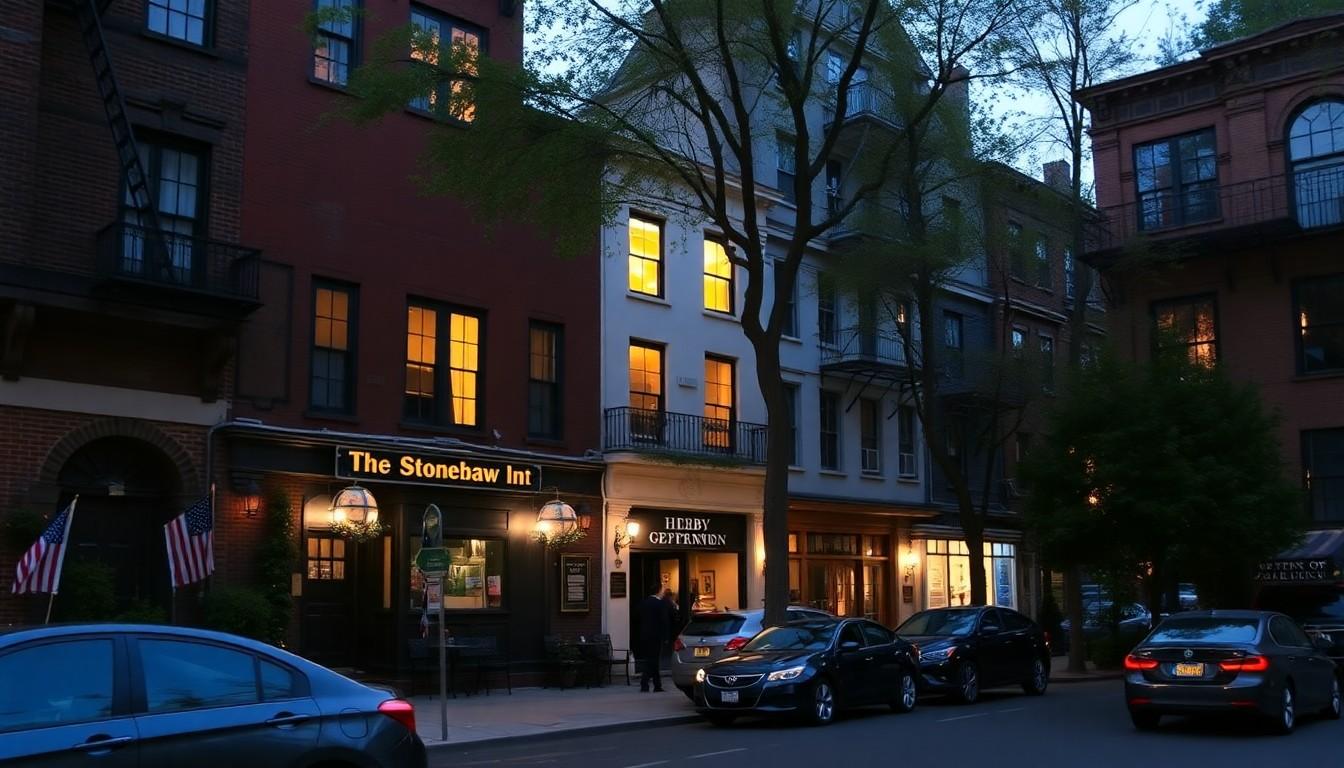
Celebrate walking into history this Pride Month: Village residents, activists and artists from Eve Adams to Edie Windsor reshaped Greenwich Village and beyond, leaving radical art, courtroom victories and warm, stubborn community spaces that still hum with memory and meaning.
Essential Takeaways
- Historic hubs: Eve Adams’s tearoom at 129 MacDougal became a safe, lively meeting place where women gathered, whispered and organised.
- Political firsts: Deborah Glick was the first openly gay member of the New York State Assembly and fought for marriage and gender-expression protections.
- Cultural breakthroughs: Lorraine Hansberry wrote A Raisin in the Sun while living in the Village, changing Broadway and public conversation.
- Direct action: Ana Maria Simo, Sarah Schulman and the Lesbian Avengers turned living-room strategy into citywide Dyke Marches and sustained activism.
- Landmark justice: Edie Windsor’s Supreme Court victory helped secure federal recognition and benefits for same-sex couples.
Eve Adams’s tearoom: a warm, defiant gathering place
Step inside the story and you can almost hear tea cups clinking and laughter spilling down a MacDougal Street stairwell. Eve Adams opened her tearoom in 1925 and fashioned a deliberate refuge where lesbian and queer women could meet, read and talk politics. Village Preservation and local historians point to that basement, later La Lanterna, as a focal point for a fledgling community, with a famously blunt sign that made the room’s purpose clear. Her short collection, Lesbian Love, circulated among friends and activists and drew the attention of police; Adams was arrested, jailed, and eventually deported. The tearoom’s memory matters because it shows how small, domestic spaces became political infrastructure; if you’re researching queer urban history, you’ll want to note how intimacy and activism overlapped here.
Deborah Glick: politics rooted in local life
Deborah Glick’s career reads like a love letter to the Village as much as a record of legislative change. She moved to the area in the 1970s, came out publicly at a time when that was still risky, and later brought that courage into Albany. Glick backed key laws, from anti-discrimination measures to marriage-equality efforts, and she has repeatedly framed policy in everyday terms: schools, parks, storefronts. Her journey illustrates how local organising and social life, dance nights, alliance meetings, conversations in print shops, grew into formal political power. If you’re thinking about running for office or supporting local candidates, take a cue from Glick: deep community ties and steady advocacy matter.
Lorraine Hansberry: art that cracked open Broadway
Lorraine Hansberry’s A Raisin in the Sun changed American theatre, and her Greenwich Village years helped shape the writer behind it. Living in apartments on Bleecker and Waverly, she mixed study, activism and social life while producing work that forced mainstream audiences to confront racial segregation and family struggle. Later research and letters reveal a second, quieter life in which Hansberry explored same-sex desire and political ideas, showing how creative brilliance and personal complexity coexisted. For readers and theatre-goers, her story is a reminder that revolutionary art often comes from people living many lives at once.
Eileen Myles and the East Village counterculture
Eileen Myles is a voice that feels both intimate and blunt, the kind of writer whose poems smell faintly of late-night coffee and punk flyers. Myles’s readings at CBGB and involvement with The Poetry Project tied queer literary life to the gritty DIY scenes of the East Village. Beyond books and performances, Myles turned their energy toward local preservation fights and neighbourhood causes. If you care about sustaining cultural communities, Myles’s example shows how authors and artists can be civic actors as well as creators, using reputation to protect places that nurture dissenting voices.
Sarah Schulman and the archive of struggle
Sarah Schulman has spent decades documenting queer life, activism and the AIDS crisis with the clarity of a chronicler and the precision of an advocate. Her books and plays blend memoir, history and organising lessons; her ACT UP years and co-founding of the Lesbian Avengers turned frontline protest into recorded public memory. Schulman’s work is a practical resource: it shows how community histories are built, why oral histories matter, and how stories by insiders change public understanding. For activists organising today, her archive is both toolbox and warning: preserve records, name names, and keep fighting.
Ana Maria Simo, the Lesbian Avengers and the Dyke March
Sometimes the living-room conversation seeds a movement, and that’s exactly what happened in Ana Maria Simo’s East 1st Street apartment. Simo helped launch Medusa’s Revenge, then co-founded the Lesbian Avengers in the early 1990s, an outfit that translated visibility into direct action, from street theatre to mass marches. The Dyke March that grew from those efforts remains a staple of NYC Pride and a global template for grassroots protest. If you’re organising an event, consider the Avengers’ playbook: be visible, keep your message clear, and centre those most affected.
Edie Windsor, Thea Spyer and a court decision that shifted law
The intimate story of Edie Windsor and Thea Spyer has a public, legal second act that changed the United States. When Spyer died, Windsor’s fight against a federal estate-tax denial under the Defense of Marriage Act reached the Supreme Court, which ruled in Windsor’s favour in 2013. That decision cleared a path for federal recognition of same-sex marriages in states that already allowed them, and it transformed practical matters, taxes, benefits, survivor rights, for thousands of couples. The takeaway is simple: personal losses can become public victories, and attention to legal detail can unlock sweeping social change.
Why these Village stories still matter today
These lives connect neighbourhood cafés, theatre stages, legislative halls and courthouse steps into a single lineage: small acts, opening a door, running for office, publishing a poem, have cumulative power. Village Preservation’s maps and programmes keep the thread alive, and you can visit many plaques and sites to make the history feel immediate. For Pride Month and beyond, these stories remind us that community spaces and activist networks are fragile but renewable, and that preserving memory helps fuel tomorrow’s fights.
It's a small act of pilgrimage to walk these blocks, but it’s one that connects you to a long, proud line of people who refused to be invisible.
Source Reference Map
Story idea inspired by: [1]
Sources by paragraph: